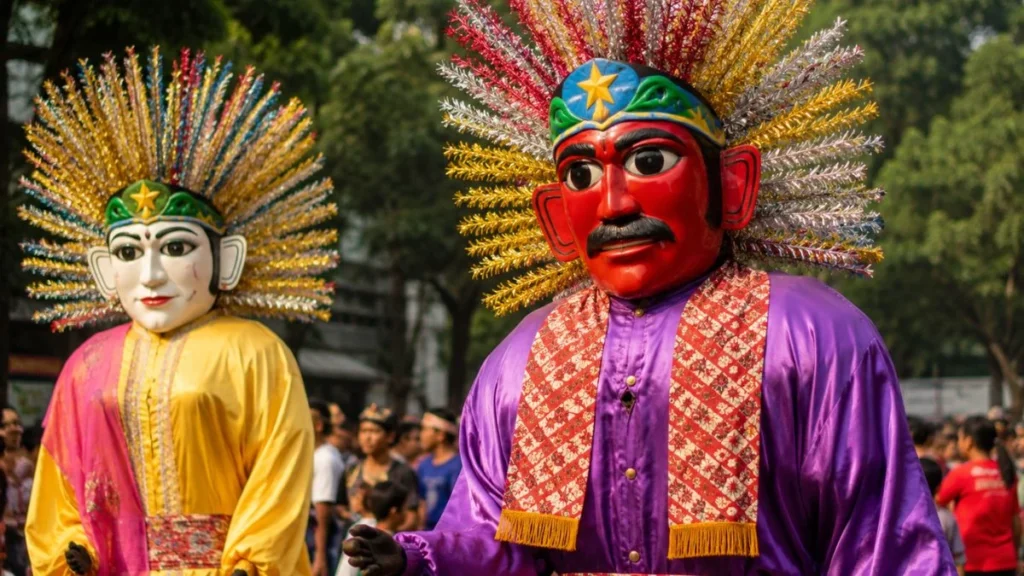
Ask most people what “Jakarta culture” means, and they’ll probably describe traffic, skyscrapers, and a generic modern capital — not a distinct ethnic identity. But Jakarta does have native people of its own, and they aren’t defined by any single bloodline at all. Betawi culture Jakarta communities built emerged from centuries of intermarriage among the many groups that passed through the city, making Betawi identity something closer to a creole culture than a traditional ethnicity. For the wider context, see our Ultimate Guide to Understanding Indonesia.
The Betawi are widely recognized as the native inhabitants of Jakarta, though “native” here doesn’t mean a single bloodline going back to time immemorial. Betawi identity emerged through centuries of cultural interaction in Batavia — Jakarta’s name under Dutch colonial rule — between people from across the archipelago and beyond, including Malays, Chinese, Arabs, Portuguese, Javanese, and Sundanese communities. Rather than one ethnic group in the conventional sense, the Betawi are better understood as a “creole” community, forged through generations of intermarriage and cultural blending among the many peoples who settled, traded, or were brought into the city.
Why It Matters
Understanding Betawi culture matters because it corrects a common assumption that Jakarta, as a sprawling modern capital, has no distinct local culture of its own. Recognizing the Betawi reveals a genuine ethnic identity with its own language, cuisine, music, and traditions — one that predates and underlies the international, cosmopolitan city Jakarta has since become. It also offers insight into how identity itself can form through blending rather than a single shared bloodline, a pattern reflected across much of Indonesia’s history.
Cultural Context
Several distinctive elements define Betawi identity today:
- Ondel-ondel — giant puppets standing roughly 2.5 to 3 meters tall, made from lightweight bamboo frames covered in woven rattan and cloth, traditionally believed to ward off evil spirits and disease. Originally called Barongan, they now appear as festive, comedic performance figures at celebrations rather than purely spiritual guardians, and are officially embraced by the Jakarta city government as a symbol of local identity.
- Gambang Kromong — a distinctive Betawi musical ensemble blending Chinese, Javanese, and Sundanese instruments, including the gambang (xylophone) and kromong (gong-chime), traditionally accompanying ondel-ondel performances and other celebrations.
- Lenong — traditional Betawi folk theater combining humor, music, and distinctive local dialogue, often delivering social commentary and moral messages through entertainment.
- Distinct culinary identity — Betawi cuisine reflects the community’s layered cultural history, including kerak telor (a glutinous rice and egg snack topped with toasted coconut), soto Betawi (a creamy coconut-milk beef soup), nasi uduk Betawi (fragrant coconut rice), and laksa Betawi (noodles in rich coconut broth).
- Three internal cultural zones — coastal Betawi communities developed a maritime culture, the central zone became home to popular arts, fashion, and cuisine, and the outer zone maintained a more agrarian culture centered on farming and livestock, each producing its own dialect variation.
- Regional dialect influence — the Betawi dialect has significantly shaped modern Jakarta slang and casual Indonesian more broadly, including its role in the development of bahasa gaul.
Historical Background
The Betawi emerged over roughly two centuries, from around the 17th to 19th centuries, through sustained cultural interaction in Batavia under Dutch colonial administration. Rather than descending from a single pre-existing ethnic group native to the region, the Betawi formed from waves of migrants and traders — Malay, Chinese, Arab, Portuguese, Javanese, Sundanese, and others — who settled in the growing colonial port city and gradually intermarried and blended traditions over generations.
Ondel-ondel’s own origins trace back further, to pre-Islamic times in the Jakarta region, showing clear Hindu-Buddhist influence blended with native Betawi belief, even though most Betawi culture today centers around Islamic values. Anthropological research links the tradition’s roots to agrarian baritan or village-cleansing ceremonies practiced in areas like Cireundeu and Ciputat, with some accounts dating a version of the reinforcement-repelling puppet tradition back to the 17th century, though its precise origins remain genuinely uncertain. For much of its history, ondel-ondel (then more commonly called Barongan) was considered a sacred, even frightening, spiritual guardian, specifically invoked when the city faced disease outbreaks or disaster. That changed significantly under Jakarta Governor Ali Sadikin (1966–1977), who revived and popularized ondel-ondel as a public cultural icon, notably featuring it in Jakarta’s 450th anniversary celebrations in 1977, alongside performances by beloved Betawi singer Benyamin Sueb. In recent years, Jakarta’s provincial government has continued formal preservation efforts, including Regional Regulation No. 4 of 2015 on the Preservation of Betawi Culture, aimed at reviving cultural icons like traditional sadariyah clothing and kebaya kerancang.
Regional Differences
- Central Jakarta remains closely associated with the “popular culture” zone of Betawi identity, historically producing much of the community’s arts, fashion, and culinary tradition.
- Coastal areas of Jakarta developed a distinctly maritime-oriented Betawi culture, shaped by the city’s historical role as a major trading port.
- Outer Jakarta and surrounding suburban areas, including places like Cireundeu and Ciputat, maintained a more agrarian Betawi identity tied to farming and livestock, and are specifically linked to some of ondel-ondel’s earliest ritual origins.
- Each of these three zones developed its own dialect variation, reflecting genuine internal diversity within Betawi identity rather than a single uniform culture across the greater Jakarta area.
Practical Guide
If you want to experience Betawi culture in Jakarta:
- Look for ondel-ondel at festivals and public celebrations. These giant puppets remain one of the most visible and accessible entry points into Betawi cultural identity, frequently appearing at major city events.
- Try Betawi cuisine specifically, not just generic Jakarta food. Dishes like kerak telor, soto Betawi, and nasi uduk Betawi offer a genuine taste of the community’s distinct culinary heritage.
- Seek out Gambang Kromong or Lenong performances. These traditional music and theater forms offer a deeper cultural experience than ondel-ondel alone.
- Visit dedicated cultural sites and monuments. Jakarta hosts specific memorials and cultural centers dedicated to Betawi heritage, offering more structured historical context for interested visitors.
Common Misunderstandings
“Betawi is just another name for ‘people from Jakarta.'” Betawi refers specifically to a distinct historical and cultural identity formed through centuries of intermarriage among diverse settler groups in colonial-era Batavia, not simply anyone currently living in the modern city.
“Ondel-ondel has always been comedic entertainment.” Ondel-ondel (originally called Barongan) was historically viewed as a sacred, even frightening, spiritual guardian against disease and evil spirits, only shifting toward its modern festive, comedic role in more recent generations.
“Betawi culture disappeared as Jakarta modernized.” Betawi cultural icons, including ondel-ondel, Gambang Kromong, and traditional cuisine, remain actively preserved and promoted today, including through formal government regulation aimed specifically at sustaining Betawi heritage.
Betawi culture reveals Jakarta as far more than a generic, culturally blank capital city — it holds a genuine native identity, forged through centuries of blending rather than a single ethnic lineage, and still visibly present in the city’s puppets, music, food, and festivals today. Understanding this history adds real depth to how Jakarta’s own local culture developed, distinct from the many regional identities that make up the rest of Indonesia.
For related reading, see Bahasa Gaul: Jakarta’s Slang Explained and Indonesian Wedding Traditions by Region, or browse the full Regional Cultures pillar.
FAQ
Who are the Betawi people?
The Betawi are the native inhabitants of Jakarta, a creole community formed through centuries of intermarriage and cultural blending among Malay, Chinese, Arab, Portuguese, Javanese, Sundanese, and other groups in colonial-era Batavia.
What is ondel-ondel?
Ondel-ondel are giant Betawi puppets, roughly 2.5 to 3 meters tall, traditionally believed to ward off evil spirits and disease, now used primarily as festive performance figures at celebrations across Jakarta.
What foods are considered authentically Betawi?
Kerak telor, soto Betawi, nasi uduk Betawi, laksa Betawi, and asinan Betawi are among the dishes most closely associated with distinct Betawi culinary tradition.
Is Betawi considered a single ethnic group?
Not in the traditional sense — Betawi identity emerged from a blend of multiple ethnic and cultural groups over roughly two centuries, making it more of a creole cultural identity than a single bloodline-based ethnicity.
Who helped revive ondel-ondel as a modern Jakarta symbol?
Jakarta Governor Ali Sadikin (1966–1977) played a significant role in reviving and popularizing ondel-ondel as a public cultural icon, notably during Jakarta’s 450th anniversary celebrations in 1977.