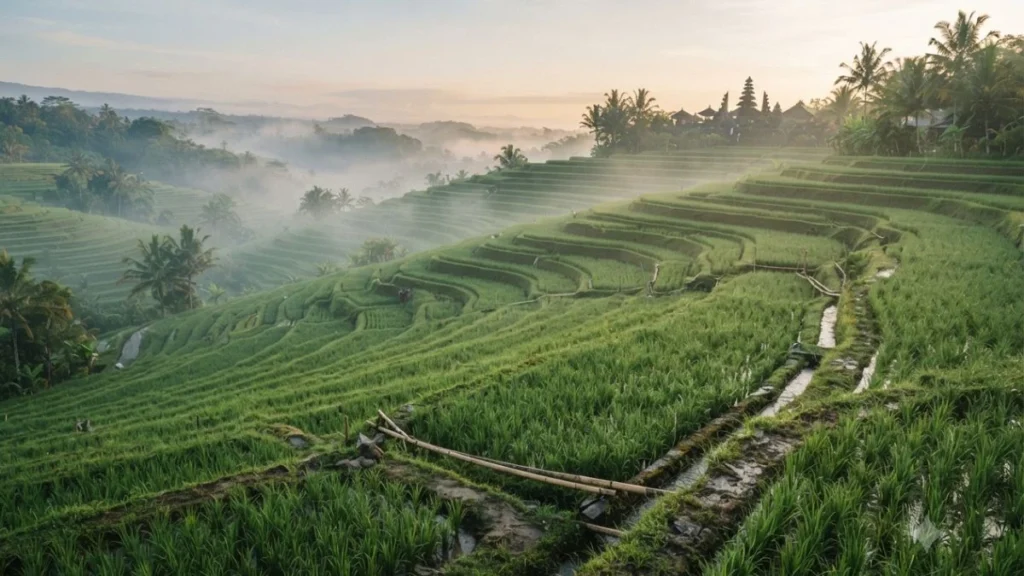
Bali’s famous emerald rice terraces aren’t just beautiful — they’re the visible surface of a thousand-year-old cooperative water management system that has kept the island’s agriculture running without a single centralized authority. UNESCO’s recognition of subak reveals a rare case where farming, religion, and community governance are fused into one working system. For the wider context, see our Ultimate Guide to Understanding Indonesia.
Subak is a traditional Balinese irrigation system and farmer cooperative that manages the distribution of water from mountain lakes and rivers to terraced rice fields through a network of canals, tunnels, and water temples. In 2012, UNESCO inscribed the “Cultural Landscape of Bali Province: the Subak System as a Manifestation of the Tri Hita Karana Philosophy” as a World Heritage Site. It covers roughly 19,500 hectares across five rice terrace landscapes and their associated water temples, including the well-known Jatiluwih Rice Terraces and the 18th-century Royal Water Temple of Pura Taman Ayun.
Why It Matters
Subak matters far beyond agriculture — it’s a working example of decentralized, community-based governance that has sustained one of Indonesia’s most productive rice-growing regions for roughly a thousand years without relying on rigid, top-down control. Understanding it also explains why Bali’s rice terraces look and function the way they do, and why religious temples are so tightly integrated into what might otherwise look like a purely technical irrigation network.
Cultural Context
Subak is built on the Balinese Hindu philosophy of Tri Hita Karana — the belief that wellbeing depends on maintaining harmony across three relationships: Parahyangan (harmony with the divine), Pawongan (harmony among people), and Palemahan (harmony with nature). Rather than treating water management as a purely technical problem, subak treats it as a spiritual and social responsibility as much as a practical one.
Each subak is a self-governing farmer association tied to a specific water source and irrigation network. Members meet regularly to plan planting schedules, share water fairly through a rotating system, maintain canals and dikes, and organize temple ceremonies tied to the agricultural calendar — including harvest celebrations. Water temples sit at the center of each subak, serving as both spiritual anchors and coordination points for water-sharing decisions among farmers.
Historical Background
The earliest known written reference to subak dates to a 1071 CE inscription from the reign of King Marakata, though the system is widely believed to be older than the written record, with UNESCO dating its origins to around the 9th century. The philosophical foundation of Tri Hita Karana is understood to have developed through roughly 2,000 years of cultural exchange between Bali and India, blending imported religious concepts with local agricultural and social practices into something distinctly Balinese.
In 2012, UNESCO formally recognized the cultural landscape built around subak as a World Heritage Site, specifically framing it as a manifestation of the Tri Hita Karana philosophy rather than simply an engineering achievement — an important distinction that reflects how deeply intertwined the spiritual and practical dimensions of the system really are.
Regional Differences
The UNESCO-listed subak landscape spans five distinct sites across Bali, each with its own character:
- Jatiluwih Rice Terraces, part of the Catur Angga Batukaru site, are the most visually iconic and widely photographed subak landscape, spanning a large protected area of forests, lakes, and around 20 individual subaks and temples.
- Pura Taman Ayun, an 18th-century royal water temple, stands as the largest and most architecturally significant temple of its type on the island.
- The Pekerisan Watershed includes Pura Tirtha Empul (a sacred purification water temple), the Gunung Kawi royal shrines carved into a riverbank, and the popular Tegallalang Rice Terraces.
- Lake Batur, revered as the primary water source feeding much of Bali’s rice irrigation, is included as its own component of the listed landscape.
While subak as a general practice exists throughout Bali to varying degrees, only these specific sites carry the formal UNESCO World Heritage designation.
Practical Guide
If you want to see subak in action as a visitor:
- Visit Jatiluwih or Tegallalang Rice Terraces. Both offer accessible, well-known views of the terraced landscape that subak sustains, along with opportunities to learn about the system on-site.
- Visit a water temple respectfully. Sites like Pura Taman Ayun or Pura Tirtha Empul are active places of worship, not just tourist attractions — dress modestly and follow local guidance on entry.
- Support local guides and communities. Many subak areas rely on tourism revenue to help sustain traditional farming practices that face economic pressure from land conversion and modernization.
- Look for the terracing pattern, not just the color. Each rice terrace has its own water inlet and outlet, with bamboo gates or small dams controlling flow — a small detail that reveals the underlying engineering behind the view.
Common Misunderstandings
“Subak is just an old-fashioned irrigation method.” Subak is as much a social and religious institution as a technical one — it’s a governance system built around cooperation, fairness, and spiritual philosophy, not simply a method of moving water.
“Subak covers all of Bali’s rice fields under UNESCO protection.” The UNESCO listing specifically covers five defined sites totaling about 19,500 hectares — subak as a general practice exists more broadly across Bali, but formal World Heritage status applies only to these designated areas.
“Subak is a purely religious system with little practical function.” Subak is genuinely effective agricultural engineering — UNESCO specifically credits it with helping the Balinese become the most productive rice growers in the Indonesian archipelago despite a dense population and steep terrain.
Subak represents something rare: a centuries-old system where spiritual philosophy, community governance, and practical engineering work together seamlessly, still functioning today much as it has for a thousand years. Beyond its postcard-famous rice terraces, it offers a genuine model of how Balinese culture treats harmony — between people, nature, and the divine — as something to actively build and maintain, not just believe in.
For related reading, see Nyepi: Bali’s Day of Silence Explained and What Is Gotong Royong?, or browse the full Traditions & Festivals pillar.
FAQ
What does “subak” mean?
Subak refers to Bali’s traditional cooperative irrigation system and the farmer associations that manage it, built around water temples and shared water distribution for rice terraces.
When was subak recognized by UNESCO?
UNESCO inscribed the Subak System as a World Heritage Site in 2012, under the title “Cultural Landscape of Bali Province: the Subak System as a Manifestation of the Tri Hita Karana Philosophy.”
What is Tri Hita Karana?
It’s a Balinese Hindu philosophy centered on maintaining harmony across three relationships: with the divine, among people, and with nature — and it forms the philosophical foundation of the subak system.
How old is the subak system?
The earliest written reference dates to 1071 CE, though UNESCO traces its origins to around the 9th century, and the practice is likely even older than the written record.
Where can I see the subak system in Bali?
Popular accessible sites include the Jatiluwih Rice Terraces, Tegallalang Rice Terraces, and water temples like Pura Taman Ayun and Pura Tirtha Empul.