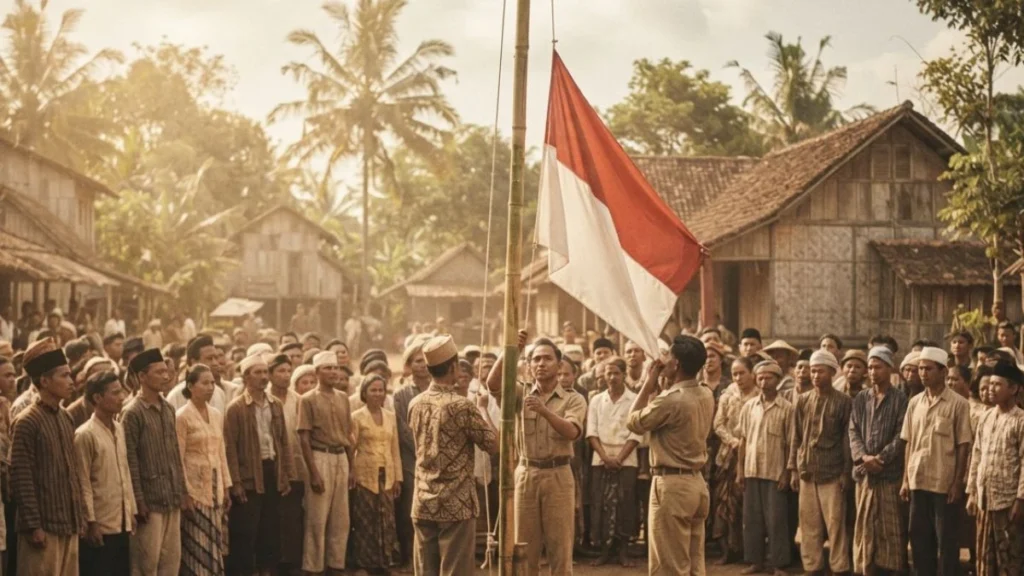
At 10 AM on a Friday morning in August 1945, a single reading of a short, deliberately understated statement changed the course of Southeast Asian history. Understanding how Sukarno shaped Indonesian independence means looking at both a singular founding moment and the complicated, decades-long figure at its center. For the wider context, see our Ultimate Guide to Understanding Indonesia.
Sukarno, born Koesno in Surabaya on June 6, 1901, became the leader of Indonesia’s independence movement and the nation’s first president. On August 17, 1945, following Japan’s surrender in World War II, Sukarno and Mohammad Hatta proclaimed Indonesian independence from Sukarno’s Jakarta home; Sukarno became president the following day. Full Dutch recognition of Indonesian sovereignty didn’t follow until December 27, 1949, after four and a half years of armed conflict, diplomatic negotiation, and mounting international pressure. The proclamation itself was a crucial starting point in a much longer struggle, not an immediate, complete transfer of power.
Why It Matters
Understanding Sukarno’s role helps explain both how modern Indonesia came into being and why the country still commemorates him as Bapak Bangsa (“Father of the Nation”). His leadership united an enormously diverse patchwork of ethnic groups, islands, and regional identities under a single independence movement — a genuinely difficult political achievement that shaped Indonesia’s founding philosophy and continues to influence its national identity and political symbolism today.
Cultural Context
Sukarno’s most enduring legacy beyond the proclamation itself is Pancasila, Indonesia’s founding philosophical framework, which he articulated in a landmark speech on June 1, 1945, before the Investigating Committee for Preparatory Work for Indonesian Independence (BPUPKI). The five principles — nationalism, internationalism, democracy, social justice, and belief in God — were intended to unify Indonesia’s diverse population around shared values rather than any single ethnic or religious identity. Sukarno is affectionately remembered by Indonesians as Bung Karno (“Brother Karno”), a term reflecting his image as a populist, deeply charismatic orator who connected personally with ordinary Indonesians throughout the independence struggle and his subsequent presidency.
Historical Background
Sukarno founded the Partai Nasional Indonesia (Indonesian National Party) in 1927 at age 26 while studying engineering, explicitly advocating for full independence from Dutch colonial rule. His nationalist activities led to repeated imprisonment and exile by Dutch authorities over the following years. When Japan occupied Indonesia in March 1942, Sukarno was released and, recognizing his influence and strong anti-colonial views, Japanese authorities placed him in leadership roles within their wartime administrative organizations — a complicated arrangement that nonetheless kept Indonesia’s independence movement politically active.
As Japan’s defeat became imminent in 1945, Sukarno was appointed chairman of the Panitia Persiapan Kemerdekaan Indonesia (PPKI), the Preparatory Committee for Indonesian Independence, with Hatta as his deputy. On August 16, 1945 — the day after the atomic bombing of Hiroshima — younger nationalist activists from the PETA youth movement, worried about a power vacuum following Japan’s surrender, pressured Sukarno and Hatta in what became known as the Rengasdengklok Incident, urging them to declare independence immediately rather than wait for Japanese authorization. The following morning, August 17, 1945, at 10 AM local time, Sukarno read the short, deliberately restrained proclamation of independence at his home on Jalan Pegangsaan Timur in Jakarta, with Hatta at his side. Sukarno became Indonesia’s first president the next day.
What followed was not a clean transition but a prolonged, four-and-a-half-year revolutionary struggle, as the Dutch attempted to reassert colonial control through military campaigns while international pressure — particularly from the United States and the newly formed United Nations — pushed toward a negotiated settlement. On November 2, 1949, the Netherlands and Indonesia reached an agreement on the transfer of power, and on December 27, 1949, the Netherlands formally handed over sovereignty to the Republic of Indonesia.
Sukarno’s presidency, which lasted until 1966, grew increasingly authoritarian over time. Dissatisfied with parliamentary democracy, he introduced a system he called “Guided Democracy,” emphasizing consensus over voting while consolidating significant personal power, and became prime minister in 1959 with military backing. Following an attempted coup in 1965 and the resulting political upheaval, Sukarno was gradually forced to transfer authority to General Suharto, effectively ending his rule by 1966. Sukarno died in 1970, leaving behind a legacy that remains genuinely complex — celebrated as the founding father of Indonesian independence while also remembered for his later authoritarian turn.
Regional Differences
- Jakarta remains the most historically significant site associated with Sukarno’s leadership, home to the location of the original independence proclamation (now Taman Proklamasi) and numerous national monuments commemorating the event.
- Java, where Sukarno grew up and was educated, formed the political base from which his early nationalist organizing efforts developed.
- Bali, his mother’s ancestral home, is sometimes noted in biographical accounts of Sukarno’s mixed Javanese-Balinese heritage, reflecting Indonesia’s broader ethnic diversity even within its founding leadership.
- Outer regions and islands, where news of the August 1945 proclamation took days or even weeks to spread, nonetheless largely and readily embraced the idea of a unified, independent Indonesia once word arrived.
Practical Guide
If you want to understand or explore this history further:
- Visit Taman Proklamasi in Jakarta. This site, near the location of Sukarno’s original 1945 residence, commemorates the proclamation of independence.
- Recognize August 17 as Indonesia’s Independence Day. Understanding Sukarno’s role adds meaningful depth to nationwide celebrations held each year on this date.
- Approach Sukarno’s legacy with balance. He’s genuinely revered as the founding father of Indonesian independence, but his later authoritarian “Guided Democracy” period is an important and more contested part of his historical record.
- Read Sukarno’s own words for firsthand perspective. His autobiography and translated political writings offer direct insight into his nationalist philosophy and the ideological foundations of Pancasila.
Common Misunderstandings
“Indonesia became fully independent the moment the proclamation was read.” The August 17, 1945 proclamation began Indonesia’s independence, but full Dutch recognition of sovereignty didn’t come until December 27, 1949, following years of armed conflict and negotiation.
“Sukarno collaborated willingly with Japan out of loyalty.” Sukarno’s cooperation with Japanese occupation authorities is generally understood by historians as a pragmatic, strategic choice to keep Indonesia’s independence movement active and organized, rather than genuine ideological alignment with Japan.
“Sukarno’s presidency was uniformly celebrated throughout his rule.” While revered for leading the independence movement, his later “Guided Democracy” period drew significant domestic and international criticism for concentrating power and moving away from earlier democratic commitments.
Sukarno’s story is inseparable from Indonesia’s own founding narrative — a leader whose oratory, political organizing, and philosophical framework helped unify a vastly diverse archipelago into a single independent nation, even as his own later rule grew more complicated and contested. Understanding both dimensions offers a fuller, more honest picture of how modern Indonesia came to be.
For related reading, see The Dutch Colonial Legacy in Indonesia Explained and Religious Diversity in Indonesia Explained, or browse the full History & Heritage pillar.
FAQ
When did Sukarno declare Indonesian independence?
Sukarno, alongside Mohammad Hatta, proclaimed Indonesian independence on August 17, 1945, in Jakarta.
When did the Netherlands formally recognize Indonesian independence?
The Netherlands formally recognized Indonesian sovereignty on December 27, 1949, following four and a half years of conflict and negotiation after the initial 1945 proclamation.
What is Pancasila and how is it connected to Sukarno?
Pancasila is Indonesia’s founding philosophical framework of five principles, first articulated by Sukarno in a landmark speech on June 1, 1945.
How long was Sukarno Indonesia’s president?
Sukarno served as Indonesia’s first president from 1945 (with formal international recognition from 1949) until he was gradually forced to transfer power to General Suharto by 1966.
Why is Sukarno called “Bung Karno”?
“Bung Karno,” meaning “Brother Karno,” is an affectionate nickname reflecting his populist, approachable image as a leader deeply connected to ordinary Indonesians during the independence struggle.