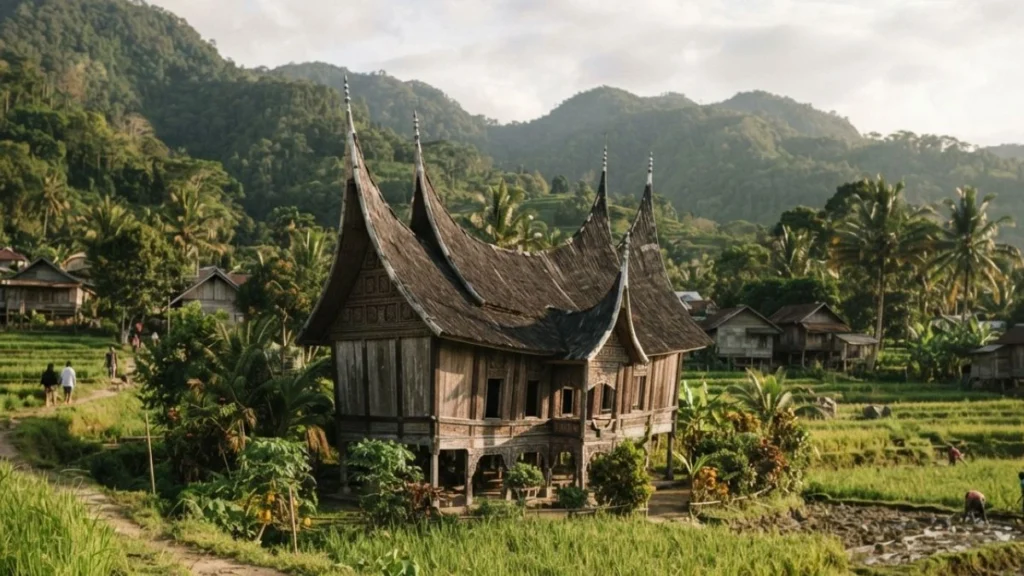
In a country where most ethnic groups trace family lines through fathers, one Sumatran society flips the entire system — property, clan membership, and family name all pass from mother to daughter, generation after generation. Understanding minangkabau matrilineal culture means encountering the world’s largest surviving matrilineal society, one that has managed something researchers find genuinely fascinating: combining deep matrilineal tradition with devout Islamic practice. For the wider context, see our Ultimate Guide to Understanding Indonesia.
The Minangkabau, the largest ethnic group native to the highlands of West Sumatra, practice a matrilineal social system in which descent, clan membership, and property — particularly land, homes, and rice paddies — pass down through the female line rather than the male line. With a population of roughly eight million people, the Minangkabau are widely recognized by anthropologists as the world’s largest matrilineal society still practicing this system today. The Minangkabau are also devoutly Muslim, and they maintain that their matrilineal adat (customary law) doesn’t conflict with Islamic teaching. They resolve the apparent tension through a distinction between two categories of inheritance.
Why It Matters
Minangkabau matrilineal culture challenges a common assumption that strong patriarchal inheritance and Islamic practice must go hand in hand — the Minangkabau demonstrate a genuinely different, long-sustained model where women hold central authority over family property and lineage while men take on complementary public and religious leadership roles. Understanding this system offers real insight into how culture and religion can coexist through careful, negotiated tradition rather than simple conflict or replacement.
Cultural Context
Minangkabau society organizes matrilineal inheritance through a distinction between two types of property:
- Harta pusaka (“high inheritance”) — ancestral property, including land and the family home (rumah gadang), which passes exclusively through the female line and cannot typically be sold or divided outside the clan.
- Harta pencaharian (“low inheritance”) — property a father earns through his own income or profession, which follows Islamic inheritance law, where sons traditionally receive a larger share than daughters.
Within this structure, women — often referred to with the respected title Bundo Kanduang — manage the household, family lineage, and ancestral property, while men, known as Datuak (Datuk), serve as clan leaders and public spokespeople representing the family in wider community and customary affairs. This creates a system of interdependence rather than female dominance alone: women hold economic and lineage authority, while men hold public and ceremonial authority, summarized in the Minangkabau philosophy “Adat basandi syarak, syarak basandi Kitabullah” (“Custom is founded on Islamic law, Islamic law is founded on the Quran”).
Traditionally, a married couple resides in the wife’s family home, and it is the mother’s brother — the maternal uncle, or mamak — who plays a particularly significant role in raising and guiding his sister’s children, rather than the biological father holding that same central authority.
Historical Background
Minangkabau matriliny developed within West Sumatra’s highlands over many centuries, with the region’s history including early Indian trade contact from around the 2nd century CE, later incorporation into the Buddhist Srivijaya Empire (7th–13th centuries), and the rise of the Hindu-influenced Malay Kingdom of Minangkabau in the 13th century. Islam arrived in West Sumatra later, likely around the 16th century, introducing a religious framework that, on its surface, tends to favor male inheritance — yet the Minangkabau navigated this by preserving matrilineal control specifically over ancestral land and property while applying Islamic inheritance rules to a father’s personally earned income, a resolution that has persisted for centuries rather than resulting in the replacement of one system by the other.
This matrilineal structure has also historically shaped the Minangkabau tradition of merantau — voluntary migration for work, education, or trade — since men, lacking the same inheritance claim to ancestral land as their sisters, have long sought opportunity and status elsewhere in Indonesia and beyond, a pattern that helped spread Minangkabau cuisine (including rendang) and cultural influence nationally and internationally.
Regional Differences
- West Sumatra’s highland villages (nagari) remain the cultural heartland of matrilineal practice, organized around clans (suku) such as Sikumbang, Caniago, Koto, and Piliang, each further divided into subclans with elected headmen.
- Villages dominated by women and elders are common in West Sumatra itself, since many men of working age pursue merantau migration elsewhere in Indonesia.
- Minangkabau migrant communities in cities like Jakarta or Medan tend to be dominated demographically by young and working-age men, a direct reflection of the merantau tradition drawing men away from the ancestral homeland.
- Coastal Minangkabau fishing communities differ somewhat from the inland agrarian pattern — since the sea isn’t treated as inheritable communal property in the same way farmland is, fishing livelihoods rely less directly on the matrilineal inheritance system than rice-farming communities do.
Practical Guide
If you’re interested in learning about or visiting Minangkabau communities:
- Visit a rumah gadang. These distinctive traditional houses, with dramatic upward-curving roof peaks, serve as the physical and symbolic center of the matrilineal clan and are often open to visitors in West Sumatra.
- Understand the high/low inheritance distinction before assuming gender roles. Minangkabau society isn’t simply “matriarchal” in a way that excludes men from authority — it’s a genuinely interdependent system with distinct, complementary roles.
- Ask about adat carefully and respectfully. Minangkabau customary law is a rich, complex system, and locals are often glad to explain its logic to genuinely curious visitors.
- Recognize merantau’s broader cultural impact. Understanding this migration tradition helps explain why Minangkabau cuisine, particularly Padang restaurants and rendang, are so widespread across Indonesia and beyond.
Common Misunderstandings
“Minangkabau society excludes men from power.” Men hold significant authority as clan leaders (datuk) and public representatives — the system is better understood as a division of authority between lineage/property (women) and public/ceremonial leadership (men) rather than female-only power.
“Matrilineal inheritance conflicts with Minangkabau Islamic faith.” The Minangkabau resolve this through a clear distinction between ancestral property (matrilineal) and a father’s personal earnings (following Islamic inheritance law), a system they see as fully compatible rather than contradictory.
“All Minangkabau communities are structured identically.” Inland agrarian villages, coastal fishing communities, and urban migrant populations each show meaningfully different relationships to the core matrilineal inheritance system, depending on local economic livelihood.
Minangkabau matrilineal culture represents one of the world’s most enduring and studied alternatives to patriarchal inheritance — a system that has navigated centuries of religious, economic, and migratory change while keeping women at the structural center of family and property. Understanding it offers a genuinely different lens on how culture, gender, and religion can coexist through careful, negotiated tradition.
For related reading, see Indonesian Wedding Traditions by Region and Nasi Padang Explained: How the Ordering System Really Works, or browse the full Regional Cultures pillar.
FAQ
What does matrilineal mean in Minangkabau culture?
It means descent, clan membership, and ancestral property pass down through the female line — from mother to daughter — rather than through the male line.
Are the Minangkabau matriarchal or matrilineal?
They are matrilineal specifically regarding inheritance and lineage; men still hold significant public and ceremonial authority as clan leaders, making the system more accurately described as interdependent rather than purely matriarchal.
How do the Minangkabau reconcile matriliny with Islam?
They distinguish between “high inheritance” (ancestral land and property, which follows matrilineal custom) and “low inheritance” (a father’s personal earnings, which follows Islamic inheritance law).
What is a rumah gadang?
A rumah gadang is a traditional Minangkabau multi-family house with a distinctive upward-curving roof, serving as the physical and symbolic center of the matrilineal clan.
What is merantau?
Merantau is the Minangkabau tradition of voluntary migration for work, education, or trade, historically linked to men’s more limited claim to ancestral land under the matrilineal inheritance system.