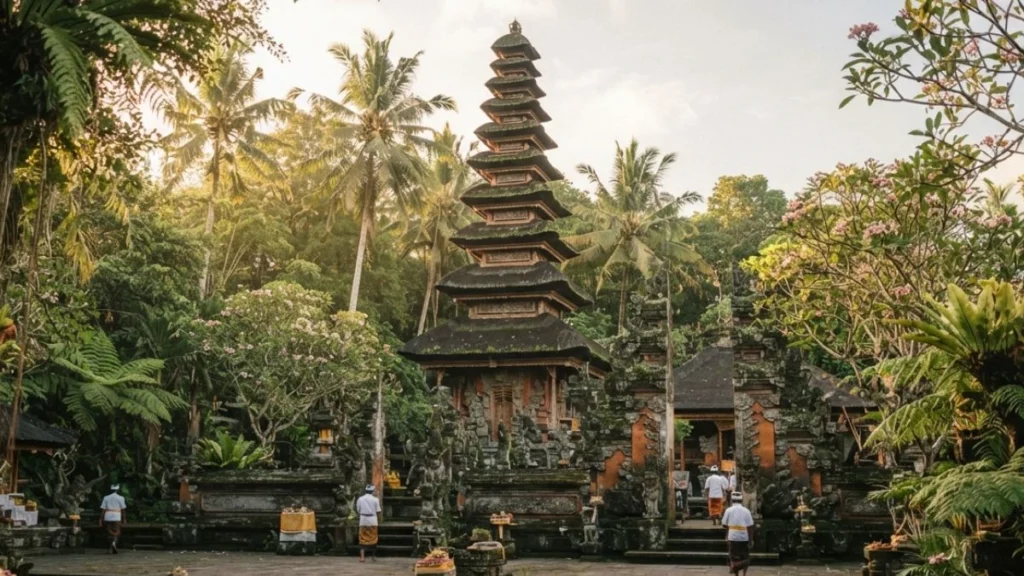
Say “I’m going to Bali” and most people picture a specific set of things — temples, rice terraces, Hindu ceremonies — that don’t automatically call to mind the rest of Indonesia at all. That instinct isn’t entirely wrong. Understanding the bali vs indonesia culture difference reveals genuinely one of the sharpest regional contrasts found within any single country in the world. For the wider context, see our Ultimate Guide to Understanding Indonesia.
Bali is one of Indonesia’s 38 provinces, not a separate country — a common misconception fueled largely by how the tourism industry markets it as a standalone destination. The confusion is understandable, though. Bali is the only Hindu-majority province in an overwhelmingly Muslim-majority nation: roughly 87% of Balinese practice Balinese Hinduism (Agama Hindu Dharma), while Islam holds a similar roughly 87% majority across Indonesia as a whole. This single religious difference cascades into distinct temple architecture, ceremonial life, daily ritual, and cultural rhythm that genuinely sets Bali apart from most of the rest of the archipelago.
Why It Matters
Understanding that Bali is a distinct cultural exception — not representative of Indonesia as a whole — matters for setting accurate expectations, whether you’re a tourist, a business traveler, or simply curious about the country. Visitors who assume Bali’s relaxed, Hindu-influenced, tourism-adapted culture reflects broader Indonesian norms can be caught off guard elsewhere in the country, while conversely, assuming the rest of Indonesia resembles Bali also undersells the genuine diversity found across the other 37 provinces.
Cultural Context
Several factors distinguish Bali culturally from most of Indonesia:
- Religion — Balinese Hinduism blends classical Hindu philosophy with older animist and ancestor-worship traditions, resulting in a genuinely distinct form of Hinduism compared to Indian Hinduism — notably without a rigid caste “untouchable” class and without child marriage traditions found historically in parts of India.
- Tri Hita Karana — Bali’s core philosophical framework, emphasizing harmony between people and the divine, people and nature, and people with one another, shapes daily ritual, architecture, and even land use across the island.
- Visible ceremonial life — thousands of temples (pura), daily flower offerings (canang sari) placed outside homes and businesses, and frequent processions and festivals give Bali a religiously visible, ever-present cultural texture distinct from the rest of the country.
- Language layering — most Balinese speak both Balinese and Indonesian, with many in tourism areas also speaking conversational English, reflecting decades of sustained international tourism exposure not found at the same scale elsewhere in Indonesia.
- Pace and lifestyle — Bali is often described as more relaxed and more accommodating of Western lifestyle norms than large Indonesian cities like Jakarta or Surabaya, a cultural shift widely attributed to the island’s long-standing tourism economy.
Historical Background
Hindu and Buddhist influence reached the Indonesian archipelago from India beginning roughly in the first millennium CE, carried by traders and religious travelers along maritime trade routes connecting China, India, the Middle East, and Europe. Hindu-Buddhist culture flourished across much of Indonesia from around the 4th to the late 15th century, but was gradually displaced elsewhere in the archipelago as Islamic trading networks grew more politically and economically influential. Bali, however, remained a stronghold where Hindu culture survived and continued evolving largely independently, even as the rest of the archipelago shifted toward Islam — making the island a living exception rather than a later religious “holdout” that resisted conversion outright.
Bali’s modern global reputation as a standalone-feeling destination has been substantially shaped by the tourism industry, which has marketed Bali distinctly since a significant tourism boom beginning in the 1980s. Tourism-related business now accounts for roughly 80% of Bali’s economy, a dependency that has, notably, also helped fund and sustain the preservation of Balinese Hindu ceremonies, temple architecture, and traditional arts rather than eroding them.
Regional Differences
- Denpasar, Bali’s provincial capital, is the most populous city in the Lesser Sunda Islands, while Ubud functions as the island’s recognized cultural and artistic heart.
- Southern tourist areas (Kuta, Seminyak, Canggu) show the heaviest Western lifestyle influence and English-language accessibility, a product of decades of concentrated tourism development.
- Rural and inland Bali retains more traditional Balinese Hindu ceremonial and agricultural life, including the subak irrigation system tied closely to Tri Hita Karana philosophy.
- The rest of Indonesia (37 other provinces), by contrast, is overwhelmingly Muslim-majority, with daily life, architecture, and public ritual shaped predominantly by Islamic practice rather than Hindu ceremonial life — meaning Bali’s cultural rhythm is the clear exception nationally, not the norm.
Practical Guide
If you’re planning to visit both Bali and other parts of Indonesia:
- Don’t assume Bali’s norms apply nationwide. Dress codes, alcohol availability, and general social atmosphere in Bali are often more relaxed than in Muslim-majority regions elsewhere in Indonesia.
- Respect Balinese Hindu customs specifically while in Bali. Temple etiquette, offering customs, and ceremonial protocols in Bali differ from religious etiquette expected at mosques or churches elsewhere in the country.
- Explore beyond southern tourist zones for a fuller picture. Inland and rural Bali offers a more traditional, less internationally adapted view of Balinese Hindu culture than the heavily touristed south.
- If traveling on to other islands, reset your expectations. Java, Sumatra, and most other regions will look, sound, and feel meaningfully different from Bali — treat it as a genuinely separate cultural experience within the same country.
Common Misunderstandings
“Bali is a separate country from Indonesia.” Bali is one of Indonesia’s 38 provinces — a common misconception fueled by how distinctly the tourism industry markets the island, often without referencing Indonesia at all.
“Balinese Hinduism is the same as Indian Hinduism.” Balinese Hinduism is a genuinely distinct localized form, blending classical Hindu philosophy with animism and ancestor worship, and lacking features like a rigid untouchable caste system found in some Indian Hindu traditions.
“Bali represents what the rest of Indonesia is like.” Bali is a striking cultural and religious exception — most of Indonesia is Muslim-majority, and daily life, ritual, and social norms elsewhere differ substantially from Bali’s Hindu-influenced culture.
Bali’s distinctiveness within Indonesia isn’t a marketing illusion — it reflects a genuinely different religious and cultural history that has survived and evolved for well over a thousand years while much of the surrounding archipelago moved in a different direction. Understanding this difference helps travelers appreciate both Bali and the rest of Indonesia more accurately, as two genuinely distinct cultural experiences within one remarkably diverse nation.
For related reading, see Subak: Bali’s UNESCO-Listed Irrigation System and Nyepi: Bali’s Day of Silence Explained, or browse the full Regional Cultures pillar.
FAQ
Is Bali a country separate from Indonesia?
No — Bali is one of Indonesia’s 38 provinces, though its distinct Hindu-majority culture and prominent global tourism branding often lead people to mistakenly think of it as standalone.
What percentage of Bali’s population is Hindu?
Roughly 87% of Bali’s population practices Balinese Hinduism, making it the only Hindu-majority province in Muslim-majority Indonesia.
How is Balinese Hinduism different from Indian Hinduism?
Balinese Hinduism blends classical Hindu philosophy with animism and ancestor worship, and notably lacks features like a rigid untouchable caste system found in parts of Indian Hindu tradition.
Why does Bali feel so different from the rest of Indonesia?
Bali’s Hindu-majority religious identity, visible ceremonial life, and decades of concentrated international tourism have shaped a cultural rhythm and lifestyle distinct from the Muslim-majority norms found across most other Indonesian provinces.
What is Tri Hita Karana?
Tri Hita Karana is Bali’s core philosophical framework, emphasizing harmony between people and the divine, people and nature, and people with one another.