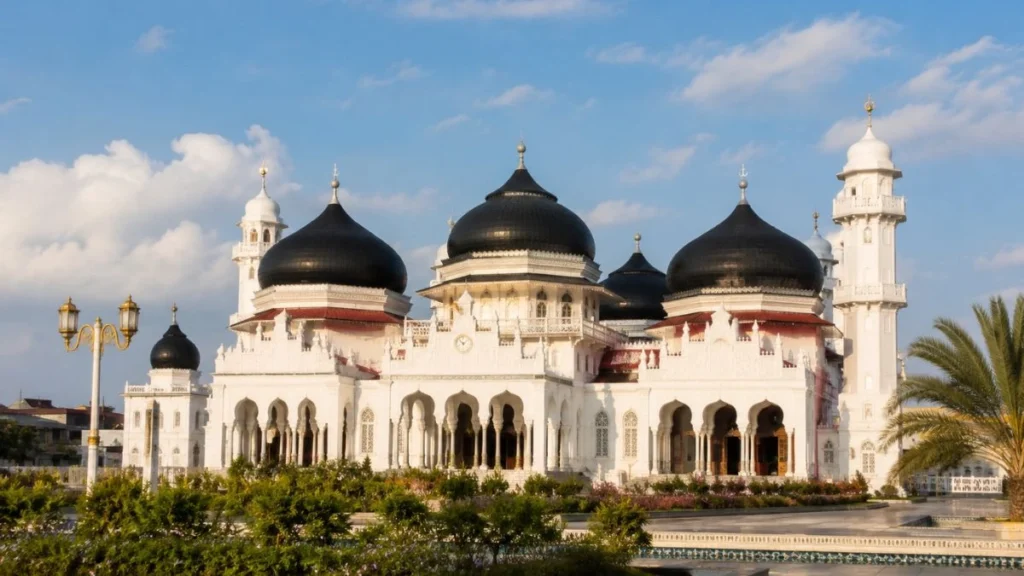
Every other province in Indonesia operates under the country’s secular national legal code. One doesn’t. In Aceh, on the northern tip of Sumatra, a formal system of Islamic law runs alongside Indonesian civil and criminal law — the only place in the entire country where this happens. Aceh sharia law Indonesia permits as a special exception traces back through sultans, decades of armed conflict, and a peace agreement signed after one of the worst natural disasters in modern history. For the wider context, see our Ultimate Guide to Understanding Indonesia.
Sharia, the moral and legal framework derived from Islamic teachings, particularly the Quran and the traditions of the Prophet Muhammad, holds formal legal status in Aceh under Indonesian law — a status no other Indonesian province has. This authority stems from Indonesia’s Law No. 18 of 2001 on Special Autonomy in Aceh, which granted the province the right to implement Islamic law, later reinforced by Law No. 11 of 2006 on the Administration of Aceh, which made enforcing Islamic law an explicit legal duty of the Acehnese government. In practice, this means Aceh maintains its own Islamic criminal code (Qanun Jinayat), enforced by a dedicated unit known as Wilayatul Hisbah, often referred to informally as “Sharia Police.”
Why It Matters
Aceh’s status matters because it represents a genuine legal exception within an otherwise secular Indonesian state — nationally, Islamic law’s influence is generally limited to civil matters like marriage, inheritance, and religious endowments, plus certain areas of Islamic banking. Understanding Aceh’s system helps explain why the province looks and functions differently from the rest of Indonesia in areas like dress codes, alcohol availability, and public conduct enforcement, and why this arrangement has drawn both domestic support as a matter of religious autonomy and significant international human rights criticism.
Cultural Context
Aceh’s Sharia framework covers a specific, defined set of offenses under its Islamic Criminal Code, passed by the Aceh parliament (Dewan Perwakilan Rakyat Aceh) in 2009:
- Regulated offenses — including alcohol consumption, production and distribution; gambling; adultery and other sexual relations outside marriage; khalwat (being alone with someone of the opposite sex who isn’t a spouse or relative); and certain homosexual acts.
- Enforcement — the Wilayatul Hisbah monitors compliance with local regulations, with violations potentially resulting in fines, detention, or public caning, depending on the offense.
- Everyday experience versus international portrayal — while international media coverage often emphasizes caning and strict punishment, many Acehnese describe Sharia in daily life as functioning more as a cultural and moral framework than a constant source of punitive enforcement.
- Scope of application — in practice, Aceh’s Sharia regulations primarily target local Muslims; foreign visitors are still expected to respect local customs and dress modestly, though enforcement against tourists specifically is uncommon.
- Documented human rights concerns — organizations including Amnesty International and Human Rights Watch have specifically criticized aspects of Aceh’s Islamic law implementation, reporting arbitrary arrests, abusive enforcement, and disproportionate impact on women and economically disadvantaged residents.
Historical Background
Islamic legal practice in Aceh isn’t a recent invention — Islam arrived in the region centuries ago through traders from the Middle East, India, and Persia, and Aceh later became home to powerful Islamic sultanates. Historical research documents Islamic legal enforcement dating to the sultanate era itself, including cases under Sultan Alaiddin Ri’ayat Syah II al-Qahhar, who applied qishash (retributive justice) law, and Sultan Iskandar Muda, who reportedly sentenced his own son to stoning after a conviction for adultery.
Aceh’s modern political relationship with the Indonesian state has been genuinely turbulent. Tension began as early as 1953, following what many Acehnese viewed as broken promises of autonomy from the central government under Sukarno, eventually fueling the rise of the Free Aceh Movement (GAM), a separatist insurgency that fought the Indonesian military for decades. In the early 2000s, facing sustained conflict, Indonesia’s national government granted Aceh greater autonomy as part of broader peace and reconciliation efforts, formalized through Law No. 18 of 2001. The devastating 2004 Indian Ocean earthquake and tsunami, which struck Aceh with particular severity, is widely credited with accelerating a genuine peace process between GAM and the Indonesian government, culminating in the 2005 Helsinki Memorandum of Understanding that formally ended the conflict. As part of that broader settlement, Aceh received the right to implement Islamic law and access to special autonomy funds from the central government, running from 2008 through 2027.
Regional Differences
- Banda Aceh, the provincial capital, serves as the administrative center for Sharia governance and hosts institutions like Universitas Islam Negeri (UIN) Ar-Raniry, a significant center for Islamic legal scholarship.
- Urban centers throughout Aceh generally see more visible enforcement activity from the Wilayatul Hisbah, given higher population density and public visibility of regulated behavior.
- Aceh’s education system reflects the province’s distinct legal status through a hybrid structure, incorporating Islamic curriculum and the traditional dayah education system alongside standard Indonesian secular schooling, rather than replacing one system with the other entirely.
- Rural areas may experience Sharia’s presence somewhat differently, often emphasizing its role as a moral and cultural framework tied to community life rather than frequent formal legal enforcement.
Practical Guide
If you’re visiting Aceh or want to understand its legal framework:
- Dress modestly and behave respectfully. Most visitors who follow basic modesty norms and avoid illegal activities encounter few issues, and Acehnese people are often described as warm and genuinely curious toward international visitors.
- Understand that enforcement primarily targets local Muslims. Foreign tourists are still expected to respect local customs, but the Sharia regulations themselves are generally applied to the Acehnese Muslim population.
- Be aware of documented human rights concerns before forming an opinion. International organizations have raised specific, credible concerns about abusive enforcement, so approaching the topic with both the historical context and these documented criticisms in mind offers a more complete picture.
- Recognize Aceh’s distinct status doesn’t extend nationally. Sharia’s formal legal authority is unique to Aceh — visiting other Indonesian provinces means operating under Indonesia’s standard secular legal system instead.
Common Misunderstandings
“All of Indonesia operates under Sharia law.” Aceh is the only Indonesian province with formal legal authority to implement Islamic criminal law; the rest of the country operates under a secular legal system, with Islamic law’s influence elsewhere limited mainly to civil matters like marriage and inheritance.
“Sharia in Aceh is a purely modern political development.” While its current legal formalization dates to the early 2000s Special Autonomy Law, Islamic legal practice in the region traces back centuries to the sultanate era, including documented cases of Islamic legal enforcement under historical Acehnese rulers.
“Sharia enforcement in Aceh has been free of controversy.” Organizations including Amnesty International and Human Rights Watch have specifically documented concerns about arbitrary enforcement, abuse, and disproportionate impact on women, making this a genuinely contested aspect of Aceh’s legal system, not a uniformly accepted arrangement.
Aceh’s Sharia law status reflects a genuinely unique chapter in Indonesian legal and religious history — rooted in centuries of Islamic sultanate tradition, reshaped by decades of conflict, and ultimately formalized through a peace process born partly out of catastrophic tragedy. Understanding both its historical foundation and its documented human rights controversies offers the fullest, most accurate picture of how this singular arrangement actually functions today.
For related reading, see Religious Diversity in Indonesia Explained and How Ramadan Shapes Daily Life in Indonesia, or browse the full Beliefs & Spirituality pillar.
FAQ
Is Aceh the only Indonesian province with Sharia law?
Yes — Aceh is the only province in Indonesia with formal legal authority to implement Islamic criminal law, a status granted through special autonomy legislation.
When did Aceh gain the right to implement Sharia law?
Aceh’s modern legal authority stems from Law No. 18 of 2001 on Special Autonomy, later reinforced by Law No. 11 of 2006, with the Aceh Islamic Criminal Code specifically passed by the Aceh parliament in 2009.
What is the Wilayatul Hisbah?
The Wilayatul Hisbah, often called “Sharia Police,” is the enforcement unit responsible for monitoring compliance with Aceh’s Islamic legal regulations.
Does Aceh’s Sharia law affect tourists?
In practice, Sharia regulations primarily target local Muslims, though foreign visitors are still expected to dress modestly and respect local customs; most tourists encounter few issues if they do so.
Has Aceh’s Sharia law faced international criticism?
Yes — organizations including Amnesty International and Human Rights Watch have documented specific concerns about arbitrary enforcement, abuse, and disproportionate impact on women and economically disadvantaged residents.