For centuries, one of the largest religious monuments ever built simply vanished — swallowed by jungle, buried under volcanic ash, and reduced in local memory to a cursed hill best avoided. Understanding borobudur history rediscovery reveals how a British colonial administrator, acting on rumor alone, helped bring one of the world’s greatest Buddhist monuments back into the light. For the wider context, see our Ultimate Guide to Understanding Indonesia.
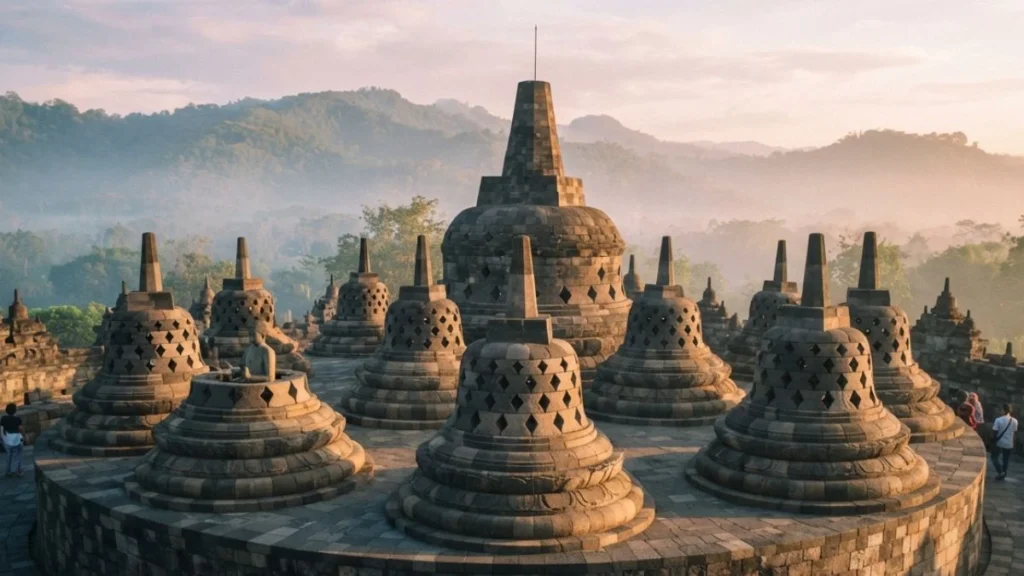
Borobudur is a massive 9th-century Mahayana Buddhist temple in Central Java, built by the Sailendra dynasty and long recognized as the largest Buddhist monument in the world. After Islam became the dominant religion in Java by around the 14th–15th century, Borobudur was abandoned, gradually buried under volcanic ash from nearby Mount Merapi and overtaken by jungle growth, disappearing from active use for roughly 800 years. In 1814, Sir Thomas Stamford Raffles — the British lieutenant-governor of Java during a brief period of British control — heard reports of a “hill of statues.” He dispatched Dutch engineer H.C. Cornelius with a team of around 200 workers to investigate, leading to Borobudur’s dramatic rediscovery after centuries hidden from the outside world.
Why It Matters
Borobudur’s rediscovery story matters beyond archaeology — it fundamentally reshaped how Europeans, and eventually the world, understood pre-Islamic Javanese civilization, revealing a sophisticated Buddhist kingdom capable of extraordinary architectural and artistic achievement. Understanding this history also helps visitors appreciate why Borobudur holds such deep significance for Indonesia today, both as a UNESCO World Heritage Site and as a defining symbol of the country’s ancient cultural heritage.
Cultural Context
Borobudur’s design reflects deep Buddhist cosmological symbolism, structured as six square terraces topped by three circular platforms crowned with a massive central stupa. The monument contains 2,672 relief panels and 504 Buddha statues — the largest and most complete collection of Buddhist relief art in the world — depicting Buddhist teachings, the life of Siddhartha Gautama, and scenes from everyday life in 8th-century Java, including the well-known “Borobudur Ship” relief showing a traditional outrigger vessel that highlights the maritime capability of ancient Nusantara civilizations.
Before Islam spread across Java, Buddhist pilgrims used Borobudur for worship and ritual practice for several centuries. As the temple fell into disuse, local communities came to associate the overgrown ruins with bad luck and lingering spirits, avoiding the site and allowing it to fade almost entirely from written history, surviving only in local folklore as a mysterious, cursed hill.
Historical Background
Borobudur was constructed roughly between 780 and 825 CE under the Sailendra dynasty, with King Samaratungga traditionally credited with overseeing its completion, during a period when Buddhist and Hindu dynasties competed for influence within the Mataram Kingdom of Central Java. By around the 11th century, political power shifted eastward within Java, and the temple gradually fell out of active use; by the 14th–15th centuries, as Islam became Java’s dominant religion, Borobudur was fully abandoned, with volcanic ash and thick jungle eventually burying much of its lower levels for centuries.
In 1814, Raffles — who had developed a genuine passion for Javanese history and culture during Britain’s brief occupation of Java following the Napoleonic Wars — authorized Cornelius’s expedition after hearing rumors of a “mountain of Buddhist sculptures” near the village of Bumisegoro. Cornelius’s team spent roughly two months clearing trees, vegetation, and volcanic soil to expose the monument’s full form, a process largely completed by 1817. Raffles personally visited the site and was reportedly enraptured by its scale and craftsmanship, even collecting two fallen stone Buddha heads. In the decades following rediscovery, Dutch colonial authorities permitted archaeological study, though looting remained a serious problem well into the early 20th century, with looters decapitating hundreds of Buddha statues for sale to private collectors and foreign museums. The first major restoration effort ran from 1907 to 1911, followed by a much larger UNESCO-backed restoration project in the 1970s and 1980s under President Suharto, culminating in Borobudur’s designation as a UNESCO World Heritage Site in 1991.
Regional Differences
- Central Java, where Borobudur is located near Muntilan outside modern Yogyakarta, remains the epicenter of this history, alongside two smaller related temples, Pawon and Mendut, positioned along the same geographical line.
- Yogyakarta, as the nearest major city, has grown into the primary gateway for visitors and researchers studying or touring the site, benefiting economically and culturally from its proximity to the monument.
- The broader Sailendra-era Mataram Kingdom spanned much of Central Java, and archaeological work at Borobudur continues to inform understanding of the region’s ancient political and religious rivalries between Buddhist and Hindu ruling dynasties.
Practical Guide
If you’re planning to visit Borobudur with its history in mind:
- Visit at sunrise if possible. Early morning light highlights the relief carvings beautifully and reflects the original spirit of Buddhist pilgrimage the site was built for.
- Look closely at the relief panels. Many depict specific scenes from Buddhist teaching alongside everyday 8th-century Javanese life — transportation, fashion, and even ships — offering a genuine historical record beyond religious symbolism alone.
- Visit Pawon and Mendut temples nearby. These smaller, related temples sit along the same historical axis as Borobudur and add meaningful context to a visit.
- Learn about the missing Buddha heads before visiting. Recognizing that many original heads were looted and now sit in foreign museums and private collections adds important context to what you’ll see on-site today.
Common Misunderstandings
“Borobudur was completely unknown before 1814.” Local Javanese communities were aware of the site’s existence, associating it with folklore and superstition, but it had effectively disappeared from wider historical and religious use for centuries before Raffles’s expedition brought it back to international attention.
“Borobudur was always intended to be seen as it looks today.” Archaeologists have found that the original foundation included 160 relief panels depicting worldly desires, which were deliberately covered by a later stone encasement — meaning even the monument’s original builders altered its intended visible design.
“The temple has always been well preserved since 1814.” Following its rediscovery, Borobudur suffered significant looting and Buddha-head decapitation throughout the 19th and early 20th centuries, and only later underwent major, careful restoration efforts.
Borobudur’s rediscovery is as remarkable as the monument itself — a nearly forgotten masterpiece brought back from centuries of jungle and volcanic ash through a single colonial administrator’s curiosity. Understanding this history transforms a visit to Borobudur from simply viewing an ancient temple into appreciating one of history’s great archaeological survival stories.
For related reading, see Majapahit: The Empire That Shaped an Archipelago and Religious Diversity in Indonesia Explained, or browse the full History & Heritage pillar.
FAQ
When was Borobudur rediscovered?
Borobudur was rediscovered in 1814, when Sir Thomas Stamford Raffles dispatched Dutch engineer H.C. Cornelius to investigate rumors of a hidden monument in Central Java.
Why was Borobudur abandoned in the first place?
Borobudur was gradually abandoned as Islam became Java’s dominant religion by around the 14th–15th century, with the site subsequently buried under volcanic ash and jungle growth.
Who built Borobudur?
Borobudur was built by the Sailendra dynasty, roughly between 780 and 825 CE, with King Samaratungga traditionally credited with overseeing its completion.
When did Borobudur become a UNESCO World Heritage Site?
Borobudur was designated a UNESCO World Heritage Site in 1991, following a major restoration effort in the 1970s and 1980s.
How many Buddha statues and reliefs does Borobudur have?
Borobudur contains 2,672 relief panels and 504 Buddha statues, making it the largest and most complete collection of Buddhist relief art in the world.