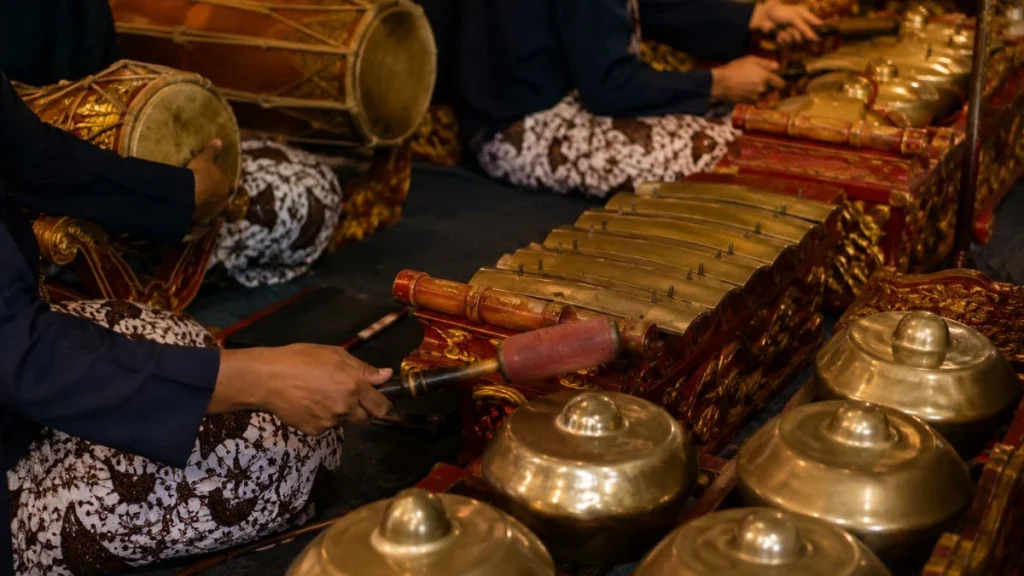
Carved into the ancient stone reliefs of Borobudur, centuries before Indonesia existed as a nation, sits an ensemble of musicians playing instruments that look remarkably familiar today. Few musical traditions anywhere in the world have stayed this recognizable for this long. Gamelan indonesia unesco recognition celebrates exactly that continuity — a bronze orchestra that has shaped Indonesian ceremony, theatre, and daily life for well over a thousand years. For the wider context, see our Ultimate Guide to Understanding Indonesia.
Gamelan is the traditional Indonesian percussion orchestra, built primarily from hand-forged bronze or iron instruments — gongs, metallophones, xylophones, and drums — often joined by bamboo flutes, stringed instruments, or vocalists. The name comes from gamel, a Javanese word for a type of mallet or hammer used to strike the instruments. Rather than tuning to a universal pitch standard, each gamelan set is tuned uniquely to its own internal scale — either the five-tone slendro or the seven-tone pelog — meaning no two gamelan ensembles sound exactly alike. In 2021, UNESCO inscribed Indonesian gamelan on its Representative List of the Intangible Cultural Heritage of Humanity.
Why It Matters
Gamelan isn’t background music — it’s a structural part of Indonesian religious ceremony, theatre, and community life, particularly in Java and Bali. Understanding gamelan helps explain why Indonesian traditional performances like wayang kulit and Balinese temple ceremonies feel incomplete without it, and why entire villages still organize their own ensembles today. Its interlocking, collaborative structure also offers a clear window into how Indonesian communities coordinate complex, layered group effort.
Cultural Context
Several features define how gamelan works and why it matters culturally:
- Interlocking parts, not solo melody — the shimmering texture gamelan is known for comes from multiple musicians playing overlapping, coordinated patterns rather than one person carrying a tune alone, closely tied to the same collaborative instinct behind angklung.
- Regional sound differences — Javanese gamelan tends to sound slow and deep, Balinese gamelan is faster, more dynamic, and joyful, while Lombok and Madura’s versions lean more rhythmic, with heavier flute presence.
- Spiritual significance — Javanese communities traditionally treat gamelan instruments as sacred objects, and the great gong (gong ageng) is believed to house the ensemble’s guiding spirit; Balinese instruments are often ceremonially blessed before use.
- Community ensembles — in Bali, village-level sekaa gong groups emerged in nearly every banjar (community association), sustaining gamelan as a living, daily practice rather than a court-only art form.
- Deliberate “imperfect” tuning — some Balinese gamelan pairs are deliberately detuned to create a vibrating effect called ombak (“wave”), adding a distinctive shimmering quality that’s considered part of the music’s spiritual energy rather than a flaw.
Historical Background
Archaeological evidence places gamelan’s origins well before Hindu-Buddhist influence reached the Indonesian archipelago around 404 CE, with some records suggesting the tradition dates back to at least the 2nd century CE. Stone reliefs carved into the Borobudur and Prambanan temples depict gamelan ensembles, offering physical proof of the tradition’s deep antiquity. Its modern instrumental form is widely believed to have developed further during the Majapahit Empire (1293 to roughly 1527), with period inscriptions specifically referencing gamelan.
Over the following centuries, royal courts in both Java and Bali commissioned their own gamelan sets for ceremonial, artistic, and diplomatic purposes, gradually developing distinct regional styles. Balinese gamelan followed a notably different path from Java’s court-centered tradition, thriving instead at the village level through locally made instruments and community sekaa gong ensembles. Gamelan’s influence eventually reached far beyond Indonesia: composer Claude Debussy encountered it at the 1889 Paris World Exposition, and its interlocking textures and tuning systems went on to influence Western composers and ethnomusicologists throughout the 20th century. In 2021, UNESCO formally recognized gamelan — encompassing Javanese, Balinese, and Sundanese styles together — as Intangible Cultural Heritage of Humanity.
Regional Differences
- Central Java and Yogyakarta host the classical court gamelan tradition, with complete modern ensembles comprising 70 to 80 instruments, solo vocalists (pasindhen), and a choir (gerongan) of up to 15 members.
- Bali developed a village-centered tradition instead of a court-centered one, with instruments considered communal property, ceremonially blessed, and performed at temple festivals, the Ubud Palace, and the annual Bali Arts Festival.
- Lombok and Madura favor a more rhythmic style with heavier use of bamboo flutes compared to Java or Bali’s metal-dominated ensembles.
- Nearly every Indonesian province now has some form of gamelan tradition today, even though the instrument’s historical center remains firmly rooted in Central Java, Yogyakarta, and Bali.
Practical Guide
If you want to experience gamelan directly:
- Attend a wayang kulit or Balinese temple ceremony. Gamelan traditionally accompanies these performances, offering the most authentic context for hearing it as intended.
- Visit the Bali Arts Festival in Denpasar. Held annually from mid-June to mid-July, it showcases gamelan performances from ensembles across the island.
- Look for university or conservatory gamelan programs. Balinese and Javanese gamelan are now taught internationally, and many cities outside Indonesia have their own community ensembles open to learners.
- Ask permission before photographing private ceremonies. Gamelan performed at public shows is generally fine to record, but private rituals call for asking first out of respect for local custom.
Common Misunderstandings
“Gamelan is a single instrument.” Gamelan refers to an entire ensemble — a coordinated set of gongs, metallophones, xylophones, drums, and sometimes flutes or strings — not one specific instrument.
“All gamelan music sounds the same.” Regional style varies significantly: Javanese gamelan tends to be slow and deep, Balinese gamelan is fast and dynamic, and Lombok/Madura styles lean more rhythmic and flute-heavy.
“Gamelan instruments are tuned like a standard piano or orchestra.” Each gamelan set is tuned to its own internal scale, using either the five-tone slendro or seven-tone pelog system — no universal pitch standard applies, so no two complete sets sound identical.
Gamelan represents one of the world’s oldest continuously practiced musical traditions, carved in stone at Borobudur centuries before it earned formal global recognition. Understanding its structure, spiritual role, and regional variety reveals just how deeply this bronze orchestra still shapes ceremony, storytelling, and community life across Indonesia today.
For related reading, see Angklung: Indonesia’s UNESCO-Listed Bamboo Instrument and Wayang Kulit Meaning: Shadow Puppetry, or browse the full Traditions & Festivals pillar.
FAQ
What does the word “gamelan” mean?
Gamelan comes from the Javanese word “gamel,” referring to a type of mallet or hammer used to strike the ensemble’s instruments.
When was gamelan recognized by UNESCO?
UNESCO inscribed Indonesian gamelan on its Representative List of the Intangible Cultural Heritage of Humanity in 2021.
What instruments make up a gamelan ensemble?
A typical gamelan includes gongs, metallophones, xylophones, and drums, often joined by bamboo flutes, stringed instruments, or vocalists.
How is Javanese gamelan different from Balinese gamelan?
Javanese gamelan tends to be slower and deeper and developed within royal courts, while Balinese gamelan is faster and more dynamic, historically rooted in village-level community ensembles.
How old is the gamelan tradition?
Gamelan predates Hindu-Buddhist influence in Indonesia, with archaeological and relief evidence at Borobudur and Prambanan pointing to origins before 404 CE, and some records tracing it back to at least the 2nd century CE.