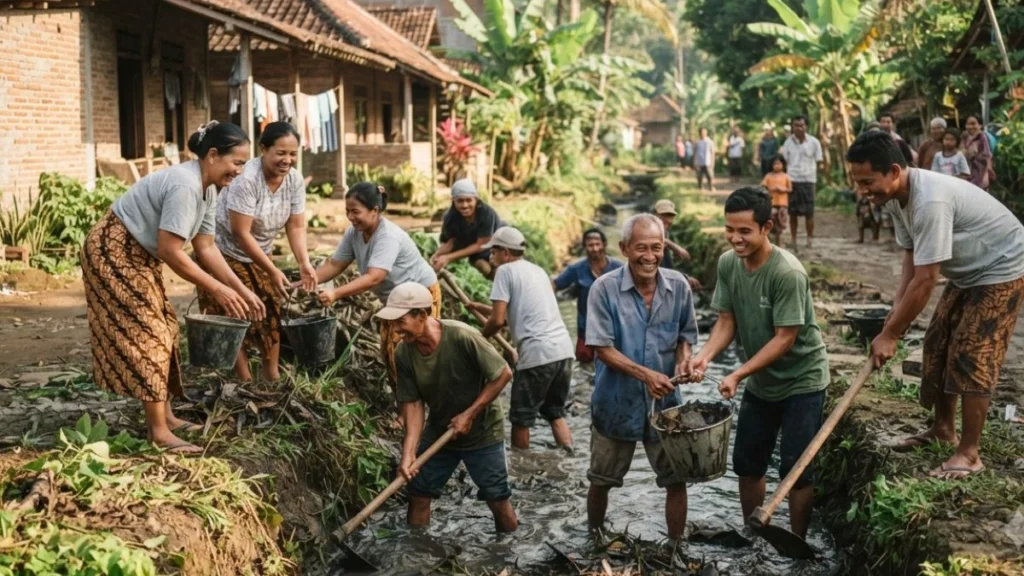
Spend enough time in an Indonesian neighborhood and you’ll see it: a group clearing a drainage ditch on a Sunday morning, neighbors carrying furniture for a family that’s moving house, or a whole village raising a wedding tent from bamboo and cloth. No one gets paid. No one really has to ask twice. The gotong royong meaning behind these moments explains a lot about how Indonesian society actually works. Our Ultimate Guide to Understanding Indonesia covers the fuller cultural picture.
Gotong royong means “mutual cooperation” or “joint bearing of burdens.” It describes the practice — and the underlying value — of community members voluntarily working together for a shared benefit, without expecting individual payment. The term combines gotong (to carry or bear together) and royong (working together in a group), and it applies to everything from small acts of neighborly help to large-scale communal labor projects.
It isn’t just a word for a type of activity. Gotong royong is treated as a national character trait in Indonesia, taught in schools, referenced in political speeches, and even written into the philosophical foundation of the state.
Why It Matters
Understanding gotong royong helps explain a lot of everyday behavior that can otherwise seem puzzling to outsiders — why neighbors seem to know each other’s business, why community obligations can take priority over individual schedules, and why refusing to participate in a shared task can carry real social weight.
For visitors and newcomers, recognizing gotong royong also opens a door: being willing to pitch in, even in a small way, is one of the fastest ways to build trust and be accepted in an Indonesian community.
Cultural Context
Gotong royong operates on the assumption that individual wellbeing is tied to collective wellbeing. This sits in contrast to more individualist frameworks common in Western societies, where cooperation is often transactional or optional.
In practice, gotong royong shows up in forms like:
- Kerja bakti — scheduled communal work, such as cleaning public spaces or roads, often organized at the neighborhood (RT/RW) level
- Helping with life events — neighbors contributing labor, food, or money for weddings, funerals, or births
- Emergency response — communities mobilizing quickly after floods, earthquakes, or fires, often before official aid arrives
- Informal daily reciprocity — small favors exchanged between neighbors with the understanding that they’ll be returned someday, in some form
Because participation is social rather than legally required, it’s enforced through reputation. Someone who consistently skips kerja bakti or ignores a neighbor’s need may not face punishment, but they will likely notice a cooling in how the community treats them.
Historical Background
While gotong royong as a practice likely predates any formal naming, it became especially prominent in Indonesian national identity through Sukarno, the country’s first president. In a well-known 1945 speech laying out the philosophical basis for the newly independent nation, Sukarno described gotong royong as the dynamic, active essence of Pancasila (Indonesia’s five founding principles) — framing it not just as a village custom, but as the ideal spirit of the entire nation working together.
This history is part of why gotong royong carries more institutional weight in Indonesia than similar traditions of mutual aid found elsewhere in the world. It has been actively promoted through education and public messaging for decades.
Regional Differences
The spirit of gotong royong is nationwide, but the specific traditions and names for it vary by region and ethnic group:
- In Java, it’s most commonly called gotong royong or referenced through kerja bakti at the community level.
- In West Sumatra, the Minangkabau call this spirit manunggal sakato (“united in agreement”), expressed through communal labor tied to adat (customary law) — such as collectively building a rumah gadang (traditional house), where men handle construction and women prepare food, all without payment.
- In Bali, the banjar system — the traditional community association — organizes collective labor and mutual obligations tied closely to religious and ceremonial life.
- In parts of Sulawesi, comparable traditions exist under local names, often connected to agricultural cycles like rice harvesting.
Despite different names and specific customs, the underlying logic — shared burden, shared benefit — stays consistent across the archipelago.
Practical Guide
If you’re living in or spending extended time in an Indonesian community, here’s how gotong royong is likely to show up, and how to navigate it:
- You may be invited to kerja bakti. This is often a Sunday morning activity organized by the local RT (neighborhood unit). Attending, even briefly, is a good way to build goodwill.
- Contributions don’t have to be labor. If you can’t physically participate, offering snacks, drinks, or a small monetary contribution is generally an acceptable substitute — ask a neighbor what’s appropriate.
- Reciprocity is expected, not tracked. Don’t expect a ledger. Help is given with the general understanding that it evens out over time, not through direct exchange.
- Life events are community events. If a neighbor is hosting a wedding or dealing with a death in the family, showing up to help — even just carrying chairs — is appreciated far more than staying uninvolved out of politeness.
Common Misunderstandings
“Gotong royong is just volunteering.” Volunteering is usually optional and individual-initiative-driven. Gotong royong carries a stronger social expectation — it’s closer to an unwritten obligation than a personal choice.
“It only happens in villages.” While it’s most visible in rural areas, gotong royong persists in cities too, often through neighborhood associations, apartment complexes, and even workplace culture.
“It means Indonesians never say no to group requests.” Gotong royong is about shared community tasks, not unlimited compliance. Individuals still set boundaries — the value applies most strongly to recognized communal responsibilities, not any request framed as “for the group.”
Gotong royong is more than a translation exercise — it’s a working model for how Indonesian communities distribute effort, support each other through hardship, and maintain social cohesion without relying solely on formal institutions. Once you can recognize it in daily life, a lot of Indonesian social behavior starts to make a lot more sense.
To go deeper into related ideas, see our guides on Understanding “Jam Karet” (Rubber Time) and Face, Harmony, and “Menjaga Perasaan”, or explore the full Culture pillar for more on Indonesian values and daily life.
FAQ
Is gotong royong a law or a custom?
It’s a custom and cultural value, not a legal requirement. Participation is driven by social expectation and reputation, not formal enforcement.
Does gotong royong still happen in big cities like Jakarta?
Yes, though less visibly than in villages. It typically shows up through RT/RW neighborhood associations, apartment or housing complex committees, and informal mutual aid among neighbors.
What’s the difference between gotong royong and kerja bakti?
Gotong royong is the broader cultural value of mutual cooperation. Kerja bakti is a specific, often scheduled activity — like a communal clean-up day — that puts gotong royong into practice.
Is gotong royong unique to Indonesia?
The specific term is Indonesian, but similar traditions of communal mutual aid exist worldwide. What makes the Indonesian version distinct is its formal status as a national value tied to the country’s founding philosophy.
Can foreigners participate in gotong royong activities?
Yes, and doing so is often welcomed. Joining a kerja bakti session or contributing to a neighbor’s event, even in a small way, is a genuine way to build community trust as a newcomer.