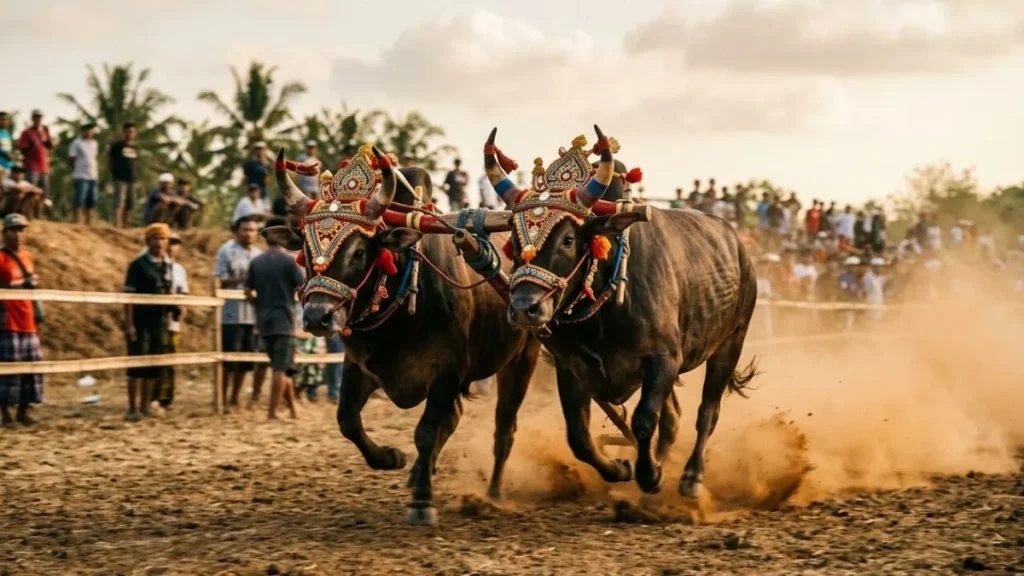
Madurese culture belongs to the people of Madura, an island just off Java’s northeast coast near Surabaya — yet despite that short distance, the Madurese have maintained a distinct identity from their Javanese neighbors for centuries. They’re widely credited as the inventors of satay and pencak silat martial arts, dominate Indonesia’s traditional grocery trade, and are famous nationwide for Karapan Sapi, an elaborate bull-racing tradition treating prize bulls as prestige investments worth more than luxury cars.
Geography suggests Madura should feel like an extension of Java — it’s a short ferry ride from Surabaya, after all. Culturally, the island has spent centuries insisting otherwise. For the wider context, see our Ultimate Guide to Understanding Indonesia.
Who Are the Madurese?
The Madurese are the native people of Madura Island, located just off the northeast coast of Java near Surabaya. Despite this geographic proximity and centuries of intertwined history with Java, the Madurese have consistently asserted a cultural identity distinct from their Javanese neighbors. They’re regarded in Indonesia as the inventors of satay and pencak silat (a traditional martial art), dominate the country’s traditional grocery shop trade, and historically played a pioneering role in classical Islamic movements in Indonesia. Madurese culture emphasizes strong communal bonds, respect for elders, resilience, and a notably entrepreneurial spirit shaped by centuries of navigating the practical challenges of island life.
What Is Karapan Sapi?
Karapan Sapi, Madura’s traditional bull race, stands as the island’s single most recognized cultural symbol — described by nearly every source on Madurese identity as far more than sport. The tradition likely originated from practical agricultural roots, since cattle speed and strength mattered directly for plowing fields and transporting harvests, but it evolved into something carrying genuine philosophical weight: a public expression of courage, resilience, and status.
- The format. Pairs of bulls pull a light cart or wooden sled, guided by a jockey who stands balanced behind them as they sprint down a muddy or dirt track.
- The ceremony before the race. Bulls enter the arena in an ornate procession, dressed in colorful ambhin garments and obet headpieces, accompanied by saronen, a traditional Madurese gamelan instrument.
- The bulls as prestige investments. Championship bulls are treated with extraordinary care — massaged daily, bathed regularly, given herbal jamu tonics, and fed specialized diets including eggs and vitamins — with a winning bull’s value reportedly comparable to a luxury car.
- The season and finale. Races typically run after the rice harvest, between August and October, across different Madurese towns, with regional winners advancing to a grand final, sometimes called the President’s Cup, held in Pamekasan.
- The philosophy behind it. Many Madurese describe the bulls’ strength and bravery as a reflection of the Madurese spirit itself — a cultural belief that courage and resilience under pressure define both the animal and the community it represents.
How Is Madurese Culture Different From Javanese Culture?
| Feature | Madurese Culture | Javanese Culture |
|---|---|---|
| Signature tradition | Karapan Sapi bull racing | Wayang kulit shadow puppetry |
| Communication style | Widely regarded as more direct | Emphasizes indirectness and restraint |
| Economic identity | Strong presence in trade and traditional grocery shops | More varied across agriculture, government, and industry |
| Religious history | Pioneering role in classical Islamic movements | Blended Islamic practice with older Hindu-Buddhist and animist tradition (Kejawen) |
| Signature dish claim | Widely credited as satay’s originators | Associated with many regional dish variations, not one single invention claim |
| Martial art | Credited as originators of pencak silat | Practiced widely but not claimed as sole originator |
Common Misunderstandings
“Madurese and Javanese are basically the same culture.” Despite geographic closeness and shared history, the Madurese have maintained a distinct language, identity, and set of traditions, repeatedly asserting cultural autonomy rather than blending fully into Javanese identity.
“Karapan Sapi is just a race for entertainment.” The tradition carries genuine philosophical and status significance in Madurese culture — bulls are treated as prestige investments reflecting courage and resilience, not simply athletic competition.
“Bull racing is a minor, fading tradition.” Karapan Sapi remains a major seasonal event drawing large domestic and international audiences, culminating in a high-profile annual final that continues to attract national attention.
FAQ
What is Karapan Sapi?
Karapan Sapi is Madura’s traditional bull race, in which paired bulls pull a jockey on a light sled across a track, held annually after the rice harvest between August and October.
Are the Madurese the same as Javanese people?
No — despite Madura’s proximity to Java, the Madurese have maintained a culturally distinct identity, including their own language and traditions, separate from Javanese culture.
What are Madurese people known for?
The Madurese are widely credited as the inventors of satay and pencak silat martial arts, are prominent in Indonesia’s traditional grocery trade, and are internationally known for the Karapan Sapi bull race.
When and where does the Karapan Sapi final take place?
Regional races run from August to October across Madurese towns, with the grand final, sometimes called the President’s Cup, typically held in Pamekasan.
How much can a champion Karapan Sapi bull be worth?
Championship bulls, given their prestige and rigorous care, can reportedly be worth as much as a new luxury car.
Conclusion
Madurese culture demonstrates that proximity doesn’t determine identity — a short ferry ride from Java, the Madurese have preserved a distinct language, economic role, and cultural symbol in Karapan Sapi that reflects centuries of asserted independence. Understanding this distinction adds real texture to how Indonesia’s cultural map actually works, well beyond simple island-by-island assumptions.
For related reading, see Sundanese Culture: West Java’s Core Philosophy and Indonesian Food Guide: Rendang, Nasi Goreng, and Satay Explained, or browse the full Regional Cultures pillar.