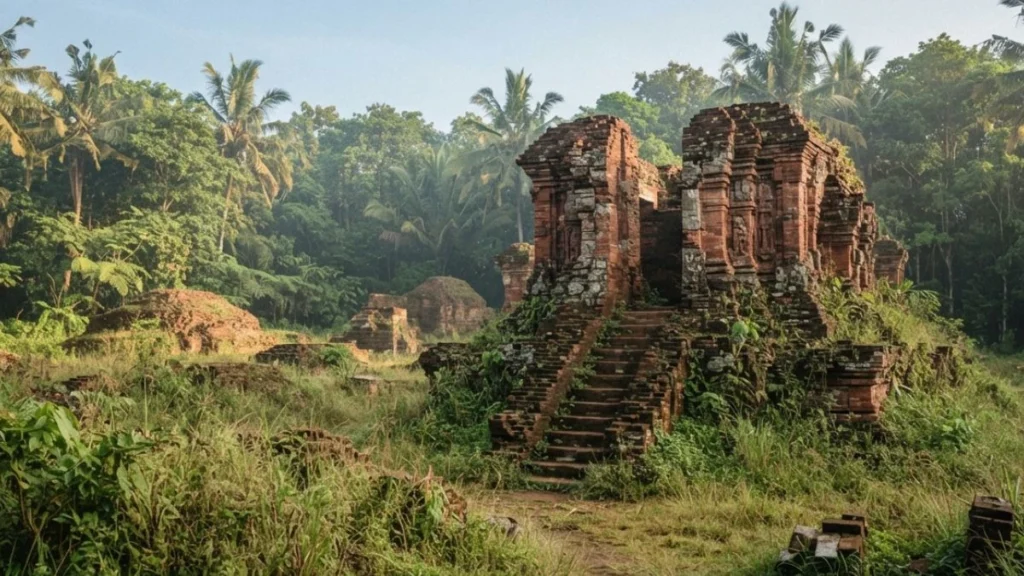
Long before “Indonesia” existed as a modern nation-state, a single East Javanese kingdom came remarkably close to unifying the entire archipelago under one rule — and its legendary prime minister swore an oath to finish the job. Understanding majapahit empire history reveals the ambitious, sophisticated, and ultimately short-lived power that many historians credit as a genuine forerunner to the idea of a unified Indonesian nation. For the wider context, see our Ultimate Guide to Understanding Indonesia.
The Majapahit Empire was a Hindu-Buddhist kingdom based in eastern Java that existed from 1293 to the early 16th century, widely regarded as the largest premodern state in the Indonesian archipelago and among the most extensive in Southeast Asian history. Raden Wijaya founded Majapahit after defeating a rival ruler with Mongol assistance, then expelling the Mongols from Java. The empire reached its peak under King Hayam Wuruk (reigned 1350–1389) and his renowned prime minister, Gajah Mada, whose famous Sumpah Palapa (“Palapa Oath”) pledged to unite the entire Nusantara — the archipelago — under Majapahit control.
Why It Matters
Majapahit matters far beyond ancient history — many Indonesian nationalists in the 20th century drew directly on Majapahit’s legacy as historical proof that a unified archipelago-wide state was achievable, lending symbolic weight to the modern idea of Indonesia itself. Understanding Majapahit also explains much of the shared cultural, administrative, and religious groundwork that later Indonesian kingdoms, and eventually the modern nation, would build upon.
Cultural Context
Majapahit represented a sophisticated fusion of Hindu-Buddhist religious tradition, centralized administration, and vibrant maritime trade. Its capital city was reportedly enclosed by high brick walls and filled with spacious pavilions and abundant gardens, reflecting the wealth generated through royal land charters, taxation reform, and control of regional trade routes. The empire maintained regular diplomatic and trade relations with China, Champa, Cambodia, Annam, and Siam, positioning Majapahit as a genuine regional power rather than a purely local Javanese kingdom.
The Nagarakretagama, an epic poem composed during Hayam Wuruk’s reign, remains one of the primary historical sources describing Majapahit’s territory, culture, and court life — though scholars caution that its praise of the empire’s reach, including claims extending into mainland Southeast Asia, likely reflects idealized political propaganda more than precise territorial fact. Majapahit’s cultural and religious legacy also survives today most visibly in Bali, where Hindu-Javanese traditions carried over from the Majapahit period continue to shape the island’s distinct religious identity even after Java itself later turned toward Islam.
Historical Background
Majapahit was founded in 1293 by Raden Wijaya, a prince of the earlier Singhasari kingdom, who capitalized on the chaos following a Mongol invasion of Java in 1292 — sent by Kublai Khan to avenge an earlier insult from Singhasari’s king. Wijaya initially collaborated with the Mongol forces to defeat a rival usurper, then turned against the Mongols and expelled them from Java, establishing Majapahit’s independent rule.
The empire’s golden age arrived under its fourth ruler, Hayam Wuruk (reigned 1350–1389), supported by his chief minister Gajah Mada, who held office from roughly 1331 until his death in 1364. Under their joint leadership, Majapahit’s authority extended over the eastern Java heartland as direct royal domain, with tributary relationships reaching Bali, Sumatra, Kalimantan, the Malay Peninsula, and trading or diplomatic ties extending to Maluku, Sulawesi, and mainland Southeast Asian kingdoms. Gajah Mada’s Sumpah Palapa oath — a pledge not to rest until the entire Nusantara was united under Majapahit — became legendary as a symbol of archipelago-wide political ambition, pursued through military campaigns such as those against Melayu (Sumatra) in 1340 and Bali in 1343.
Majapahit’s golden era proved relatively short-lived. The empire began to decline following Gajah Mada’s death in 1364, and weakened further after Hayam Wuruk’s death in 1389 triggered succession disputes and internal civil conflict among rival royal factions. Over the following century, Majapahit’s political unity fragmented, while Islamic sultanates in Java — particularly the Sultanate of Demak — grew increasingly powerful, gradually eclipsing Majapahit’s dominance. By the early 16th century, the empire had effectively collapsed, marking the end of the last major Hindu-Buddhist kingdom in Java.
Regional Differences
- East Java remained Majapahit’s core territory and administrative center throughout its existence, with the Brantas River valley serving as a particularly important zone of direct royal control.
- Bali became one of Majapahit’s most enduring cultural legacies — Hindu-Javanese traditions transplanted or reinforced during the Majapahit period continue to shape Balinese Hinduism, religious architecture, and court traditions today.
- Sumatra, Kalimantan, and the Malay Peninsula existed within Majapahit’s wider tributary and trade network, though modern historians generally consider the empire’s direct territorial control to have been concentrated in eastern Java and Bali rather than the more expansive claims found in the Nagarakretagama.
- Western Sunda (West Java) notably retained its independence from Majapahit throughout the empire’s existence, continuing as a separate polity until the early 16th century.
Practical Guide
If you’re interested in exploring Majapahit’s legacy today:
- Visit the Trowulan archaeological site in East Java. Believed to be near Majapahit’s former capital, Trowulan offers museums and ruins connected to the empire’s history.
- Look for Majapahit influence in Balinese Hinduism. Balinese temple architecture, religious practice, and court traditions carry visible traces of Majapahit-era Hindu-Javanese culture.
- Read the Nagarakretagama with appropriate context. It’s an invaluable historical source, but its territorial claims are best understood as celebratory court literature rather than a precise administrative map.
- Connect Majapahit to modern Indonesian nationalism. Recognizing how 20th-century nationalists referenced Majapahit’s legacy adds meaningful depth to understanding modern Indonesian national identity and symbolism.
Common Misunderstandings
“Majapahit controlled all of modern Indonesia and beyond.” While the Nagarakretagama suggests an expansive empire reaching into mainland Southeast Asia, most modern historians believe Majapahit’s direct control was concentrated in eastern Java and Bali, with looser tributary and trade relationships extending further.
“Majapahit fell suddenly to Islamic conquest.” The empire’s decline was a gradual process spanning more than a century, driven primarily by internal succession disputes and civil conflict, with the rise of Islamic sultanates like Demak compounding an already weakening state rather than delivering a single decisive blow.
“Gajah Mada was a king.” Gajah Mada was Majapahit’s prime minister, not a monarch — an extraordinarily powerful and influential administrative and military leader serving under King Hayam Wuruk, rather than a ruler in his own right.
Majapahit stands as a genuine high-water mark of pre-modern Southeast Asian political and cultural achievement — an empire whose ambitions of archipelago-wide unity foreshadowed, centuries later, the very idea of a unified Indonesian nation. Its legacy lives on today most visibly in Bali, and symbolically in how modern Indonesia understands its own historical claim to unity across such a vast and diverse archipelago.
For related reading, see How Borobudur Was Rediscovered After 800 Years and Sukarno and the Fight for Indonesian Independence, or browse the full History & Heritage pillar.
FAQ
When was the Majapahit Empire founded?
The Majapahit Empire was founded in 1293 by Raden Wijaya in eastern Java, following the decline of the earlier Singhasari kingdom and a failed Mongol invasion.
Who was Gajah Mada?
Gajah Mada was Majapahit’s prime minister, serving under King Hayam Wuruk, renowned for his Sumpah Palapa oath pledging to unite the entire Indonesian archipelago under Majapahit rule.
When did Majapahit reach its peak?
Majapahit’s golden age occurred during the reign of King Hayam Wuruk from 1350 to 1389, supported by Gajah Mada’s military and administrative leadership.
Why did the Majapahit Empire decline?
Majapahit declined gradually after the deaths of Gajah Mada (1364) and Hayam Wuruk (1389), due to internal succession disputes and civil conflict, compounded by the rising power of Islamic sultanates like Demak.
Does Majapahit’s legacy still exist today?
Yes — Majapahit’s Hindu-Javanese cultural and religious legacy survives most visibly in Bali, and its history has also been referenced symbolically in modern Indonesian nationalism.