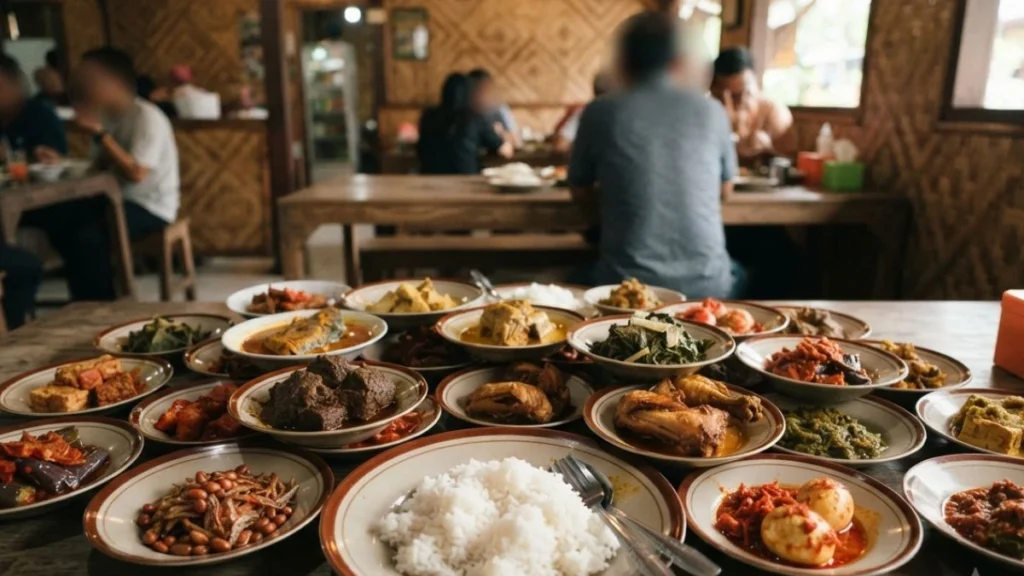
Sit down at a traditional Padang restaurant, and no one hands you a menu. Instead, a waiter appears carrying a towering stack of small plates, setting a dozen or more dishes on your table without you saying a word. Nasi padang how it works is one of the most distinctive, and occasionally confusing, dining systems in Indonesia. For the wider context, see our Ultimate Guide to Understanding Indonesia.
Nasi Padang is a style of Minangkabau cuisine from West Sumatra, built around steamed rice served with an extensive array of pre-cooked, richly spiced side dishes — beef rendang, curries, fried chicken, vegetables, and sambal among them. The ordering system itself is what makes it genuinely unusual. Traditional Padang restaurants use two distinct methods: hidang (serve), where waitstaff place a dozen or more dishes directly on your table without you ordering anything, and pesan (order), where you point to specific dishes at a display case. Either way, you pay only for what you actually eat or touch, not for everything placed in front of you.
Why It Matters
The hidang system can genuinely surprise first-time diners — seeing ten or more dishes appear unordered can feel overwhelming, or even risky, if you’re unsure how billing works. Understanding the system in advance prevents both awkward confusion and unexpectedly large bills, while also revealing something distinctive about Minangkabau hospitality: an approach built on trust, abundance, and honest self-restraint rather than rigid menus and fixed orders.
Cultural Context
The two Padang restaurant systems work quite differently:
- Hidang — After being seated, diners receive no menu. A waiter — often carrying eight to ten stacked plates at once, a genuine feat of balance and skill — brings out a dozen to fourteen small dishes and places them directly on the table. Diners simply eat what they want; untouched dishes are removed and can be served again to the next table, while opened or eaten dishes are added to the bill. This style is best suited to group dining, where the variety and abundance can be shared and appreciated collectively.
- Pesan — More common for solo diners or smaller, simpler restaurants, this system involves choosing specific dishes directly from a display case at the counter, with the waiter serving a portion of each chosen item over rice. This is generally the more economical and predictable option for individual diners.
In both systems, the underlying principle is the same: you only pay for what you actually eat, determined by an honor system where staff simply observe which plates have been opened or touched. This reflects a deeper current of trust and hospitality tied to Minangkabau culture, where the tradition originated as a way to showcase abundance and generosity without forcing diners to commit to a fixed order before seeing what’s available.
Historical Background
Nasi Padang originates from the Minangkabau people of West Sumatra, a historically matriarchal ethnic group in which women have traditionally played a central role in food preparation, often running the “kitchen brigade” behind a Padang restaurant’s rotating spread of dishes. The dish and its restaurant format spread far beyond West Sumatra through merantau, the Minangkabau tradition of migrating for work and trade — the same migration pattern responsible for spreading rendang nationally and internationally. This is why Padang restaurants (rumah makan Padang) can now be found throughout Indonesia, as well as in Malaysia and Singapore, far from their West Sumatran origin.
Regional Differences
- West Sumatra, particularly Padang and Bukittinggi, remains the cultural heartland of the cuisine, with related but distinct local variations like nasi kapau from Bukittinggi, which differs mainly in how dishes are displayed and served rather than in the dishes themselves.
- Jakarta now hosts branches of nearly every major well-known Padang restaurant chain from across Indonesia, making it arguably one of the best places to compare different regional interpretations of the cuisine side by side.
- Malaysia and Singapore, reached through historical Minangkabau migration, have their own established Padang restaurant scenes, generally following the same hidang or pesan traditions.
- Modern food courts and tourist-area restaurants increasingly favor the simpler pesan system over hidang, trading some of the traditional dining experience for predictability and ease for newcomers.
Practical Guide
Here’s how to navigate a Padang restaurant with confidence:
- Ask which system the restaurant uses before sitting down, if unsure. Smaller or more modest restaurants tend to use pesan, while larger, traditional restaurants generally use hidang.
- If dishes arrive unordered, only touch what you intend to eat. Untouched dishes generally aren’t billed, but opening or sampling a dish means it will be added to your total.
- Hidang works best for groups. The variety is designed to be shared, so dining with others allows you to sample more dishes without over-ordering individually.
- If eating alone, pesan is often more economical and simpler. Choosing specific dishes from the display case avoids the potential expense and abundance of a full hidang spread meant for a group.
- Ask the price if you’re uncertain, especially for meat and fish dishes. These are typically priced higher than vegetable dishes, and asking ahead avoids surprises on the bill.
Common Misunderstandings
“You have to pay for every dish placed on the table.” Only dishes you actually eat or touch are added to the bill — untouched dishes are removed and can be reused for the next table.
“Nasi Padang is one specific dish.” It refers to an entire style of Minangkabau dining and its wide range of dishes, not a single recipe — what’s served can vary significantly by restaurant and region.
“Hidang and pesan are the same experience.” Hidang is an unordered, abundant table spread suited to groups, while pesan is a more controlled, display-case selection process better suited to individual diners.
Conclusion
Nasi Padang’s ordering system reflects genuine Minangkabau hospitality values — abundance, trust, and shared generosity — wrapped inside one of Indonesia’s most recognizable culinary traditions. Once the hidang and pesan systems make sense, dining at a Padang restaurant shifts from potentially confusing to genuinely one of the most enjoyable ways to experience Indonesian food.
For related reading, see Why Sambal Is More Than Just “Spicy” and Indonesian Food Guide: Rendang, Nasi Goreng, and Satay Explained, or browse the full Food Culture pillar.
FAQ
Do you have to order at a Padang restaurant?
Not always — in the traditional hidang system, dishes are brought to your table automatically without ordering; in the pesan system, you choose specific dishes from a display case.
How do you pay at a Padang restaurant using the hidang system?
You pay only for the dishes you’ve opened, touched, or eaten — untouched plates are removed and typically not included in your bill.
What’s the difference between hidang and pesan?
Hidang involves waitstaff placing many dishes directly on your table without ordering, while pesan involves selecting specific dishes from a display case — hidang suits groups, while pesan is often simpler for individuals.
Where does Nasi Padang originate from?
Nasi Padang comes from the Minangkabau people of West Sumatra, Indonesia, and spread nationally and internationally through the Minangkabau tradition of merantau (migration for work and trade).
Is Nasi Padang available outside Indonesia?
Yes — due to historical Minangkabau migration, Padang restaurants are well established in Malaysia and Singapore in addition to being widespread throughout Indonesia.