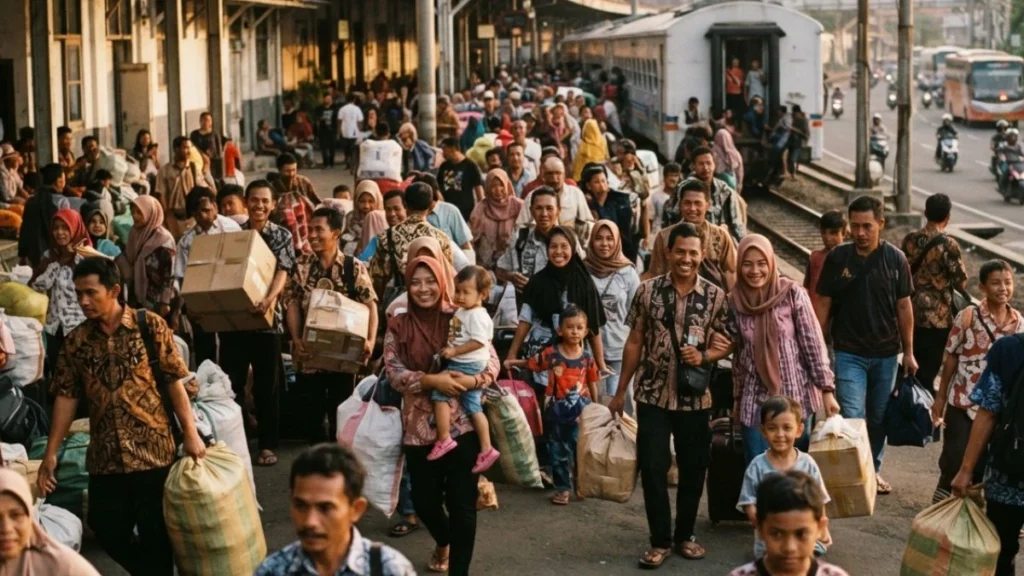
Every year, in the days before Eid al-Fitr, Indonesia’s highways, train stations, ports, and airports fill with tens of millions of people all moving in the same direction: home. Few traditions capture Indonesia’s scale quite like mudik — a recurring migration so large it briefly turns the world’s fourth most populous country inside out. For the wider context, see our Ultimate Guide to Understanding Indonesia.
Mudik is the Indonesian tradition of urban workers and migrants returning to their hometowns or ancestral villages, most prominently around Eid al-Fitr (Lebaran), the holiday marking the end of the Muslim fasting month of Ramadan. The return trip after the holiday is called balik (or balik lebaran). Government transportation ministry estimates put recent mudik participation well over 100 million people. In several recent years, more than half of Indonesia’s population has taken part — making it one of the largest annual human migrations anywhere in the world.
Why It Matters
Mudik isn’t a niche cultural curiosity — it’s a nationwide logistical event that shapes transportation planning, retail cycles, and rural economies for weeks. For visitors or newcomers, understanding mudik explains why flights, trains, and roads become extremely congested and expensive around Eid, why many businesses in major cities temporarily close, and why the holiday period carries such deep emotional weight for millions of Indonesian families.
Cultural Context
At its core, mudik is about reconnecting with family, hometown, and roots (kampung halaman) after time spent working or living away — often in Jakarta or another major city. It’s closely tied to silaturahmi, the practice of visiting and maintaining relationships with family and community, and to asking forgiveness (maaf lahir batin) from parents and elders as part of the Eid tradition.
While mudik is most strongly associated with Muslim communities and Eid al-Fitr, smaller-scale homecoming journeys also happen around Christmas and New Year, Chinese New Year, and Nyepi — meaning the underlying instinct to return home for major holidays cuts across Indonesia’s religious and cultural diversity, even if mudik as a term is most closely linked to Lebaran.
Historical Background
The word mudik has more than one proposed origin. One common explanation traces it to the Malay word udik, meaning “upstream” or “the interior” — in old river-based trade communities, people would travel downstream to trade and then return upstream (mudik) to their home villages, a pattern that gave the word its enduring sense of “returning to one’s origin.” A separate and equally common explanation treats mudik as a Javanese-derived contraction of mulih dilik, meaning “to go home for a while.”
As a mass social phenomenon tied specifically to Lebaran, mudik strengthened significantly from the 1970s onward, as urbanization pulled growing numbers of workers into Jakarta and other major cities — creating, for the first time, a large population with a hometown elsewhere to return to each year.
Regional Differences
- Greater Jakarta is the epicenter of mudik, since it draws in the largest concentration of migrant workers from across Java and beyond; the exodus out of Jakarta before Eid is the most visible part of the phenomenon nationally.
- Central Java, East Java, and West Java are consistently the top destination provinces, receiving the largest shares of returning travelers each year.
- Sumatra sees its own significant mudik flows, particularly involving ferry crossings over the Sunda Strait between Java and Sumatra, which become major bottlenecks during peak travel days.
- Outer islands and more remote regions often see mudik travel extend across multiple modes — road, ferry, and domestic flights — given greater distances from major urban centers.
Practical Guide
If you’ll be in Indonesia around Eid al-Fitr, here’s what to expect and how to plan:
- Book transportation and accommodation early. Trains, flights, and long-distance buses sell out weeks in advance, and prices rise significantly during the mudik period.
- Expect many businesses to close. Small businesses, warungs, and some services in major cities scale back or close entirely as staff return to their hometowns.
- Avoid major highways during peak travel days. The days immediately before and after Eid see the heaviest congestion, especially on the Trans-Java toll road and other major arteries.
- Plan around the holiday, not just the date. Government-declared collective leave periods often extend well beyond the official one or two-day holiday, effectively creating a much longer travel window.
Common Misunderstandings
“Mudik only happens once, right before Eid.” In practice, mudik unfolds over roughly one to two weeks, with a clear peak a few days before Eid and a second wave (balik) as people return to the cities afterward.
“Mudik is only for Muslims.” While it’s most strongly tied to Eid al-Fitr, similar homecoming travel occurs around other major holidays for Indonesia’s Christian, Confucian, and Hindu communities, reflecting a broader national instinct to return home for significant occasions.
“Mudik is just about tourism or vacation.” Survey data consistently shows the primary motivations are celebrating the holiday with family and visiting parents or relatives — leisure travel is a secondary factor for a much smaller share of travelers.
Mudik is far more than a travel rush — it’s a deeply rooted expression of family, identity, and belonging that briefly reshapes the entire country’s transportation networks and rural economies each year. Understanding it offers a real window into how central family and hometown remain in Indonesian life, even amid rapid urbanization.
For related reading, see What Is Gotong Royong? and Indonesian Collectivist Culture, or browse the full Traditions & Festivals pillar.
FAQ
What’s the difference between mudik and balik?
Mudik refers to the journey home to one’s hometown, typically before Eid al-Fitr, while balik (or balik lebaran) refers to the return journey back to the city afterward.
How many people participate in mudik each year?
Recent Indonesian government estimates have placed mudik participation well above 100 million people in several recent years, with some estimates exceeding half of the national population.
Does mudik only happen during Eid al-Fitr?
Eid al-Fitr sees by far the largest mudik movement, but smaller-scale homecoming travel also occurs around Christmas, New Year, Chinese New Year, and Nyepi for other religious communities.
Where does the word “mudik” come from?
There are two common explanations: one traces it to the Malay word “udik” (upstream/interior), and another treats it as a Javanese contraction of “mulih dilik” (to go home for a while).
What should travelers expect during mudik season?
Heavy congestion on major highways, sold-out transportation, higher prices, and many small businesses in cities temporarily closing as staff return to their hometowns.