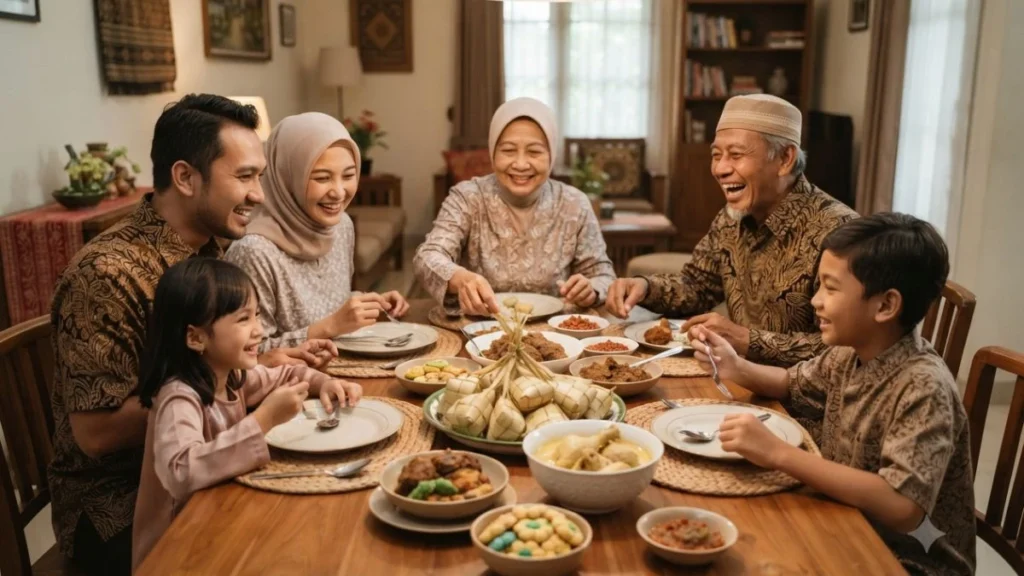
Once a year, tens of millions of Indonesians travel home, dress in their best clothes, kneel before their parents, and ask for forgiveness — all before sitting down to share ketupat and rendang with family and neighbors. Lebaran, or Eid al-Fitr, means much more than a religious holiday in Indonesia; it comes wrapped in a set of distinctly Indonesian customs layered on top of it. For the wider context, see our Ultimate Guide to Understanding Indonesia.
Lebaran, also known as Idul Fitri or Eid al-Fitr, is the Indonesian celebration marking the end of the Islamic fasting month of Ramadan. The word “Lebaran” comes from the Javanese word lebar, meaning “finished” or “wide,” symbolizing both the completion of the fast and an opening of the heart toward forgiveness. Muslims worldwide celebrate Eid al-Fitr, but Indonesia has built its own distinct set of local customs around it. These include mudik (mass homecoming travel), sungkeman (a forgiveness ritual with elders), and the widely repeated phrase “mohon maaf lahir dan batin” (“I seek forgiveness from the heart and soul”) — none of which appear in the same form elsewhere in the Muslim world.
Why It Matters
Lebaran is Indonesia’s largest annual holiday, and understanding its customs helps explain months of anticipation, a nationwide travel surge, temporary business closures, and a distinctly warm, forgiveness-centered social atmosphere that spreads well beyond religious observance. For anyone living in or visiting Indonesia, recognizing these traditions makes it far easier to participate respectfully and understand why the holiday carries such deep emotional and cultural weight.
Cultural Context
Several customs make Indonesian Lebaran distinct:
- Sungkeman — A Javanese tradition where younger family members kneel before elders, kiss their hands, and ask for forgiveness, symbolizing humility and respect for family hierarchy.
- “Mohon maaf lahir dan batin” — A widely shared phrase asking forgiveness for both physical and spiritual wrongdoings, exchanged between family, friends, neighbors, and even strangers during the holiday period.
- Halal bihalal — A distinctly Indonesian practice of open-house gatherings held in the days and weeks following Eid, where people visit one another specifically to seek mutual forgiveness and renew relationships.
- Ketupat — Rice cakes woven into diamond-shaped palm-leaf pouches, traditionally served with dishes like opor ayam (chicken in coconut milk curry) and rendang. The crossed weaving of the palm leaves is said to symbolize human mistakes, while the pure white rice inside represents purity after a month of fasting.
- THR (Tunjangan Hari Raya) — A legally mandated holiday bonus paid to employees ahead of Lebaran, a distinctly Indonesian institutionalized custom dating back to the 1950s.
- Uang Lebaran — Small gifts of new banknotes given to children, similar in spirit to holiday gift-giving traditions elsewhere.
The ritual of actively asking for and giving forgiveness during Eid is considered a distinctly Indonesian practice — most Muslim communities elsewhere in the world mark the holiday primarily with the greeting “Eid Mubarak,” without the same structured emphasis on interpersonal forgiveness found in Indonesian Lebaran traditions.
Historical Background
According to Javanese tradition, the local emphasis on asking forgiveness during Eid al-Fitr traces back to Sunan Bonang, one of the Wali Songo (the nine revered Islamic saints credited with spreading Islam across Java) in 15th-century Tuban. He is said to have encouraged Muslims to deepen the spiritual meaning of Ramadan by actively seeking and extending forgiveness to others — a practice that became deeply woven into Javanese, and later broader Indonesian, Eid celebrations. The halal bihalal tradition of open-house gatherings is generally traced to 19th-century Javanese palace customs, later adopted much more broadly across Indonesian society.
Regional Differences
While core customs like sungkeman, ketupat, and the forgiveness greeting are widespread across Indonesia, regional food traditions vary:
- Java typically features ketupat with opor ayam and rich coconut-based curries.
- Sumatra often centers Lebaran meals around rendang, the slow-cooked spiced beef dish that has become internationally recognized.
- Sulawesi has its own version of rice cakes called burasa, similar in concept to ketupat but distinct in preparation.
- Aceh and other regions maintain their own specific festive dishes and market traditions in the lead-up to the holiday.
Practical Guide
If you’re in Indonesia during Lebaran:
- Expect widespread travel disruption. The days before and after Eid see mudik, Indonesia’s massive homecoming migration — book transportation and expect congestion well in advance.
- Learn the forgiveness greeting. Saying “Mohon maaf lahir dan batin” or “Selamat Idul Fitri” to Indonesian friends, neighbors, or colleagues is warmly received and culturally appropriate, regardless of your own religion.
- Be prepared for closures. Many businesses, especially smaller ones, close for several days as staff return to their hometowns.
- If invited to a home, expect ketupat. Bringing a small gift or simply expressing well wishes when visiting is appreciated, especially during the halal bihalal period.
Common Misunderstandings
“Lebaran and Eid al-Fitr are different holidays.” They’re the same holiday — “Lebaran” is simply the Indonesian name commonly used for Eid al-Fitr.
“The forgiveness ritual is just a generic Eid greeting.” The structured practice of actively asking and granting forgiveness — especially sungkeman and halal bihalal — is a distinctly Indonesian layer added to the broader Islamic holiday, not a universal Eid custom.
“THR is just a bonus like any other holiday pay.” THR is a legally mandated payment in Indonesia specifically tied to religious holidays, with enforced minimum amounts — it’s a formal labor right, not simply a customary gift.
Lebaran in Indonesia layers deeply local customs — forgiveness rituals, mass homecoming, and distinct festive foods — onto the shared Islamic observance of Eid al-Fitr, creating a holiday experience that feels culturally unique even among the world’s Muslim-majority countries. Understanding these traditions offers a clear window into how thoroughly Islamic practice has been woven together with Indonesian cultural identity.
For related reading, see What Is Mudik? Indonesia’s Massive Annual Homecoming and How Ramadan Shapes Daily Life in Indonesia, or browse the full Traditions & Festivals pillar.
FAQ
What does “Lebaran” mean?
Lebaran comes from the Javanese word “lebar,” meaning “finished” or “wide,” symbolizing the completion of the Ramadan fast and an opening toward forgiveness.
What is sungkeman?
Sungkeman is a Javanese Lebaran tradition where younger family members kneel before elders, kiss their hands, and ask for forgiveness as a sign of humility and respect.
Is asking for forgiveness during Eid unique to Indonesia?
Yes — the structured, widely practiced custom of actively seeking and granting forgiveness during Eid al-Fitr, including phrases like “mohon maaf lahir dan batin,” is considered distinctly Indonesian compared to Eid traditions elsewhere.
What is THR?
THR (Tunjangan Hari Raya) is a legally mandated holiday bonus that Indonesian employers must pay employees ahead of major religious holidays, including Lebaran.
What food is traditionally served during Lebaran?
Ketupat (rice cakes wrapped in palm leaves) is a nationwide staple, commonly served with dishes like opor ayam and rendang, though specific dishes vary by region.