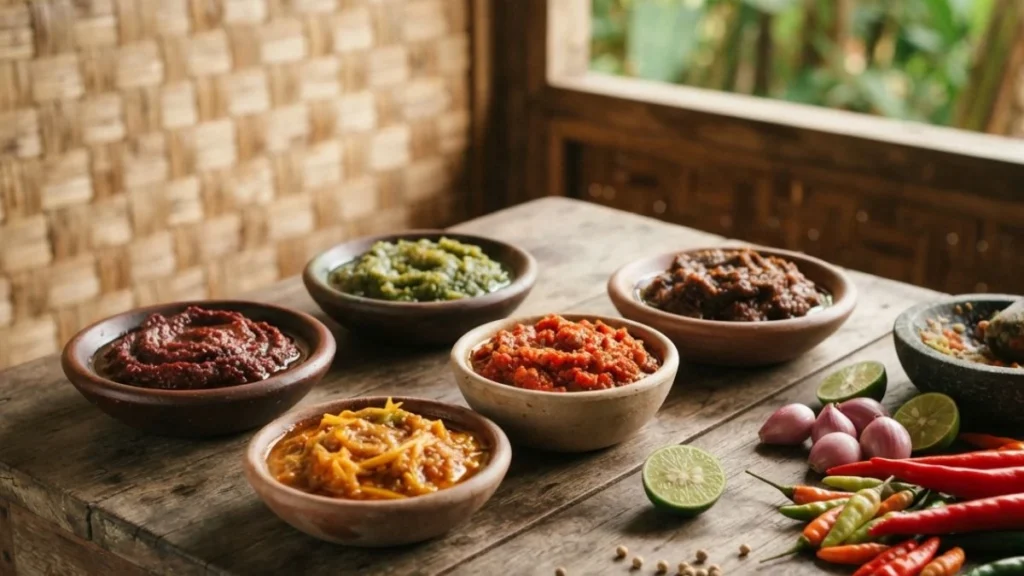
Ask an Indonesian what makes a meal feel complete, and the answer is rarely the main dish — it’s whether there’s sambal on the table. Understanding sambal indonesian chili paste as a genuine culinary category, rather than a single condiment, reveals one of the most varied and culturally significant elements of Indonesian cuisine. For the wider context, see our Ultimate Guide to Understanding Indonesia.
Sambal is a broad category of Indonesian chili-based pastes and sauces, typically made from chili peppers combined with ingredients like garlic, shallot, shrimp paste (terasi), lime, or tomato, depending on the specific recipe. Rather than referring to one fixed dish, “sambal” describes an entire family of condiments. Academic surveys of Indonesian cookbooks have identified well over 200 distinct sambal varieties nationwide, with some estimates placing the number as high as 300. Indonesians serve sambal alongside nearly every type of meal, from everyday rice dishes to festive holiday spreads — making it less a garnish and more a defining element of how the country actually eats.
Why It Matters
Understanding sambal’s range and cultural role helps explain why it’s treated so seriously in Indonesian food culture — many Indonesians consider a meal incomplete without it, and sambal recipes are often closely guarded family traditions passed down through generations. For visitors, recognizing that “sambal” isn’t a single flavor profile, but a hugely varied category ranging from mild to intensely hot, helps set the right expectations when ordering or trying it for the first time.
Cultural Context
Some of the most widely recognized sambal varieties include:
- Sambal oelek/ulek — a simple, raw chili paste often used as a base for other sambal preparations.
- Sambal terasi — made with fermented shrimp paste, offering a deep, savory, umami-rich flavor.
- Sambal matah — a fresh, uncooked Balinese sambal made with raw shallots, lemongrass, and chili, distinct from most other varieties in its raw, aromatic preparation.
- Sambal ijo (hijau) — a green chili sambal originating from Padang, West Sumatra, commonly served alongside the region’s rich, spiced dishes.
- Sambal goreng ati — a stir-fried chili paste with liver, frequently featured in Lebaran (Eid al-Fitr) spreads alongside ketupat and opor ayam.
- Tempoyak — a fermented durian-based sambal found in parts of Sumatra, showing just how far regional interpretations of “sambal” can extend beyond a simple chili condiment.
Sambal-making is often deeply personal and regional — academic research on Indonesian sambal diversity notes that Java alone accounts for the majority of documented sambal variants, with other islands like Sumatra, Bali, and Kalimantan each contributing their own distinctive regional styles, such as South Kalimantan’s fruit-based sambals incorporating local produce like young mango and key lime.
Historical Background
Before the 16th century, Indonesian spicy condiments were made using native ingredients like long pepper and ginger, without the chili peppers most people associate with sambal today. Chili peppers themselves are native to the Americas and were introduced to the Indonesian archipelago by Portuguese traders in the 16th century — a genuinely transformative moment for Indonesian cuisine, sometimes described by food historians as a cultural renaissance of spicy food. By the 18th century, chili-based sambals were well documented across the Indonesian archipelago and the Malay Peninsula, with each community developing its own variations based on locally available ingredients and existing culinary traditions.
Regional Differences
- Java hosts the largest share of documented sambal varieties nationwide, reflecting the island’s dense population and wide culinary diversity.
- Bali is especially known for sambal matah, its distinctive raw, lemongrass-forward preparation tied closely to Balinese ceremonial and everyday cooking.
- West Sumatra (Padang) is associated with sambal ijo, a green variety that pairs closely with the region’s iconic Padang cuisine.
- North Sumatra’s Batak communities use andaliman, a numbing Sichuan pepper relative, in their distinctive local sambal preparations.
- South Kalimantan and Palembang are known for fruit-based sambals that incorporate tropical produce alongside chili and shrimp paste.
Practical Guide
If you’re trying sambal for the first time:
- Ask about heat level before diving in. Sambal varies enormously in spiciness — some varieties are genuinely very hot, while others, like certain fruit-based sambals, are much milder.
- Start with sambal terasi or sambal matah. These are widely available, well-balanced introductions to sambal’s range of flavor beyond pure heat.
- Treat sambal as a condiment, not a side dish to eat alone. It’s designed to be mixed into rice or paired with other dishes, not consumed as a standalone item in large quantities.
- Expect variation from place to place. The same-named sambal can taste meaningfully different depending on the region, restaurant, or home cook preparing it.
Common Misunderstandings
“Sambal is just hot sauce.” While chili is central, sambal’s defining feature is its enormous regional and ingredient diversity — from raw herb-forward preparations to fermented durian versions — going well beyond what “hot sauce” typically implies.
“All sambal is extremely spicy.” Heat level varies significantly by variety and region; some sambals prioritize umami, sourness, or freshness over sheer spiciness.
“Sambal is a modern condiment.” Its roots trace back centuries, with chili-based versions well documented since at least the 18th century, evolving from even older non-chili spicy condiment traditions.
Sambal represents far more than a spicy garnish — it’s a living culinary tradition with hundreds of regional expressions, each reflecting local ingredients, history, and identity. Understanding its true range transforms sambal from a simple side note into one of the richest lenses for exploring Indonesian food culture as a whole.
For related reading, see Indonesian Food Guide: Rendang, Nasi Goreng, and Satay Explained and Nasi Padang Explained, or browse the full Food Culture pillar.
FAQ
How many types of sambal are there in Indonesia?
Academic surveys have documented between roughly 110 and over 200 distinct sambal varieties across Indonesia, with some estimates reaching as high as 300 when including all regional variations.
What is the difference between sambal oelek and sambal terasi?
Sambal oelek is a simple, raw chili paste often used as a base for other recipes, while sambal terasi incorporates fermented shrimp paste for a deeper, savory, umami flavor.
Is all sambal very spicy?
No — heat level varies widely by variety and region, with some sambals, particularly fruit-based versions, being much milder than others.
Where does sambal matah come from?
Sambal matah originates from Bali and is distinctive for being a raw, uncooked preparation made with fresh shallots, lemongrass, and chili.
When were chili peppers introduced to Indonesian cuisine?
Chili peppers, native to the Americas, were introduced to Indonesia by Portuguese traders in the 16th century, fundamentally transforming Indonesian spicy food traditions.