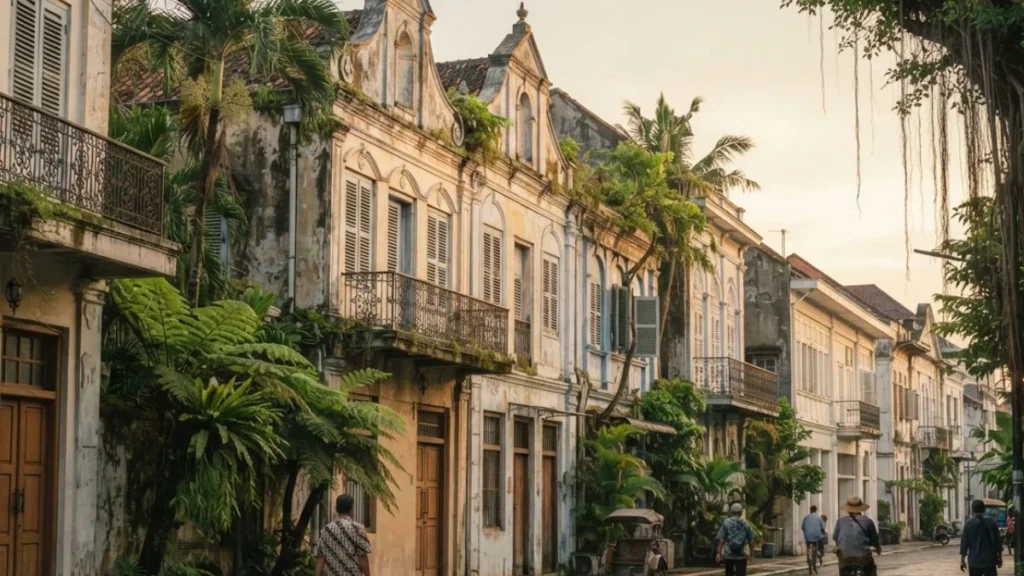
Three and a half centuries is a long time for one nation to shape another — long enough to leave behind legal systems, architecture, vocabulary, and a shared national identity forged largely in resistance to it. Understanding what Dutch colonial history in Indonesia left behind means grappling with one of the longest, and most consequential, European colonial periods anywhere in Asia. For the wider context, see our Ultimate Guide to Understanding Indonesia.
Dutch colonial rule in Indonesia began with the Dutch East India Company (VOC), established in 1602 to dominate the lucrative spice trade. It evolved over more than 300 years into direct Dutch state control of the archipelago, ending only when the Netherlands formally recognized Indonesian independence on December 27, 1949. Along the way, Dutch rule reshaped Indonesia’s political administration, legal systems, and economy, and even set the country on its path toward a national identity. Historians describe this legacy as genuinely complex — brutal economic exploitation on one hand, and the unintended creation of the shared political framework that became the modern Indonesian state on the other.
Why It Matters
Understanding this history helps explain much of contemporary Indonesia — from its centralized administrative structure and legal traditions to lingering economic inequalities tied to colonial-era extraction. It also clarifies why Indonesian nationalism developed the way it did: a genuinely diverse patchwork of sultanates, ethnic groups, and islands were unified largely through the shared experience of colonial rule and the collective struggle to end it, a foundation that continues to shape Indonesian identity today.
Cultural Context
Dutch colonialism left visible marks across Indonesian society that remain recognizable today:
- Administrative and legal systems — the Dutch established a centralized bureaucracy and introduced Western legal concepts that continue to influence Indonesian governance and law.
- Architecture — Dutch colonial-era buildings remain visible in older Indonesian cities, particularly in areas like Jakarta’s Kota Tua (Old Town) and Bandung.
- Language — numerous Indonesian words have Dutch origins, a linguistic legacy from centuries of administrative and economic contact, even though Dutch itself was never widely spoken among the general population.
- National identity — perhaps the most significant legacy: the shared experience of colonial rule and the collective fight against it forged a sense of common purpose among Indonesia’s enormously diverse ethnic and regional communities, laying the groundwork for a unified independent nation.
Historical Background
Dutch involvement began in the late 16th century with the spice trade, formalized through the VOC’s founding in 1602 as a chartered trading company with quasi-governmental powers, including its own army and authority to wage war and negotiate treaties. The VOC expanded its control gradually through the 17th and 18th centuries via strategic alliances, military campaigns, and economic coercion — including violent episodes like the 1621 Banda Islands massacre and the use of “hongi patrols” to enforce spice monopolies. Following the VOC’s bankruptcy and formal dissolution in 1799, and a brief period of British administration under Raffles from 1811 to 1816, the Dutch government assumed direct control of the territory, formally establishing the Dutch East Indies.
In the 1830s, Governor-General Johannes van den Bosch introduced the Cultuurstelsel (Cultivation System), forcing Indonesian farmers to dedicate a portion of their land or labor to producing export crops like sugar, coffee, and indigo for the Dutch treasury — a system that generated enormous colonial profits while causing widespread famine and hardship, later criticized by Dutch author Multatuli and gradually reformed from the 1870s onward. The early 20th century saw the introduction of the Dutch “Ethical Policy,” a reform effort that expanded limited education and infrastructure, but ultimately did little to address the deeper inequities of colonial rule.
Growing Indonesian nationalist movements — including organizations like Budi Utomo and Sarekat Islam — began imagining the colony’s diverse population as a unified people entitled to self-determination. The Japanese occupation from 1942 to 1945 abruptly ended Dutch colonial authority, and following Japan’s surrender, Sukarno and Hatta declared Indonesian independence on August 17, 1945. The Dutch attempted to reassert control through military campaigns in 1947 and 1948, but after years of revolution, guerrilla resistance, and mounting international pressure, the Netherlands formally recognized Indonesian sovereignty on December 27, 1949.
Regional Differences
- Java, particularly Jakarta (formerly Batavia) and Bandung, retained the heaviest concentration of Dutch colonial administrative infrastructure and architecture, reflecting the island’s role as the political and economic center of the Dutch East Indies.
- Aceh experienced some of the fiercest and most prolonged resistance to Dutch control, fighting the Aceh War from 1873 to 1904 with resilient guerrilla tactics that inflicted heavy Dutch casualties and costs.
- The Banda Islands (Maluku) bore the brunt of the VOC’s earliest and most violent spice monopoly enforcement, including the devastating 1621 massacre tied to control of nutmeg production.
- Outer islands and smaller sultanates were often drawn into Dutch control later and more gradually than Java, sometimes through exploited rivalries between local powers that the Dutch used to weaken unified resistance.
Practical Guide
If you’re exploring Indonesia’s Dutch colonial history as a visitor or researcher:
- Visit Jakarta’s Kota Tua (Old Town). This district preserves some of the most visible Dutch colonial-era architecture, offering a tangible sense of the Dutch East Indies’ administrative center.
- Approach the history with nuance, not a single narrative. Historians note that Dutch domestic accounts of this era have sometimes minimized the violence of colonization, so seeking out Indonesian historical perspectives alongside Dutch ones offers a fuller picture.
- Look for Dutch-derived vocabulary in everyday Indonesian. Recognizing these linguistic traces offers a subtle, everyday reminder of the colonial period’s lasting influence.
- Connect this history to Indonesia’s national holidays. Understanding the Dutch colonial period adds meaningful context to Indonesia’s Independence Day (August 17) celebrations each year.
Common Misunderstandings
“Dutch colonization was primarily about spreading civilization or development.” While later policies like the Ethical Policy included limited education and infrastructure initiatives, the core of Dutch rule for most of its history centered on economic extraction and political control, often at devastating human cost.
“Indonesia was a single unified territory that the Dutch simply took over.” Before Dutch expansion, the archipelago was a diverse mosaic of separate sultanates and port cities; the Dutch gradually unified this territory for imperial administrative purposes, a framework that Indonesian nationalists later repurposed as the geographic basis for a unified independent state.
“Indonesian independence was simply granted by the Netherlands in 1945.” While independence was declared on August 17, 1945, the Netherlands didn’t formally recognize Indonesian sovereignty until December 27, 1949, following years of revolution, military conflict, and international diplomatic pressure.
The Dutch colonial legacy in Indonesia is a genuinely double-edged inheritance — centuries of exploitation and violent control that also, paradoxically, helped forge the unified national identity and administrative framework of the modern Indonesian state. Understanding both sides of this history offers essential context for how Indonesia became the nation it is today.
For related reading, see Sukarno and the Fight for Independence and How Borobudur Was Rediscovered After 800 Years, or browse the full History & Heritage pillar.
FAQ
When did Dutch colonial rule in Indonesia begin and end?
Dutch involvement began with the VOC’s founding in 1602, evolving into direct state colonial rule after 1800, and formally ended when the Netherlands recognized Indonesian sovereignty on December 27, 1949.
What was the Cultuurstelsel (Cultivation System)?
It was a Dutch colonial policy introduced in the 1830s that forced Indonesian farmers to dedicate land or labor toward producing export crops for the Dutch treasury, generating major colonial profits while causing widespread hardship and famine.
How long did the Dutch rule Indonesia?
Dutch presence in Indonesia lasted more than 350 years, from the VOC’s establishment in 1602 until formal recognition of Indonesian independence in 1949, making it one of the longest European colonial periods in Asia.
What lasting effects did Dutch colonization have on Indonesia?
Lasting effects include Indonesia’s centralized administrative and legal systems, Dutch-derived vocabulary in the Indonesian language, colonial-era architecture in cities like Jakarta, and the shared national identity forged through resistance to colonial rule.
When was Indonesian independence declared?
Indonesian independence was declared by Sukarno and Hatta on August 17, 1945, though the Netherlands didn’t formally recognize Indonesian sovereignty until December 27, 1949.