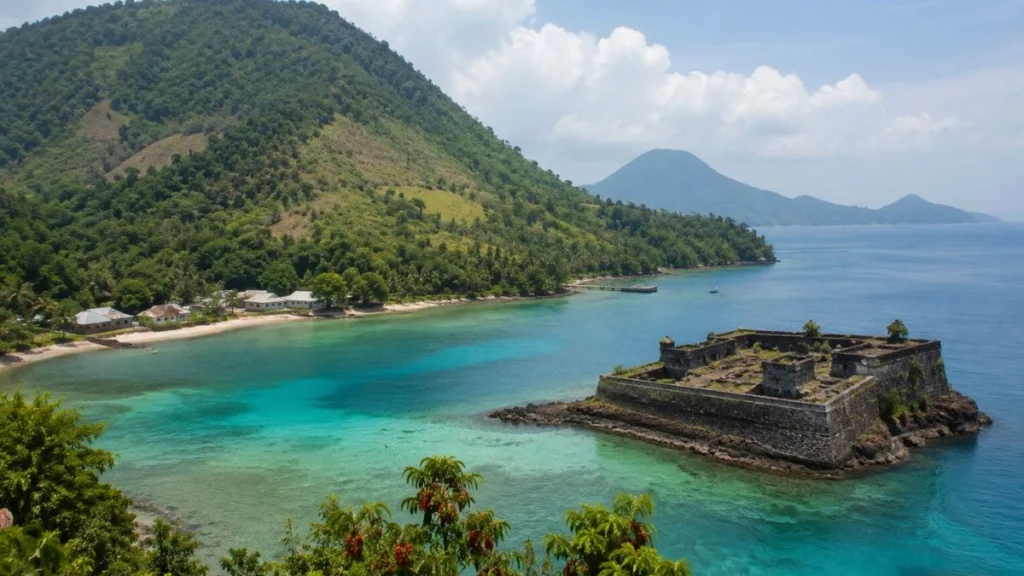
New York City exists as it does today partly because of a tiny Indonesian island most people have never heard of. In 1667, the Dutch and British signed a treaty that handed Manhattan to the British — in exchange for a nutmeg-producing speck of land in eastern Indonesia barely three kilometers long. Spice Islands Indonesia history holds one of the strangest, most consequential trades in world history, and it happened entirely because of a single spice. For the wider context, see our Ultimate Guide to Understanding Indonesia.
The Spice Islands, known today as Maluku or the Moluccas, are a remote cluster of volcanic islands in eastern Indonesia, situated between Sulawesi and New Guinea. For centuries during the medieval and early modern periods, this was the only place on Earth where nutmeg and cloves grew naturally — a genuine global monopoly that made the islands worth fighting wars over. Nutmeg came specifically from the tiny Banda Islands, while cloves originated from just five islands further north, including Ternate, Tidore, Moti, Makian, and Bacan. That extreme scarcity turned ordinary kitchen spices into some of the most valuable commodities in the world, driving European exploration, colonial conquest, and, eventually, one of history’s most famous real estate trades.
Why It Matters
The Spice Islands matter because they connect Indonesia directly to the founding of modern global trade, European colonial expansion, and even the history of New York City. Understanding this history reveals how a handful of remote volcanic islands, easily overlooked on a map, once commanded enough economic power to reshape empires and inspire genuinely brutal colonial violence. It also offers essential context for understanding Indonesia’s broader Dutch colonial history, since the fight for control of these specific islands helped establish the trading networks that eventually became the Dutch East Indies.
Cultural Context
Several elements define the Spice Islands’ outsized historical significance:
- A genuine natural monopoly — nutmeg and mace grew almost exclusively in the Banda Islands, while cloves were native to just five islands in northern Maluku, meaning whoever controlled these specific locations controlled the entire world’s supply.
- Extraordinary value — nutmeg was once believed capable of curing the plague, while cloves were prized for masking the smell of spoiling meat in a world without refrigeration, making both spices worth more than their weight in gold at various points in history.
- Centuries of prior trade networks — Arab traders introduced cloves to Europe as early as the 4th century CE, deliberately concealing their exact source, a monopoly that held until Portuguese explorers broke through following Vasco da Gama’s voyage around the Cape of Good Hope in 1497.
- Genuine colonial brutality — Dutch forces dealt ruthlessly with local Bandanese opposition in the 17th century, killing, enslaving, and deporting much of the indigenous population and replacing them with Dutch-owned slave labor to secure the nutmeg monopoly.
- The “Manhattan Transfer” — locally in Banda, the 1667 territorial swap between Run Island and Manhattan is still specifically remembered and referred to by this name, reflecting how central the exchange remains to local historical memory.
Historical Background
Europeans first reached Maluku in 1512, arriving specifically in search of the spices that had already been circulating through Arab, Indian, and Chinese trade networks for centuries. Portuguese traders established an early foothold, but the Dutch, through the VOC (Dutch East India Company), gradually asserted dominance through the 17th century. In 1621, Dutch forces under the VOC violently seized control of the Banda Islands, with historical accounts describing the near-total destruction of the local Bandanese population through killing, starvation, slavery, and deportation — among the more brutal episodes of Indonesia’s colonial history. To further secure their monopoly, the Dutch deliberately coated all exported nutmeg seeds in lime, ensuring no fertile seed could be smuggled out and planted elsewhere.
The British maintained a foothold on Run, a tiny nutmeg-producing island in the Banda group, defending it as one of their first overseas colonies for roughly 1,540 days against Dutch siege. After decades of conflict between the two powers, the 1667 Treaty of Breda formally resolved the standoff: the British ceded Run Island to the Dutch, and in exchange, the Dutch relinquished their claim to New Amsterdam in North America — the colony that became Manhattan, New York. Contemporary observers at the time widely agreed the Dutch had secured the far more valuable side of the bargain, given nutmeg’s extraordinary worth in that era.
The Dutch monopoly didn’t last indefinitely. During the Napoleonic Wars, British forces briefly retook the Banda Islands in 1810, and before returning them to Dutch control at the war’s end, deliberately uprooted hundreds of nutmeg saplings and transplanted them to British colonies including Ceylon, Grenada, Penang, and Singapore. Within roughly a decade, the Dutch nutmeg monopoly had effectively broken, and within a generation, the once-fought-over Banda Islands faded from global commercial importance, slipping out of the maps that had once made them among the most valuable territory in the world.
Regional Differences
- The Banda Islands, particularly Banda Neira and Run, were the exclusive historical source of nutmeg and mace, and remain the region most closely tied to the Manhattan trade story today.
- Ternate, Tidore, Moti, Makian, and Bacan, in northern Maluku, were the original sources of cloves, with Ambon eventually becoming the epicenter of world clove production under Dutch control.
- Run Island specifically remains remote and sparsely populated today, home to roughly 2,000 people, mostly descendants of plantation workers brought from elsewhere in Indonesia, with limited infrastructure including no airport and only intermittent electricity.
- Modern Maluku as a whole comprises over a thousand islands across two Indonesian provinces, remaining genuinely remote and difficult to access despite major advances in transportation since Indonesian independence in 1949.
Practical Guide
If you want to explore the Spice Islands’ history directly:
- Visit Banda Neira as your primary base. It offers the most accessible entry point into the region’s nutmeg history, along with historical forts and colonial-era architecture.
- Consider a yacht charter or expedition-style travel. Many of the smaller, historically significant islands, including Run itself, remain difficult to reach through conventional transportation.
- Look for remaining Dutch colonial fortifications. Structures like Fort Belgica in Banda Neira offer tangible physical connections to the centuries of conflict fought over these islands.
- Approach the history with awareness of its darker chapters. The nutmeg trade’s profitability came at genuine human cost to the indigenous Bandanese population, worth acknowledging alongside the more commonly told “traded for Manhattan” story.
Common Misunderstandings
“The Manhattan-for-Run trade was a minor historical footnote.” At the time, nutmeg was so valuable that most contemporary observers agreed the Dutch had secured the significantly better deal — Manhattan was, by the standards of 1667, the less valuable piece of territory.
“The spice monopoly was maintained purely through trade agreements.” The Dutch secured and defended their nutmeg monopoly through documented violence against the indigenous Bandanese population, including killing, enslavement, and deportation, not simply commercial negotiation.
“Nutmeg’s monopoly lasted indefinitely.” British forces deliberately broke the Dutch monopoly during the Napoleonic Wars by transplanting nutmeg saplings to other colonies, and within a generation, the Banda Islands’ global commercial importance had faded significantly.
The Spice Islands offer one of history’s clearest examples of how a single natural resource, confined to a few remote volcanic islands, could reshape global trade, fund empires, and directly influence the fate of a city as significant as New York. Understanding this history reveals Indonesia’s surprising and often overlooked role at the very center of early modern global commerce, alongside the genuine human cost that came with it.
For related reading, see The Dutch Colonial Legacy in Indonesia Explained and How Borobudur Was Rediscovered After 800 Years, or browse the full History & Heritage pillar.
FAQ
Why did the Dutch trade Manhattan for a tiny Indonesian island?
Nutmeg was extraordinarily valuable in the 17th century, and the tiny island of Run was one of the few places in the world where it grew — making it, by contemporary standards, a more valuable asset than Manhattan at the time.
What is the “Manhattan Transfer”?
It’s the local Bandanese term for the 1667 Treaty of Breda exchange, in which the British ceded Run Island to the Dutch in return for Dutch-controlled New Amsterdam, which became Manhattan, New York.
Where do nutmeg and cloves originally come from?
Nutmeg and mace originated exclusively from the Banda Islands, while cloves came from five islands in northern Maluku — Ternate, Tidore, Moti, Makian, and Bacan — before cultivation eventually spread elsewhere.
How did the Dutch protect their nutmeg monopoly?
The Dutch coated exported nutmeg seeds in lime to prevent fertile seeds from being smuggled out, and used violent force, including killing and enslaving Bandanese residents, to suppress local and foreign competition.
Can you still visit the Spice Islands today?
Yes — travelers can visit parts of Maluku, particularly Banda Neira and the Banda Islands, though many locations remain remote, often requiring boat or expedition-style travel to reach.