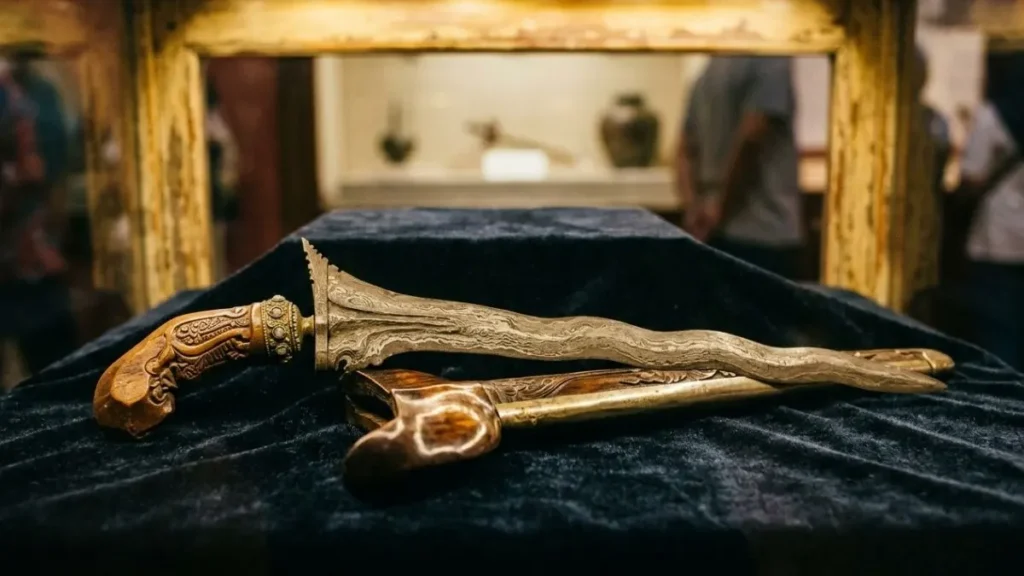
Keris is a distinctive, asymmetrical Indonesian dagger recognized by UNESCO in 2005 as a Masterpiece of the Oral and Intangible Heritage of Humanity. Beyond its function as a weapon, keris is treated as a spiritual object believed to hold magical power and even a soul of its own. The earliest known examples date to the 10th century, most likely originating in Java before spreading across Southeast Asia, and blades are still forged today through ritual-steeped craftsmanship passed down by spiritual bladesmiths called empu.
Most historic weapons get retired to museum cases once their practical use fades. Indonesia’s keris took a different path — it kept its cultural weight by becoming something closer to a living object than a relic. For the wider context, see our Ultimate Guide to Understanding Indonesia.
What Is a Keris?
A keris (also spelled kris) is a distinctive asymmetrical dagger from Indonesia, most closely associated with Java and Bali. Unlike an ordinary weapon, UNESCO officially describes it as both a functional blade and a spiritual object believed to possess magical powers. Its blade is typically narrow with a wide, asymmetrical base, forged from alternating layers of iron and pamor — nickelous iron laminations that create the blade’s distinctive rippling surface pattern. Blades often feature an odd number of wavy curves (luk), considered auspicious in Javanese tradition, though straight-bladed keris also exist.
Why Is Keris Considered Spiritual, Not Just a Weapon?
Keris carries meaning far beyond combat utility, functioning across a genuinely wide range of cultural roles:
- A sanctified heirloom (pusaka). Many keris are passed down as family treasures believed to carry protective or ancestral power, maintained with regular cleaning and ritual offerings.
- A ceremonial and status symbol. Keris remains integral to Javanese weddings, where it traditionally symbolizes the groom’s readiness and responsibility, and continues to signal social status in formal dress.
- A vessel believed to hold a soul. Owners often treat their keris with the same respect given to a living being, performing rituals to maintain its spiritual potency over time.
- A ritual performance object. In Bali’s Barong Dance, entranced dancers stab themselves in the chest with their own keris, believed to remain unharmed through the blade’s mystical protection.
- A product of sacred craftsmanship. The bladesmith, or empu, is regarded as both a skilled artisan and a spiritual practitioner, invoking blessings and imbuing the blade with mystical properties during forging — a process that can take years for a single high-quality piece.
How Old Is the Keris Tradition?
UNESCO’s official record places the earliest known keris at around the 10th century CE, most likely originating on the island of Java before spreading throughout Southeast Asia. Some historians trace design influences even further back — to Hindu-Buddhist kingdoms in Java by roughly the 9th century, and some accounts suggest Bronze Age roots reaching as far as 1000 BCE — though the codified keris form recognized today is most firmly documented from the medieval period onward. As Islam spread across Indonesia in the 15th and 16th centuries, keris design absorbed Islamic artistic influences — floral motifs and geometric patterns — blending with, rather than replacing, existing Javanese aesthetic and spiritual traditions. That layering continued through the colonial period, when the keris endured as a symbol of cultural resilience even as European influence reshaped much of Indonesian society.
Keris and Indonesia’s Other Traditional Blades
| Weapon | Associated Region | Notes |
|---|---|---|
| Keris | Java, Bali (nationwide significance) | Asymmetrical wavy blade, UNESCO-recognized 2005 |
| Rencong | Aceh | Distinct curved dagger tied to Acehnese identity |
| Badik | Sulawesi | Regional dagger with its own ceremonial vocabulary |
| Kujang | West Java (Sundanese) | Curved blade tied to Sundanese heritage |
| Mandau | Borneo (Dayak) | Traditional Dayak sword, historically tied to headhunting-era warfare |
Common Misunderstandings
“Keris is just a decorative knife.” While often displayed as art, keris carries genuine ceremonial, spiritual, and social weight in Indonesian culture — used in weddings, rituals, and as sanctified family heirlooms, not merely decoration.
“All keris blades are identical in design.” UNESCO catalogs roughly 40 blade form variants (dhapur) and around 120 metal alloy pattern variants (pamor), reflecting enormous craftsmanship diversity rather than a single standard design.
“Keris tradition disappeared after Indonesia modernized.” Empu bladesmiths continue practicing ritual-steeped forging today, and keris remains actively used in weddings, ceremonies, and as treasured heirlooms across contemporary Indonesia.
FAQ
When was keris recognized by UNESCO?
UNESCO proclaimed the Indonesian keris a Masterpiece of the Oral and Intangible Heritage of Humanity in 2005, later inscribing it on the Representative List of the Intangible Cultural Heritage of Humanity in 2008.
How old is the keris tradition?
UNESCO’s official record traces the earliest known keris to around the 10th century CE, most likely originating in Java, though some historians point to design influences dating even further back.
What does “pamor” mean on a keris blade?
Pamor refers to the pattern created by nickelous iron laminations on a keris blade — UNESCO catalogs roughly 120 distinct pamor variants, each carrying its own aesthetic and symbolic significance.
Who makes keris blades?
Keris blades are traditionally forged by an empu, a bladesmith regarded as both a skilled artisan and a spiritual practitioner who ritually imbues the blade with mystical properties during the forging process.
Is keris used in weddings today?
Yes — keris remains a standard part of traditional Javanese wedding attire, symbolizing the groom’s readiness and responsibility, alongside its broader ceremonial and status significance.
Conclusion
Keris survived the transition from active weapon to cultural artifact by never fully losing its spiritual dimension — a blade still believed by many Indonesians to hold protective power, ancestral connection, and even a soul of its own. Understanding both its craftsmanship and its enduring ritual role reveals why UNESCO singled it out as a masterpiece of living heritage, not simply historical metalwork.
For related reading, see Understanding Batik: Indonesia’s Wax-Resist Textile Art and Kebaya: The Garment Five Countries Call Their Own, or browse the full Culture pillar.