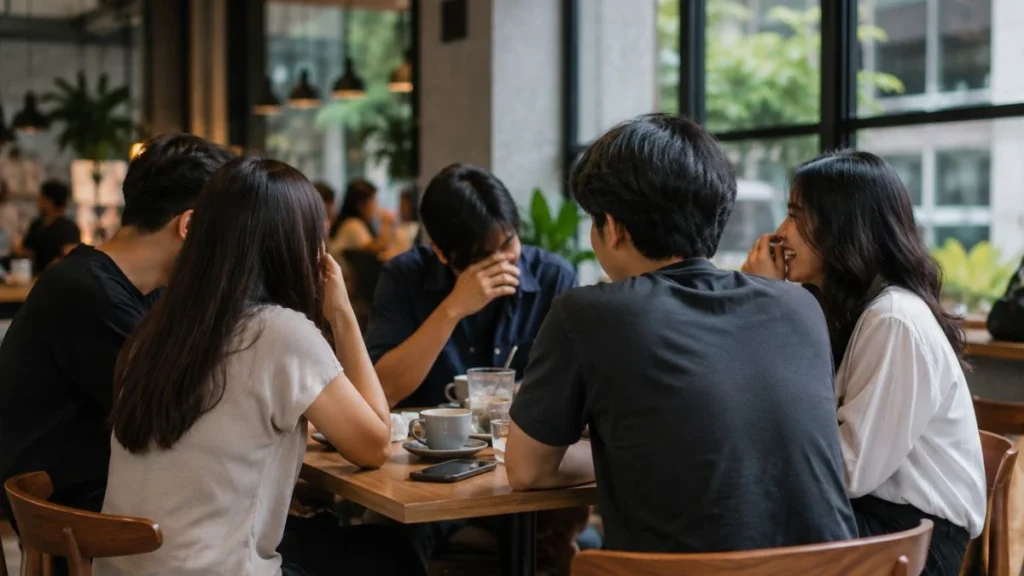
Open an Indonesian textbook and you’ll learn saya for “I” and kamu for “you.” Walk into any Jakarta cafe and you’ll hear gue and lo instead — and if you stick to the textbook version, you’ll sound like you learned Indonesian from your grandmother’s era. Bahasa gaul Indonesia speakers actually use daily has quietly become the real national vernacular, even though no school ever formally teaches it. For the wider context, see our Ultimate Guide to Understanding Indonesia.
Bahasa gaul, literally “sociable language” or “language for socializing,” is the informal, constantly evolving slang variety of Indonesian spoken primarily in urban areas, especially Jakarta. It differs from standard Bahasa Indonesia in both vocabulary and grammar, drawing heavily on the Betawi dialect (native to Jakarta), regional languages, English, and playful new coinages. Though rooted specifically in the capital, bahasa gaul has spread so widely through national media and youth culture that it now functions as something close to Indonesia’s de facto informal register, understood and used by young people well beyond Jakarta itself.
Why It Matters
Understanding bahasa gaul matters because it’s the Indonesian people actually speak in daily, casual life — the version absent from most textbooks and formal classes. For learners, recognizing that “correct” classroom Indonesian and everyday spoken Indonesian can sound genuinely different helps prevent confusion when real conversations don’t match what a course taught. For anyone curious about Indonesian youth culture, bahasa gaul also offers a living record of humor, identity, and social change across recent decades.
Cultural Context
Several features define how bahasa gaul actually works in practice:
- Core vocabulary swaps — gue replaces saya (“I”), and lo replaces kamu (“you”), forming the most basic and recognizable marker of casual speech.
- Playful word transformation — bahasa gaul often manipulates words through reversal, substitution, or sound-alike replacement; a well-documented 2000s-era style, popularized through Debby Sahertian’s published slang dictionary, replaced words with similar-sounding but unrelated substitutes, such as swapping mau (“want”) for mawar (“rose”).
- Regional and ethnic borrowing — bahasa gaul draws vocabulary from Betawi, Javanese, Chinese (particularly Hokkien), and other regional languages, reflecting Jakarta’s status as a melting pot of ethnicities from across the archipelago.
- “Keminggris” — a more recent trend blending English words and phrases directly into Indonesian sentences, especially associated with “Bahasa Gaul Anak Jaksel” (South Jakarta youth slang), often used on social media to signal education and global fluency.
- Constant turnover — new slang terms rise and fall in popularity quickly, driven heavily by social media, television, and shifting youth trends, meaning any list of current bahasa gaul risks feeling dated within just a few years.
Historical Background
Linguists trace the deeper roots of Indonesian slang to prokem, a coded street language linked to marginalized groups, prison and drug subcultures, and Jakarta’s Betawi community, with some scholars pointing to the 1980s as a key period of development. The specific term “bahasa gaul” itself is generally dated to the late 1990s, and its rise into mainstream youth culture is closely tied to increased television and radio exposure — MTV Indonesia in particular has been credited with popularizing bahasa gaul in the early 2000s, associating it with images of being “young and modern.” Around the same period, a distinct wave of gay-community-originated slang entered wider circulation, notably through Debby Sahertian’s Kamus Bahasa Gaul (“Slang Language Dictionary”), which documented and helped spread the playful word-substitution style common in that era.
Because bahasa gaul functions as spoken street language rather than a formally codified system, its exact timeline remains genuinely debated among linguists, with different sources emphasizing different decades and origin points. What’s consistent across accounts is the pattern: young people in Jakarta developing their own linguistic identity, distinct from both formal Indonesian and their parents’ generation, with each subsequent wave — from prokem’s underworld roots to MTV-era youth cool to today’s English-inflected “Keminggris” — building on what came before rather than replacing it outright.
Regional Differences
- Jakarta and Bandung remain the trend-setting centers for bahasa gaul, with Bandung in particular considered a youth-culture hub alongside the capital.
- Regional variation exists even within slang itself — Javanese speakers, for instance, often blend their own regional vocabulary into casual Indonesian, using words like ndak (no) or bojo (originally “spouse” in formal Javanese, used more casually as “boyfriend/girlfriend” in slang) alongside Jakarta-derived terms.
- Youth outside Jakarta and Bandung often still understand and can use bahasa gaul, given its heavy promotion through national media, but tend to default to their own regional language or dialect when speaking with peers from the same area — using bahasa gaul with local peers can come across as somewhat pretentious or “trying too hard.”
- South Jakarta (“Jaksel”) specifically has developed its own recognizable sub-style blending heavy English code-switching into Indonesian, distinct enough to be discussed as its own linguistic phenomenon in academic literature.
Practical Guide
If you want to understand or use bahasa gaul appropriately:
- Start with the basics: gue and lo. These two pronoun swaps alone will make you sound noticeably more natural in casual Jakarta conversation than sticking strictly to saya and kamu.
- Listen more than you speak at first. Bahasa gaul changes quickly, and using outdated slang can read as trying too hard — pay attention to how people actually talk before adopting specific terms yourself.
- Match your register to your audience. Bahasa gaul is appropriate with peers in casual settings, but formal Bahasa Indonesia remains expected in business, official, and many first-meeting contexts.
- Don’t assume it works the same way nationwide. Someone from a smaller city may understand bahasa gaul perfectly well but still prefer using their own regional language among local friends.
Common Misunderstandings
“Bahasa gaul is just bad or incorrect Indonesian.” It’s a distinct informal register with its own internal logic, playful wordplay, and cultural meaning — not simply a degraded version of standard Bahasa Indonesia.
“Everyone in Indonesia uses the same slang.” Bahasa gaul is strongest in Jakarta and Bandung specifically; other regions often prefer their own local languages or dialects among peers, even while understanding Jakarta-derived slang from national media.
“Bahasa gaul has a single clear origin story.” Linguists genuinely disagree on its precise timeline, tracing different threads — prokem street slang, Betawi dialect influence, 1990s coinage, and 2000s gay-community wordplay — that all fed into what’s now called bahasa gaul.
Bahasa gaul reveals something formal language classes rarely capture: how a living language actually moves, adapts, and reinvents itself through the people using it every day. Understanding its playful, ever-shifting nature offers a genuinely useful — and genuinely fun — way to connect with Indonesian youth culture beyond the textbook.
For related reading, see Betawi Culture: Jakarta’s Original People and Basic Indonesian Phrases Every Traveler Should Know, or browse the full Language & Expressions pillar.
FAQ
What does “bahasa gaul” mean?
Bahasa gaul literally translates to “sociable language,” combining “bahasa” (language) with “gaul” (trendy, cool, or social) — referring to Indonesia’s informal youth slang.
Where did bahasa gaul originate?
It developed primarily in Jakarta, with roots linguists trace to 1980s prokem street slang and the Betawi dialect, with the specific term “bahasa gaul” becoming widely used from the late 1990s onward.
What are gue and lo?
Gue and lo are the informal slang equivalents of “I” (saya) and “you” (kamu) in standard Indonesian, among the most basic and widely recognized features of bahasa gaul.
Is bahasa gaul used across all of Indonesia?
It’s most strongly associated with Jakarta and Bandung, though it’s widely understood nationwide through media exposure; other regions often still prefer their own local languages among peers.
What is “Keminggris”?
Keminggris refers to a more recent trend of blending English words and phrases into Indonesian sentences, particularly associated with South Jakarta youth slang and social media culture.