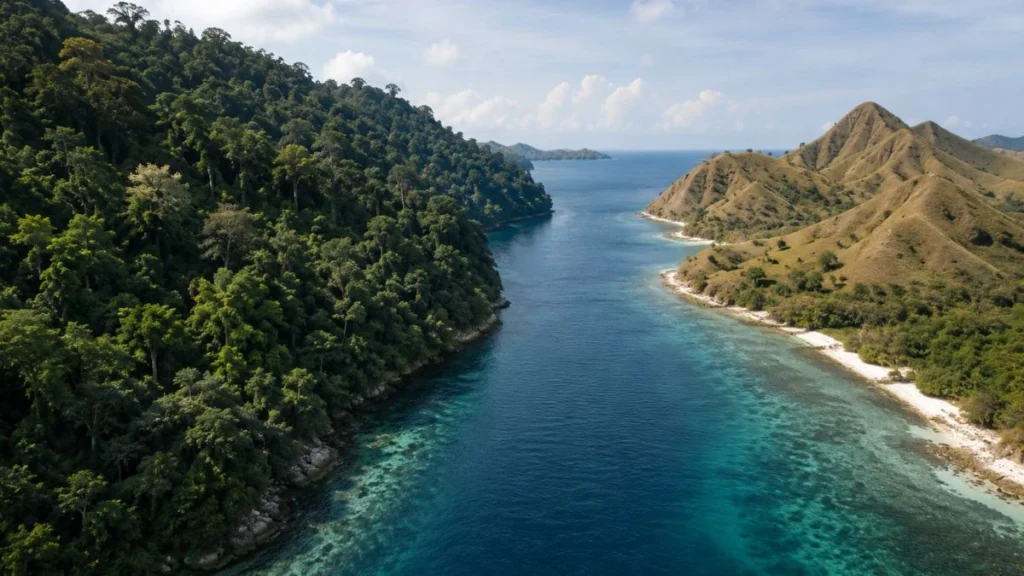
Stand on the beach in Bali and you might spot a wild boar or a species related to Asian deer. Cross a strait just 35 kilometers wide to Lombok, and the animals change entirely — marsupials and cockatoos replace anything you’d recognize from mainland Asia. No visible wall, mountain range, or fence divides these islands. The Wallace Line in Indonesia marks one of the most striking invisible borders in the natural world, and it took a 19th-century naturalist tramping through the archipelago for over a decade to even notice it was there. For the wider context, see our Ultimate Guide to Understanding Indonesia.
The Wallace Line is a faunal boundary running through the Indonesian archipelago, first proposed in 1859 by British naturalist Alfred Russel Wallace and later named in his honor by biologist Thomas Henry Huxley. It separates two fundamentally different biogeographic realms: to the west, islands like Sumatra, Java, and Bali share wildlife closely related to mainland Asian species; to the east, islands including Lombok and beyond show a distinct mix of Asian and Australian-origin fauna. The line runs through narrow but decisive water barriers — the Lombok Strait between Bali and Lombok, and the Makassar Strait between Borneo and Sulawesi — separating ecosystems that, despite sitting just tens of kilometers apart, evolved along completely different paths.
Why It Matters
The Wallace Line matters because it reveals something genuinely counterintuitive about geography and evolution: physical closeness doesn’t guarantee ecological similarity. Understanding it helps explain why Indonesia hosts such extraordinary, unevenly distributed biodiversity — tigers and elephants on one side of an invisible line, tree kangaroos and cockatoos on the other, with almost no overlap despite minimal distance between islands. It also marks a foundational moment in the history of science: Wallace’s observations here directly fed into his independent development of the theory of evolution by natural selection, alongside Charles Darwin.
Cultural Context
Several features define the Wallace Line’s ecological significance:
- A sharp divide, not a gradual blend — west of the line, wildlife includes elephants, tigers, rhinos, and primates typical of the Asian mainland; east of it, marsupials, monotremes, cockatoos, and large flightless birds like cassowaries dominate, reflecting Australian ancestry instead.
- Sulawesi as the exception — this island sits in an unusual transitional zone, hosting a genuine mix of both faunal types, including babirusa and black-crested macaques alongside cockatoos and cuscus, species rarely found together anywhere else in the archipelago.
- Almost no cross-line mammal species — the crab-eating macaque stands out as essentially the only terrestrial mammal found naturally on both sides of the boundary, despite some island gaps measuring only around 35 kilometers.
- Wallacea — the broader transitional region between the strict Wallace Line and the edge of the Australian continental shelf, now recognized as its own distinct biogeographic zone rather than a simple dividing line.
- Present-day conservation relevance — the region’s unique, sharply divided biodiversity makes it a genuine priority for conservation efforts, given how many species on both sides exist nowhere else on Earth.
Historical Background
Alfred Russel Wallace spent roughly eight years traveling through the Malay Archipelago in the mid-19th century, covering an estimated 14,000 miles and collecting more than 125,000 specimens, including insects, birds, reptiles, and mammals. During this expedition, he noticed a striking pattern: islands like Sumatra, Java, and Bali shared wildlife closely related to the Asian mainland, while islands to the east, including New Guinea, hosted marsupials and other species tied to Australia instead. He formally proposed the dividing line in a paper published in 1859, and expanded on the theory in an 1863 presentation to the Royal Geographical Society of London, arguing that “all the islands eastward of Borneo and Java formed part of an Australian or Pacific continent, from which they were separated.”
Wallace theorized that deep water channels — rather than simple distance — explained the divide, since the narrow Lombok Strait separating Bali and Lombok is far deeper than the shallow waters connecting Sumatra, Java, and Bali to the Asian mainland. Modern geologists have since confirmed and refined this insight: during past Ice Ages, dramatically lower sea levels connected Sumatra, Java, and Borneo to the Asian mainland via an exposed land bridge across the shallow Sunda Shelf, allowing Asian species to migrate freely across what are now separate islands, while the far deeper waters east of the line remained an uncrossable barrier even at the lowest historical sea levels. Wallace’s biogeographic observations in the region also directly informed his independent theory of evolution by natural selection, developed around the same period as, and shared jointly with, Charles Darwin — work that later earned Wallace recognition as a founding figure of modern biogeography.
Regional Differences
- Sumatra, Java, and Bali, sitting on the shallow Sunda Shelf, share the closest ecological ties to mainland Southeast Asia, historically connected by exposed land during past Ice Ages.
- The Lombok Strait, between Bali and Lombok, marks one of the sharpest and most frequently cited transitions along the entire line, despite the strait itself being only about 35 kilometers wide at its narrowest point.
- The Makassar Strait, between Borneo and Sulawesi, forms another key segment of the boundary, though Sulawesi’s unique transitional wildlife complicates a truly clean divide at this crossing.
- Sulawesi and the broader Wallacea region, extending toward New Guinea, represent a genuinely blended zone rather than a hard line, home to species found nowhere else because of this unusual mixing of Asian and Australian biological influence.
Practical Guide
If you want to explore the Wallace Line’s effects directly:
- Compare wildlife on Bali and Lombok. Despite their proximity, the two islands offer a genuinely accessible way to observe the faunal shift Wallace first documented, from Asian-associated species on Bali to more Australasian wildlife on Lombok.
- Visit Sulawesi to see the transitional mix. This island uniquely hosts species from both sides of the divide, offering a rare chance to see Asian and Australian-descended wildlife coexisting.
- Look into Komodo National Park. East of the Wallace Line, this UNESCO-listed park hosts the Komodo dragon and other species found nowhere else on Earth, reflecting the region’s unusual evolutionary isolation.
- Read Wallace’s own account for deeper context. His book chronicling the expedition offers firsthand insight into both the wildlife and the broader Indonesian communities he encountered during his travels.
Common Misunderstandings
“The Wallace Line is a single, precisely fixed boundary everywhere.” While clearly defined at crossings like the Lombok and Makassar Straits, the broader transitional region known as Wallacea complicates a perfectly clean divide, particularly around Sulawesi.
“Animals could easily have crossed the narrow straits if they wanted to.” The key barrier isn’t distance but water depth — the straits along the Wallace Line are exceptionally deep even compared to nearby channels, meaning they remained uncrossable even when Ice Age sea levels were at their lowest.
“Wallace discovered evolution independently of, and unrelated to, his biogeography work.” His observations of this exact faunal divide in Indonesia directly shaped his development of evolutionary theory, presented jointly with Charles Darwin’s work rather than as a separate, unrelated discovery.
The Wallace Line stands as one of the clearest reminders that Indonesia isn’t ecologically uniform — it’s a genuine meeting point between two of the world’s major biogeographic realms, split by water barriers too deep for most wildlife to ever cross. Understanding this invisible boundary adds a genuinely different dimension to Indonesia’s story, beyond its human history and into the deep evolutionary forces still shaping the archipelago’s astonishing biodiversity today.
For related reading, see How Borobudur Was Rediscovered After 800 Years and Papua’s Distinct Culture and Identity Explained, or browse the full History & Heritage pillar.
FAQ
What is the Wallace Line?
The Wallace Line is a faunal boundary running through the Indonesian archipelago, separating Asian-associated wildlife to the west from a mix of Asian and Australian-origin species to the east.
Who discovered the Wallace Line?
British naturalist Alfred Russel Wallace proposed the boundary in 1859 after years of studying wildlife distribution across the Malay Archipelago; biologist Thomas Henry Huxley later named it in his honor.
Where exactly does the Wallace Line run?
It passes through the Lombok Strait between Bali and Lombok, and the Makassar Strait between Borneo and Sulawesi, marking a sharp transition in wildlife despite relatively short distances between islands.
Why don’t animals cross the Wallace Line?
The straits along the line are unusually deep, meaning they remained impassable even during past Ice Ages when lower sea levels connected other nearby islands via exposed land bridges.
What is Wallacea?
Wallacea is the broader transitional biogeographic region between the Wallace Line and the edge of the Australian continental shelf, home to a genuine blend of Asian and Australian-descended species, particularly around Sulawesi.