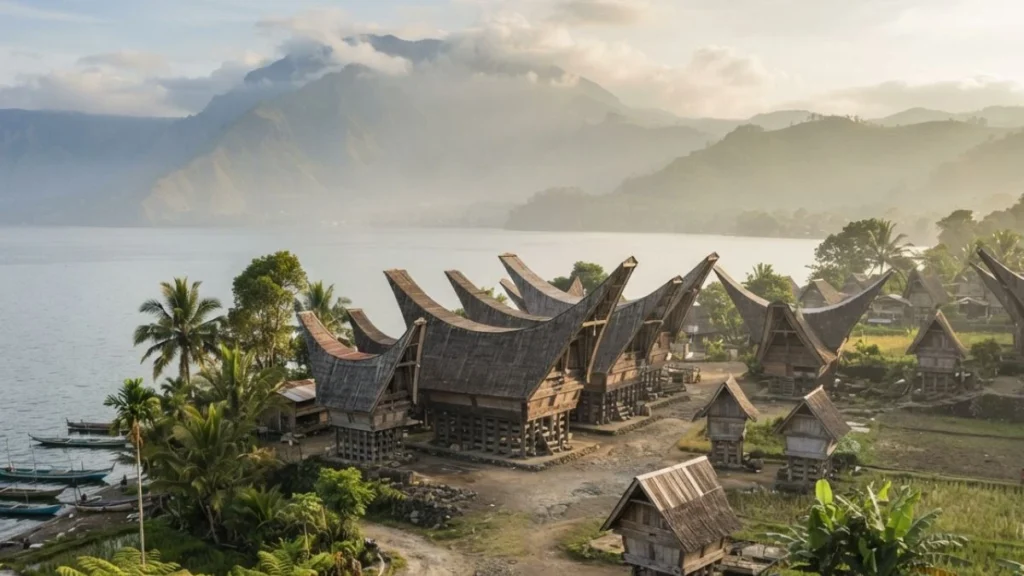
Around a vast volcanic lake in the northern Sumatran highlands lives a people whose entire social structure runs on a principle most Indonesians elsewhere would find unusual: you must marry outside your own clan, full stop. Batak culture, centered on Lake Toba, reveals a genuinely distinct patrilineal society whose clan system still shapes identity even generations after migrating far from the highlands. For the wider context, see our Ultimate Guide to Understanding Indonesia.
The Batak are an ethnic group native to the highlands surrounding Lake Toba in North Sumatra, numbering roughly 6 to 9 million people and comprising several related but distinct sub-groups, including the Toba, Karo, Simalungun, Pakpak (Dairi), Angkola, and Mandailing. Batak society is organized around marga — patrilineal clans passed down through the father’s line. These clans function as exogamous units: marriage within one’s own marga is strictly prohibited, so Batak individuals must marry into a different clan entirely. This clan system remains a defining marker of Batak identity even among those who have migrated far from North Sumatra to cities like Medan and Jakarta.
Why It Matters
Understanding Batak culture highlights just how differently identity and kinship can be organized within a single country — in contrast to matrilineal Minangkabau society or the more hierarchical, indirect communication norms found in Java, Batak culture is built on strict patrilineal descent, clan exogamy, and, by regional reputation, a more direct communication style. Recognizing this diversity helps illustrate the genuine range of family, social, and communication systems that coexist across the Indonesian archipelago.
Cultural Context
Several features distinguish Batak clan society:
- Marga — patrilineal, exogamous clans that function as both a genealogical identity and a practical support network; Batak individuals are unusual among Indonesian ethnic groups in commonly carrying a transmissible clan surname, similar to Western family naming conventions.
- Bridewealth marriage system — a husband’s family traditionally provides gifts and services to the wife’s family, with the bride formally becoming a member of her husband’s group once an agreed threshold of gifts is met.
- Wife-giving and wife-receiving lineage relationships — Batak kinship structures a ritually significant relationship between families that give brides and those that receive them, extensively honored through ceremonial oratory at life-passage events.
- Distinctive traditional architecture — Batak longhouses, particularly well preserved around Lake Toba, feature dramatic saddle-shaped roofs and intricate carvings, with villages traditionally organized as a line of houses (jabu) facing rice granaries (sopo).
- Reburial and ossuary traditions — some Batak families, particularly among the Toba, still practice reburial ceremonies performed at least a generation after death, in which bones are exhumed, cleaned, mourned, and placed in memorial structures called tugu.
- Regional communication style — the Batak are often noted by other Indonesians as more direct and expressive in conversation compared to the more indirect, harmony-focused communication style associated with Javanese culture.
Historical Background
The Batak are believed to descend from a Proto-Malayan people who lived in relative isolation in the highlands around Lake Toba until roughly 1825, with Indian cultural influence — including ideas around government, writing, religion, and craft — reaching Batak society by around the 2nd or 3rd century CE. Despite this outside influence, the Batak never developed a single unified state, instead maintaining distinct cultural divisions and clan-based social organization that persists today.
Batak society historically practiced indigenous local religions tied closely to ancestor veneration and the agricultural cycle, though this changed significantly beginning in the 19th century. Conflict with the neighboring, already-Islamized Minangkabau in the early 1800s led some Batak sub-groups, including the Mandailing, Angkola, and Karo, to gradually convert to Islam. Dutch Christian missionaries arrived comparatively late, beginning only in 1850, with the Batak fully brought under Dutch colonial control only after a prolonged conflict known as the Batak War (1872–1894). Today, most Batak are Christian, predominantly Protestant through the Batak Christian Protestant Church (Huria Kristen Batak Protestan), with a smaller Muslim minority concentrated among specific sub-groups like the Mandailing and Angkola.
Regional Differences
Batak society is commonly divided into distinct sub-groups, each with its own dialect and cultural nuances:
- Toba Batak, centered directly around Lake Toba, represent the largest and most widely recognized Batak sub-group, with their dialect serving as the primary focus of Batak linguistic and cultural research.
- Karo Batak, inhabiting the Karo Highlands around Berastagi and Kabanjahe, use their own distinct dialect (merga rather than marga) and maintain somewhat more sparsely decorated traditional architecture compared to Toba longhouses.
- Simalungun Batak, near Lake Toba, are known for tonal linguistic features and distinct ceremonial expressions.
- Mandailing and Angkola Batak, in the southern parts of North Sumatra, show much stronger Islamic influence, and some members of these groups have historically preferred not to be identified under the broader “Batak” label given its more Toba-centered connotation.
- Pakpak (Dairi) Batak, in the Pakpak highlands, reflect a more rural, agriculturally focused regional identity and dialect.
Practical Guide
If you’re interested in learning about or visiting Batak communities:
- Visit Lake Toba and Samosir Island. This region remains the cultural heartland of Toba Batak identity, offering traditional architecture, cultural performances, and scenic volcanic caldera landscapes.
- Recognize marga as an active, living system, not just history. Many urban Batak in Medan or Jakarta still identify strongly with their clan name and draw on marga networks for social and financial support.
- Approach reburial ceremonies with genuine respect if invited to observe one. These practices, when still performed, carry deep ancestral and family significance rather than being a tourist spectacle.
- Don’t assume all Batak groups share identical customs. The Toba, Karo, Simalungun, Mandailing, Angkola, and Pakpak each maintain distinct dialects, architectural styles, and, in some cases, religious identities.
Common Misunderstandings
“All Batak people share one unified culture and language.” Batak is best understood as a family of related but distinct sub-groups — Toba, Karo, Simalungun, Mandailing, Angkola, and Pakpak — each with its own dialect and cultural particulars, some of which aren’t mutually intelligible.
“The Batak are all Christian.” While the majority are Christian, particularly Toba and Karo Batak, groups like the Mandailing and Angkola are predominantly Muslim, reflecting genuine religious diversity within Batak society.
“Marga is just a historical tradition with no modern relevance.” Clan affiliation remains an active source of identity, social connection, and even financial and political support for many Batak, including those who have lived in cities like Medan or Jakarta for generations.
Batak culture offers a genuinely distinct model of Indonesian identity — patrilineal, clan-based, and historically shaped by a complex blend of isolation, Indian cultural contact, and comparatively late colonial and religious conversion. Understanding this system highlights just how much variation exists across Indonesia’s ethnic landscape, even within a single large island like Sumatra.
For related reading, see Why West Sumatra Follows Its Mothers: Minangkabau Matrilineal Culture and Indonesian Wedding Traditions by Region, or browse the full Regional Cultures pillar.
FAQ
What is marga in Batak culture?
Marga refers to the patrilineal, exogamous clan system central to Batak identity, requiring individuals to marry outside their own clan and functioning as a lasting network of family and social connection.
What religion do the Batak practice?
Most Batak today are Christian, predominantly Protestant, though a Muslim minority exists among sub-groups like the Mandailing and Angkola, alongside remnants of older indigenous belief systems.
How many Batak sub-groups are there?
The Batak comprise several distinct sub-groups, commonly identified as the Toba, Karo, Simalungun, Pakpak (Dairi), Angkola, and Mandailing.
Where do the Batak traditionally live?
The Batak are native to the highlands surrounding Lake Toba in North Sumatra, though many have migrated to cities like Medan and Jakarta over time.
How is Batak marriage traditionally structured?
Batak marriage traditionally involves a bridewealth system, where a husband’s family provides gifts and services to the wife’s family, with strict exogamy requiring marriage outside one’s own marga.