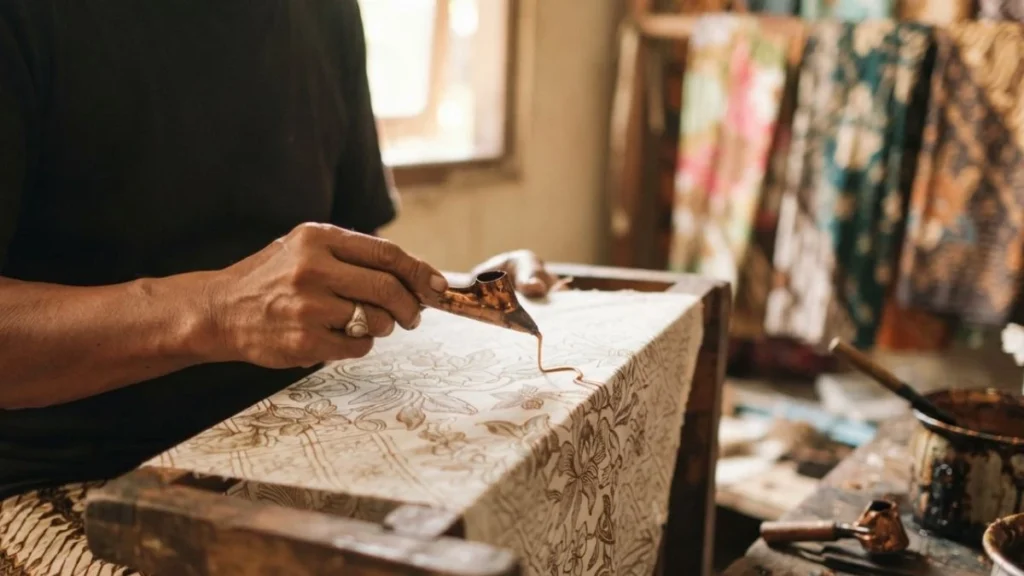
A newborn is carried in it. A bride is dressed in it. The dead are shrouded in it. Few textile traditions anywhere in the world accompany a person through quite so much of life as Indonesian batik does. Its meaning goes well beyond appreciating a beautiful fabric — it’s a centuries-old craft that UNESCO has formally honored as a living piece of world heritage. For the wider context, see our Ultimate Guide to Understanding Indonesia.
Batik is a traditional Indonesian textile art created through a wax-resist dyeing technique. Artisans apply hot wax in intricate dots and lines onto fabric before dyeing it, so waxed areas resist color while exposed areas absorb it — a process often repeated multiple times to build up layered, multicolored patterns. The word “batik” is generally traced to the Javanese term ambatik, combining amba (“to write” or “wide”) and titik (“dot”), reflecting the meticulous dot-and-line technique at the craft’s core. In 2009, following a nomination driven by public participation across Indonesia, UNESCO inscribed Indonesian batik on its Representative List of the Intangible Cultural Heritage of Humanity, recognizing both its artistic sophistication and its deep cultural significance in Indonesian life.
Why It Matters
Batik isn’t simply decorative fabric — it’s a genuine artistic language, with patterns and motifs historically carrying philosophical meaning, marking specific life stages, and even signaling social status or regional identity. Understanding batik’s depth helps explain why it remains worn for business, academic, and ceremonial occasions alike in Indonesia, and why the country takes such evident pride in its UNESCO recognition. For visitors, learning to appreciate batik’s craftsmanship also transforms it from a simple souvenir into a genuinely meaningful cultural artifact.
Cultural Context
Batik accompanies Indonesians through nearly every major life milestone: infants are traditionally carried in batik slings decorated with motifs believed to bring good luck, formal batik garments are worn at weddings and business functions, and funerary batik is used to shroud the dead. Some royal Javanese batik cloths have even played a ceremonial role in specific rituals, including symbolic casting into a volcano.
Two primary techniques define traditional batik production:
- Batik tulis (“written batik”) — wax applied by hand using a canting, a small spouted copper tool that allows wax to flow like ink, producing the most intricate, labor-intensive designs, sometimes taking months to complete a single cloth.
- Batik cap (“stamped batik”) — wax applied using a carved copper stamp, allowing for faster, more consistent pattern reproduction than hand-drawn batik tulis.
Motifs and patterns often carry specific symbolic or philosophical meaning tied to the community or region that produced them, with some classical Javanese court patterns historically reserved for royalty or specific ceremonial occasions.
Historical Background
The wax-resist dyeing technique itself is genuinely ancient and not unique to Indonesia — similar methods have been documented along ancient trade routes between Egypt and India, with a wax-resist indigo cloth found in an Egyptian pharaoh’s tomb dated to around the 5th century BCE. In the Indonesian archipelago specifically, the oldest known batik textile evidence dates to around the 5th century CE, discovered in the Toraja region of Sulawesi, while some historical accounts trace batik’s more formalized development in Java to around the 8th century CE.
Batik flourished for centuries afterward, reaching a particular peak of artistic refinement and prominence in Java during the 19th and 20th centuries, closely tied to royal court patronage in cities like Yogyakarta and Surakarta (Solo). By the 16th century, the term “batik” had spread more broadly to describe wax-resist textile techniques across Southeast Asia, reflecting centuries of cultural and trade exchange among Indonesia, Malaysia, Thailand, and neighboring countries. In 2009, following sustained advocacy and public participation from Indonesian communities and cultural stakeholders, UNESCO formally recognized Indonesian batik as an Intangible Cultural Heritage of Humanity — a designation that has since helped drive renewed national and international interest in preserving traditional batik-making skills, which by 2015 supported tens of thousands of small businesses and nearly 200,000 Indonesian craftspeople, designers, and artisans.
Regional Differences
Batik styles vary distinctly across Indonesia, particularly across Java:
- Central Java (Yogyakarta and Surakarta/Solo) is associated with classical royal court batik, typically featuring more muted, earthy colors (browns, indigo, cream) and traditional geometric or symbolic patterns tied to court heritage.
- The North Coast of Java (Pesisir), including cities like Pekalongan and Cirebon, developed a distinctly different, more vibrant and colorful batik tradition, historically influenced by Chinese, Arab, and Dutch trading communities along the coast.
- Other regions across Indonesia have developed their own local batik variations and motifs, reflecting regional identity, available natural dyes, and distinct artistic traditions beyond Java’s dominant styles.
Practical Guide
If you want to appreciate or purchase batik authentically:
- Learn to distinguish batik tulis from batik cap. Hand-drawn batik tulis is generally more valuable and time-intensive than stamped batik cap, and pricing should reflect that difference.
- Ask about the specific regional style and its meaning. Central Javanese court batik and North Coast Pesisir batik carry genuinely different histories and visual styles worth understanding before purchasing.
- Consider visiting a batik workshop. Watching artisans work with a canting or wax stamp offers a much deeper appreciation of the craft’s skill and patience than viewing finished cloth alone.
- Wear batik appropriately for the occasion. Batik is commonly worn in business, academic, and formal settings in Indonesia, making it a genuinely versatile and respected garment choice, not merely a tourist souvenir.
Common Misunderstandings
“Batik is unique to Indonesia.” While Indonesian batik is by far the most internationally recognized, wax-resist dyeing techniques have ancient roots elsewhere too, including regions along historic Egypt-India trade routes, and similar traditions exist in countries like Nigeria, China, India, and Malaysia.
“All batik is made the same way.” Batik tulis (hand-drawn) and batik cap (stamped) require significantly different skill levels, time investment, and production costs, and shouldn’t be assumed equivalent in value or authenticity.
“Batik is just decorative fabric with no deeper meaning.” Many traditional batik patterns carry specific philosophical, regional, or ceremonial significance, historically marking life stages, social status, or specific community identity rather than serving purely decorative purposes.
Batik represents one of Indonesia’s most globally recognized and deeply meaningful cultural traditions — a wax-and-dye art form that has accompanied Indonesians through birth, marriage, and death for centuries, now formally honored as a piece of world heritage. Understanding its history, technique, and regional variety turns a simple piece of patterned cloth into a genuine window onto Indonesian identity and craftsmanship.
For related reading, see What Is Gotong Royong? and Indonesian Wedding Traditions by Region, or browse the full Culture pillar.
FAQ
What does the word “batik” mean?
Batik is generally traced to the Javanese word “ambatik,” combining “amba” (to write/wide) and “titik” (dot), reflecting the technique’s characteristic dot-and-line wax application.
When was batik recognized by UNESCO?
UNESCO inscribed Indonesian batik on its Representative List of the Intangible Cultural Heritage of Humanity in 2009.
What is the difference between batik tulis and batik cap?
Batik tulis is hand-drawn using a canting tool, making it more intricate and time-intensive, while batik cap uses a carved copper stamp for faster, more consistent pattern reproduction.
How old is the batik tradition in Indonesia?
The oldest known Indonesian batik textile evidence dates to around the 5th century CE, found in Toraja, Sulawesi, though wax-resist dyeing techniques more broadly are far more ancient globally.
Is batik only worn for special occasions in Indonesia?
No — while special ceremonial batik exists, everyday batik designs are also commonly worn in business, academic, and formal daily settings across Indonesia.