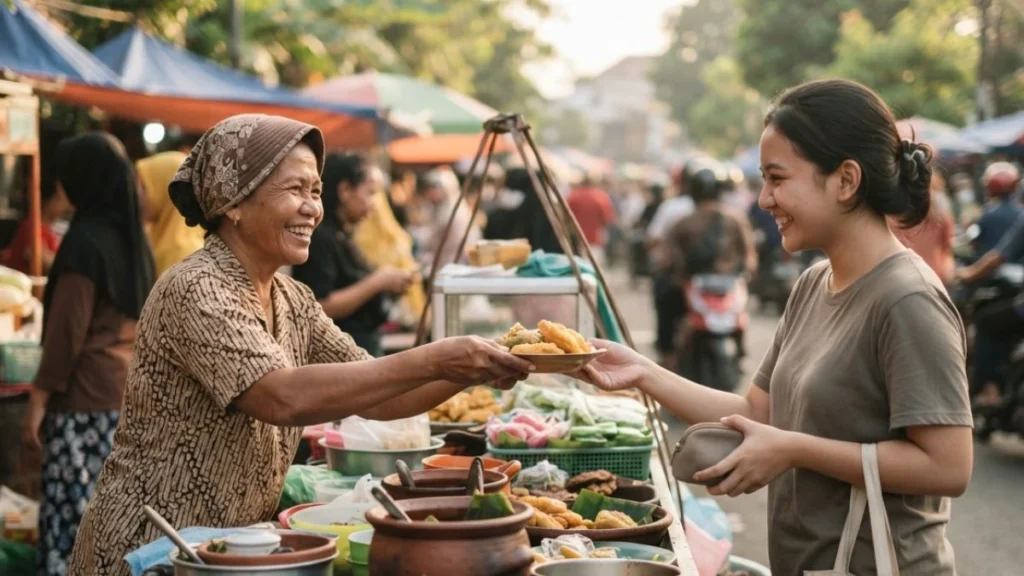
Missed flight, terrible news, an awkward misunderstanding with a stranger — in Indonesia, the response to all three might look remarkably similar: a warm, easy smile. For visitors used to reading facial expressions as a direct window into someone’s mood, this can be genuinely confusing. Understanding why indonesians smile the way they do means learning to read a signal that carries far more meaning than happiness alone. For the wider context, see our Ultimate Guide to Understanding Indonesia.
Indonesians smile constantly and in nearly every situation — not only when happy, but also when nervous, embarrassed, confused, frustrated, or even genuinely upset. Rather than a simple expression of joy, smiling in Indonesia works as a broad social tool. It maintains harmony (rukun), softens tension, and helps people avoid open confrontation or embarrassment. A smile can just as easily mean “everything is fine” as it can mean “I’m holding back something difficult to say” — making it one of the most important, and most easily misread, pieces of Indonesian body language.
Why It Matters
Misreading the Indonesian smile is one of the most common sources of cross-cultural confusion for foreigners living in or visiting Indonesia — mistaking a nervous or uncomfortable smile for genuine agreement, or assuming a smiling colleague isn’t taking a serious problem seriously, can lead to real misunderstandings. Learning to read smiling as one signal among several, rather than a direct translation of internal emotion, is an essential skill for navigating Indonesian social and professional life accurately.
Cultural Context
The Indonesian smile serves several distinct social functions, often overlapping in a single interaction:
- Maintaining harmony (rukun) — smiling helps smooth over tension, disagreement, or discomfort, prioritizing group harmony over openly displaying negative emotion.
- Saving face — smiling through embarrassment, criticism, or a difficult conversation helps both parties avoid the discomfort of an open, unresolved confrontation, closely connected to the values explored in our guide to saving face in Indonesian culture.
- A coping mechanism (sabar) — smiling in frustrating situations, like being cut off in traffic or dealing with a difficult neighbor, reflects a cultural value of patience and emotional restraint rather than visible irritation.
- Softening bad news — smiling or even light laughter while delivering serious or difficult news is a genuine cultural pattern, not a sign that the situation isn’t being taken seriously; showing anger in response to bad news can actually make locals more hesitant to share difficult information in the future.
- Social lubrication with strangers — a smile toward an unfamiliar face, whether a neighbor, a vendor, or a foreign visitor, functions as a low-stakes, universally friendly gesture that keeps everyday interactions pleasant.
Importantly, a smile in Indonesia doesn’t always signal genuine happiness — it can just as easily mask sadness, anxiety, disagreement, or anger, meaning the smile itself is often only the surface layer of a more complex, unspoken message.
Historical Background
The cultural weight placed on smiling and emotional restraint in Indonesia is closely tied to the broader value of halus — a Javanese-origin ideal referring to refined, subtle, and polite behavior — which has spread well beyond Java to influence social norms across much of the country. This connects directly to Indonesia’s strongly collectivist cultural orientation, in which group harmony is prioritized over individual emotional expression, discouraging direct confrontation, public criticism, or visible displays of frustration in favor of smoother, less disruptive social exchanges. Over generations, smiling became one of the most accessible, universally understood tools for maintaining that harmony, since it requires no explicit explanation and can diffuse tension instantly and non-verbally.
Regional Differences
- Javanese culture places especially strong emphasis on halus refinement and emotional restraint, making smiling as an emotional cover particularly pronounced in Javanese social settings.
- Batak communities (North Sumatra) are often noted as more directly expressive by comparison, though still generally polite and socially considerate.
- Bali, sometimes nicknamed a “land of smiles” internationally, has built much of its hospitality-driven tourism reputation around warm, welcoming public friendliness.
- Urban centers like Jakarta, with more cosmopolitan and internationally exposed populations, show somewhat more direct emotional expression in certain contexts, while still broadly retaining the underlying cultural preference for smiling over open confrontation.
Practical Guide
Here’s how to read and respond to Indonesian smiles appropriately:
- Don’t assume a smile always means agreement or happiness. Pay attention to context, tone, and body language alongside the smile itself, especially in serious or sensitive conversations.
- Avoid reacting with visible anger or frustration, even if a smile seems out of place. Responding harshly to a smile during a difficult conversation can make Indonesians more hesitant to share honest or difficult information with you in the future.
- Smile back, even in tense moments. Returning a smile, rather than a stern expression, is generally the more socially appropriate and better-received response in most everyday Indonesian interactions.
- Look for other cues when something feels off. A hesitant smile, a longer pause, or a slight shift in tone often signals discomfort or disagreement hiding beneath a friendly expression.
Common Misunderstandings
“Indonesians aren’t taking a serious situation seriously if they’re smiling.” Smiling during difficult news or serious discussions is a cultural coping and harmony-preserving mechanism, not a sign of indifference or a lack of concern.
“A smile always means someone is happy or in agreement.” A smile can mask a wide range of emotions in Indonesia, including embarrassment, frustration, sadness, or disagreement — it’s rarely a simple, one-to-one signal of positive feeling.
“This behavior is dishonest or fake.” Smiling as emotional management is a genuine, deeply ingrained cultural practice rooted in valuing group harmony over individual emotional display, not an attempt to deceive.
Indonesia’s near-constant smiling reflects a genuinely different cultural relationship with emotional expression — one that prioritizes harmony, patience, and social ease over openly displaying every internal feeling. Understanding this helps outsiders read Indonesian social interactions far more accurately, turning what once looked like a puzzling contradiction into a meaningful, consistent cultural pattern.
For related reading, see Indonesian Indirect Communication and Saving Face in Indonesian Culture, or browse the full Culture pillar.
FAQ
Why do Indonesians smile even when something bad happens?
Smiling functions as a coping mechanism and harmony-preserving tool, helping soften difficult news or frustrating situations rather than openly displaying negative emotion.
Is smiling in Indonesia always genuine?
Not necessarily — a smile can mask a range of emotions, including embarrassment, sadness, or disagreement, in addition to genuine happiness.
How should I respond if someone smiles during a serious conversation?
Avoid reacting with visible frustration or anger; responding calmly and smiling back is generally better received and helps maintain open, honest communication going forward.
Is this smiling behavior the same across all of Indonesia?
The underlying value is nationwide, though it’s especially pronounced in Javanese culture, with slightly more direct emotional expression found in some other regional cultures, like among the Batak.
What Indonesian cultural concept is closely connected to this smiling behavior?
The Javanese-origin concept of halus (refined, subtle, polite behavior) and Indonesia’s broader collectivist emphasis on group harmony are both closely tied to why smiling plays such a central social role.