“Dayak” isn’t the name of one people — it’s an umbrella term covering an estimated 200 to 450 distinct ethnolinguistic groups scattered across the world’s third-largest island. Dayak culture Kalimantan communities call home spans a genuinely staggering range of languages, customs, and traditions, unified less by a single identity than by a shared way of life shaped by Borneo’s rivers and rainforest. For the wider context, see our Ultimate Guide to Understanding Indonesia.
Dayak is a generic term for the non-Muslim indigenous peoples native to the island of Borneo, most of whom traditionally settled along the island’s larger rivers. The word itself is believed to mean “upriver” or “inland,” originally used by Malay and other coastal groups to describe the indigenous populations of Borneo’s interior. Estimates of the number of distinct Dayak sub-groups vary widely, from roughly 200 to as many as 450, spread across Indonesian Kalimantan as well as Malaysian Sarawak and Sabah and Brunei. Despite this diversity, most Dayak groups share core cultural traits: communal longhouse living, animist spiritual roots, and deep, practical reliance on the surrounding rainforest.
Why It Matters
Dayak culture offers a genuinely distinct model of Indonesian identity, organized around river geography and shared ecological life rather than a single language, kingdom, or religion. Understanding it also highlights an ongoing tension in modern Indonesia: many Dayak communities today face real pressure from deforestation, palm oil expansion, and mining, threatening both their ancestral land and the cultural traditions tied directly to it. Recognizing Dayak diversity helps correct the common flattening of “Dayak” into a single, uniform identity.
Cultural Context
Several features define traditional Dayak life across most sub-groups:
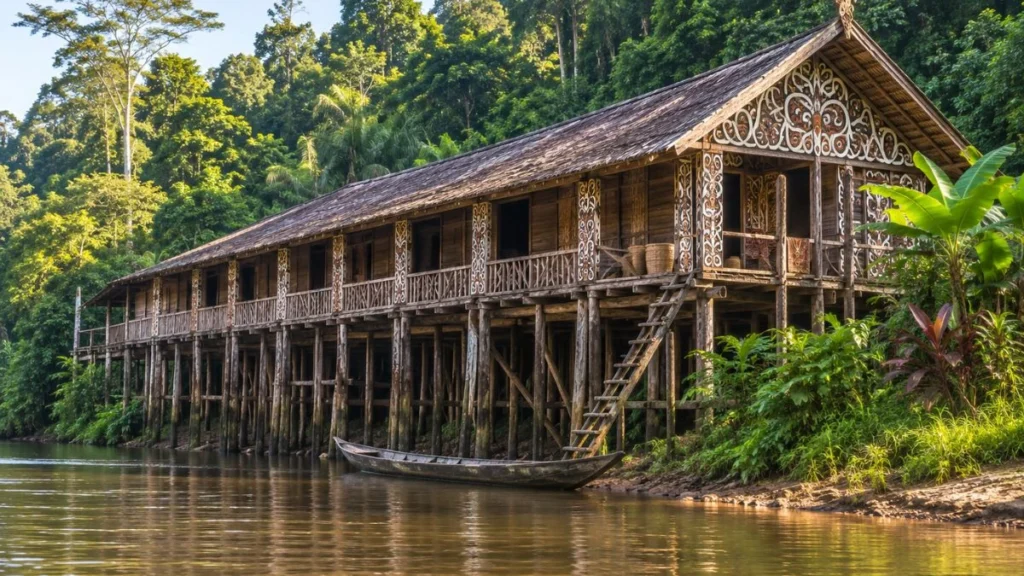
- Longhouses (rumah panjang or rumah betang) — massive communal wooden structures, often built on stilts and ranging from roughly 40 to 440 feet long, housing multiple families from the same group under one roof.
- Kaharingan — a native religious practice historically classified by the Indonesian government as a form of Hinduism for legal recognition purposes, though by Western anthropological standards it would be considered an animist religion built around shamanic ritual.
- Reverence for nature — many Dayak communities believe spirits inhabit forests, rivers, and mountains, a belief system that has historically shaped sustainable agriculture, hunting, and fishing practices passed down for generations.
- Distinctive tattoos — intricate tattooing traditions, particularly among groups like the Kayan and Benuaq, historically marked beauty, bravery, and life milestones, with some communities historically expecting men to earn specific tattoo motifs through achievements like headhunting.
- A historical headhunting tradition — now abandoned, headhunting was traditionally tied to spiritual belief rather than simple warfare, rooted in the idea that an enemy’s head contained soul matter that could be absorbed by the victor.
- River-based naming patterns — many Dayak sub-groups took their specific names from the rivers or areas they settled near, which is part of why so many distinct group names exist across Borneo today.
Historical Background
Dayak peoples are generally believed to have migrated into Borneo as part of the broader Austronesian migration from mainland Asia roughly 3,000 years ago, gradually settling along the island’s major river systems rather than its coasts. Over centuries, groups that migrated to new areas often took on new names tied to local rivers or landmarks, a pattern that helps explain why so many distinct, related Dayak sub-groups exist today despite shared linguistic and cultural roots. Historically, Borneo’s Muslim, coastal Malay and Banjarese populations remained politically and numerically dominant along the coast, while Dayak communities occupied the interior — a geographic and religious divide that shaped the term “Dayak” itself, historically applied specifically to the island’s non-Muslim indigenous peoples.
Headhunting persisted as a genuine warrior tradition among various Dayak groups into the 19th and early 20th centuries, gradually suppressed under Dutch colonial administration and later Indonesian governance. Dayak communities have a long history of seeking greater political recognition and autonomy; in 1953, Dayak leaders sought official recognition of a “Great Dayak territory,” reflecting decades of tension with the coastal Banjarese-dominated political structure in southern Kalimantan. Christian missionary activity, alongside more limited Islamic conversion, gradually reshaped Dayak religious life through the 20th century, though Kaharingan and other animist practices persist today, often alongside a formally adopted world religion.
Regional Differences
Kalimantan’s four (now expanded) provinces host distinct Dayak sub-groups with genuinely different languages and customs:
- West Kalimantan is home to groups including the Kendayan (also called Dayak Kanayatn), numbering roughly 366,000 people, alongside numerous other sub-ethnic communities.
- Central Kalimantan hosts the Ngaju, generally considered the largest and most culturally and politically influential Dayak group on the island.
- East Kalimantan is home to prominent groups including the Kenyah, Kayan, and Bahau peoples, each maintaining distinct languages, customs, and artistic traditions, including the Kayan’s well-known tattoo artistry.
- The Iban, though more associated with Malaysian Sarawak, also have a presence in Indonesian Borneo and are among the most internationally recognized Dayak groups, historically noted for extensive longhouse communities and their past reputation as skilled headhunters.
- Coastal areas throughout Kalimantan remain more closely associated with Muslim Malay and Banjarese populations, reinforcing the traditional interior-versus-coast cultural divide that shaped Dayak identity historically.
Practical Guide
If you’re interested in learning about or visiting Dayak communities respectfully:
- Recognize the enormous diversity behind the single label “Dayak.” Avoid treating it as one uniform culture — ask specifically which sub-group’s traditions you’re encountering, whether Ngaju, Kenyah, Iban, or another.
- Visit a traditional longhouse if given the genuine opportunity. Some communities welcome respectful visitors interested in longhouse life, traditional dance, and craftsmanship, particularly in East and Central Kalimantan.
- Approach animist and Kaharingan practices with respect, not spectacle. These are living spiritual traditions for many Dayak individuals, not simply cultural performances for tourists.
- Understand the real environmental pressures Dayak communities face today. Deforestation, palm oil expansion, and mining directly threaten both ancestral land and cultural continuity, adding important context to any visit or discussion of Dayak life.
Common Misunderstandings
“Dayak refers to a single ethnic group.” Dayak is a generic umbrella term covering an estimated 200 to 450 distinct ethnolinguistic sub-groups across Borneo, sharing broad cultural similarities but not one unified identity, language, or history.
“All Dayak people still practice headhunting.” Headhunting was a historical warrior tradition tied to specific spiritual beliefs, largely suppressed by the early-to-mid 20th century — it is not a practice among Dayak communities today.
“Dayak communities are uniformly animist today.” While Kaharingan and animist beliefs persist in various forms, most Dayak people today identify as Christian, with a smaller number practicing Islam, often blending these faiths with older spiritual traditions tied to the land.
Dayak culture represents one of Indonesia’s most internally diverse regional identities — hundreds of distinct river-based communities sharing longhouse living, spiritual reverence for the rainforest, and a long history of resilience against outside pressure. Understanding this diversity offers a genuinely fuller picture of Kalimantan’s cultural landscape, well beyond any single, flattened idea of what “Dayak” means.
For related reading, see Papua’s Distinct Culture and Identity Explained and Local Spirits and Sacred Places: Animism in Indonesia Today, or browse the full Regional Cultures pillar.
FAQ
What does the word “Dayak” mean?
Dayak is believed to mean “upriver” or “inland,” a generic term originally used by coastal Malay groups to describe Borneo’s indigenous interior peoples.
How many Dayak sub-groups are there?
Estimates vary widely, ranging from roughly 200 to 450 distinct ethnolinguistic Dayak groups across Borneo, depending on the source and classification method used.
What religion do the Dayak practice?
Most Dayak people today are Christian, with a smaller Muslim minority, though many communities maintain ties to Kaharingan or other animist beliefs alongside their formal religion.
Do Dayak people still live in longhouses?
Some communities still maintain traditional longhouse living, though many Dayak individuals today live in smaller, modern dwellings, particularly in more urbanized areas of Kalimantan.
Is headhunting still practiced by Dayak communities?
No — headhunting was a historical warrior tradition tied to specific spiritual beliefs, largely abandoned by the early-to-mid 20th century under colonial and later Indonesian governance.