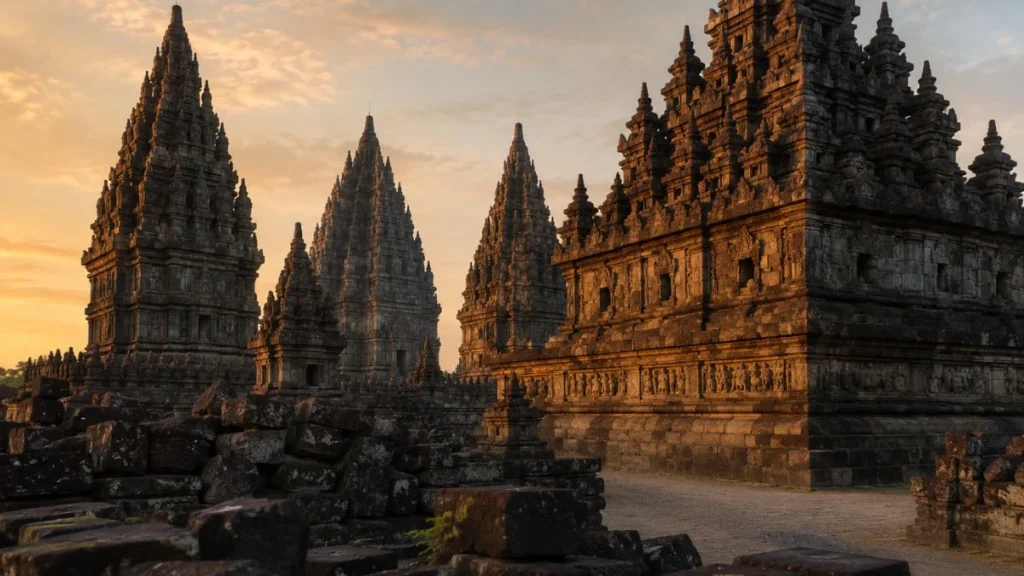
Fifty years after Borobudur rose from the Central Java plains as a monument to Buddhism, a rival dynasty answered with something taller, sharper, and dedicated to an entirely different faith. Prambanan temple history tells a story of religious rivalry carved permanently into stone — and one of Java’s most enduring folk legends grew up around it. For the wider context, see our Ultimate Guide to Understanding Indonesia.
Prambanan is a 9th-century Hindu temple complex located near Yogyakarta in Central Java, widely regarded as the largest Hindu temple complex in Indonesia and one of the largest in Southeast Asia. Inscriptions link its construction to King Rakai Pikatan of the Sanjaya dynasty, built to honor the Hindu Trimurti — Brahma the Creator, Vishnu the Preserver, and Shiva the Destroyer. The central Shiva temple rises 47 meters, slightly taller than Borobudur itself, flanked by the Brahma and Vishnu temples at roughly 33 meters each. Locally, Prambanan is also known as Candi Roro Jonggrang, a name tied to one of Java’s most famous folk legends.
Why It Matters
Prambanan offers a striking counterpoint to Borobudur — two of Indonesia’s most significant ancient monuments, built within decades of each other, representing rival faiths that nonetheless coexisted on the same island. Understanding Prambanan’s history reveals how religious identity, royal politics, and folklore intertwine in Javanese cultural memory, and why the temple remains both a serious archaeological site and a living piece of local storytelling passed down through generations.
Cultural Context
Several elements define Prambanan’s cultural significance beyond its scale:
- Siwagrha — based on the Siwagrha inscription, this was the temple complex’s original name, Sanskrit for “House of Shiva,” confirming its primary dedication to the Hindu god Shiva.
- Mandala cosmology — the complex’s layout follows Hindu cosmological principles, designed to evoke Mount Meru, the mythical mountain home of the gods in Hindu belief.
- 240 temples in total — though many now stand only as ruins, the full complex originally included the three main Trimurti temples alongside numerous smaller shrines arranged in concentric, symbolic order.
- The Roro Jonggrang legend — local folklore holds that a princess named Roro Jonggrang, daughter of the Kingdom of Baka, was pressured into marrying Bandung Bondowoso after he defeated her father in battle. She agreed on the condition that he build a thousand temples in a single night; when he nearly succeeded with supernatural help, she tricked him into believing dawn had arrived early, and in his fury he cursed her into stone — becoming, many believe, the Durga statue that still stands in the Shiva temple’s northern chamber today.
- The “Prambanan curse” — a popular modern belief holds that unmarried couples who visit Prambanan together risk having their relationship break apart, a folk tradition still acknowledged by the site’s management as cultural heritage rather than official warning, even as thousands of couples visit without incident each year.
Historical Background
Archaeologists date Prambanan’s construction to the mid-9th century CE, roughly 50 years after Borobudur, under King Rakai Pikatan of the Sanjaya dynasty. Many historians read the temple’s construction as a deliberate statement: a return of Hindu dynastic power in Java after decades of Buddhist Sailendra dominance, with Prambanan’s height and scale seemingly designed to rival Borobudur itself. Political and religious lines weren’t entirely rigid, however — through a marriage between Rakai Pikatan and princess Pramodawardhani of the Sailendra dynasty, the two ruling houses merged, and the kingdom came to hold both Hinduism and Buddhism as recognized faiths side by side.
Nearby, the Buddhist temple compound of Candi Sewu — built by the same king around the same period — became woven into the Roro Jonggrang legend as the “thousand temples” Bandung Bondowoso supposedly built in one night; in reality, Candi Sewu contains 249 temples, not a literal thousand, and “sewu” itself means “one thousand” in Javanese only as a figure of speech. Archaeological evidence contradicts the legend’s central claim in another way too: Prambanan was built over decades through organized royal labor, not overnight through supernatural means, though the myth’s endurance says as much about Javanese cultural memory as any historical record could. Like Borobudur, Prambanan was eventually abandoned, likely due to political shifts, earthquakes, and volcanic activity, and it wasn’t systematically restored until the 20th century, later receiving UNESCO World Heritage status alongside recognition as one of Southeast Asia’s most significant surviving Hindu monuments.
Regional Differences
- Central Java, specifically the Prambanan Plain near Yogyakarta, remains the temple’s location and the broader region most closely associated with 9th-century Hindu-Buddhist monument building, alongside Borobudur roughly 50 kilometers away.
- The Ratu Boko site, associated with the legendary Kingdom of Baka in the Roro Jonggrang story, sits nearby and adds further archaeological context to the folklore surrounding the temple.
- Candi Sewu, the neighboring Buddhist compound tied into the same legend, illustrates how Hindu and Buddhist sacred sites existed within walking distance of one another in this period, reinforcing the broader pattern of religious coexistence found across Central Java’s ancient monuments.
Practical Guide
If you’re planning to visit Prambanan:
- Visit Borobudur and Prambanan together. Their proximity and roughly 50-year construction gap make for a genuinely illuminating comparison between Java’s Buddhist and Hindu monumental traditions.
- Look for the Durga statue in the Shiva temple’s northern chamber. Many visitors specifically seek this out, given its association with the Roro Jonggrang legend.
- Visit Candi Sewu and Ratu Boko nearby. These sites deepen the context around the legend and offer a fuller picture of the surrounding 9th-century religious landscape.
- Treat the “Prambanan curse” as cultural folklore, not fact. Local guides and temple management acknowledge it as heritage storytelling, not a literal risk to relationships.
Common Misunderstandings
“Roro Jonggrang is documented historical fact.” It’s a folk legend, not verified history — archaeological evidence shows Prambanan was built over decades by organized royal labor, not overnight through supernatural means.
“Prambanan and Borobudur were built by the same religious tradition.” Prambanan is a Hindu temple complex, while Borobudur is Buddhist — built roughly 50 years apart by rival dynasties, reflecting a genuine shift in religious and political power in Central Java.
“Candi Sewu literally contains one thousand temples.” Despite “sewu” meaning “one thousand” in Javanese, the complex actually contains 249 temples — the name functions as a figure of speech tied to the legend, not a literal count.
Prambanan stands as both a serious archaeological monument and a living piece of Javanese storytelling, its stone towers carrying centuries of religious history alongside a folk legend still taught in Indonesian schools today. Understanding both sides — the verified history and the enduring myth — reveals why the temple continues to capture imagination well beyond its role as an ancient religious site.
For related reading, see How Borobudur Was Rediscovered After 800 Years and Majapahit: The Empire That Shaped an Archipelago, or browse the full History & Heritage pillar.
FAQ
When was Prambanan built?
Prambanan was built in the mid-9th century CE, roughly 50 years after Borobudur, under King Rakai Pikatan of the Sanjaya dynasty.
Who is Roro Jonggrang?
Roro Jonggrang is the central figure of a Javanese folk legend, a princess said to have been cursed into stone after tricking a prince who tried to build a thousand temples in one night to win her hand in marriage.
Which Hindu gods does Prambanan honor?
Prambanan honors the Trimurti — Brahma the Creator, Vishnu the Preserver, and Shiva the Destroyer — with the central Shiva temple as the complex’s tallest and most significant structure.
Is the Prambanan curse real?
It’s a folk belief, not a documented risk — temple management and local scholars treat it as cultural heritage and storytelling rather than a factual warning, and many couples visit without any issue.
How does Prambanan compare to Borobudur?
Prambanan is a Hindu temple complex built roughly 50 years after the Buddhist monument of Borobudur, standing slightly taller at 47 meters and reflecting a shift in religious and political power in 9th-century Central Java.