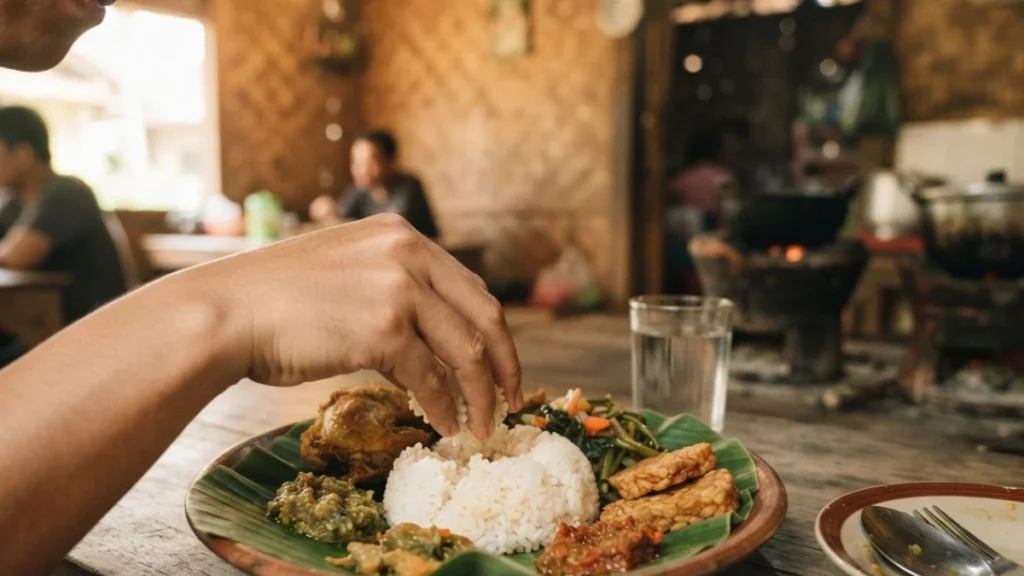
Sit down at a Padang rice stall or a village lesehan in Yogyakarta, and you might notice something: no forks in sight. Just fingers, rice, and sauce, moving with practiced ease. Understanding eating with hands indonesia etiquette requires unlearning a few Western table-manner instincts and picking up a whole new set of rules — ones rooted in cleanliness, respect, and centuries of tradition. For the wider context, see our Ultimate Guide to Understanding Indonesia.
Eating with hands, locally called muluk, is a common and culturally significant way of eating in Indonesia, especially with traditional dishes like nasi padang, ayam goreng (fried chicken), and other rice-based meals. The core etiquette rule is straightforward but essential: always eat and pass food with the right hand. Indonesians traditionally reserve the left hand for personal hygiene, so most consider it unclean and impolite to use for food. Proper technique involves using the fingertips, not the palm, to gently form a small ball of rice before dipping it in sauce and eating — and a bowl of water called a kobokan is typically provided for washing hands before and after the meal.
Why It Matters
Getting this etiquette right matters more than it might seem — using the left hand, even accidentally, can come across as genuinely disrespectful in many Indonesian settings, particularly in more traditional or Muslim-majority communities. For visitors, understanding and correctly practicing this etiquette is also a meaningful way to show respect and connect more authentically with local hosts, who generally appreciate the effort even if a newcomer’s technique isn’t perfect at first.
Cultural Context
Eating with hands in Indonesia carries genuine cultural and even philosophical weight — many Indonesians believe food simply tastes better when eaten directly by hand, seeing it as a closer, more natural connection to what they’re eating. The practice also reflects broader social values found throughout Indonesian dining culture:
- Right-hand-only rule — Rooted in hygiene norms where the left hand is traditionally associated with personal cleaning, making the right hand the only appropriate choice for eating or passing food and receiving it from others.
- Kobokan etiquette — The small bowl of water provided before meals is for washing hands, not drinking — a genuinely common mistake among first-time visitors.
- Fingertip technique — Only the fingertips should touch the food, not the whole palm, forming small, neat portions rather than grabbing food messily.
- Waiting for elders or hosts — In shared or family-style meals, it’s customary to wait until an elder or host gestures or begins eating before serving yourself.
This practice sits within a broader Indonesian dining culture that treats meals as social and relational events — closely connected to values explored in our guide to gotong royong meaning, where communal eating traditions like Minangkabau’s makan bajamba (shared meals from a single large container) reinforce social bonds and mutual respect.
Historical Background
Eating with hands predates the widespread introduction of Western cutlery across Southeast Asia, reflecting an older, region-wide tradition shared with countries like Malaysia, the Philippines, and parts of India, rather than something unique to Indonesia alone. As colonial influence and modernization introduced spoons, forks, and formal Western dining norms — particularly in urban and upscale settings — eating with hands remained the everyday practice in most traditional, rural, and family settings, especially for rice-based meals where the technique developed specifically around forming and dipping rice by hand.
Regional Differences
- Bali and Lombok, being major tourist destinations, more commonly use Western cutlery in restaurants catering to visitors, though hand-eating remains common in local and traditional settings.
- Muslim-majority regions, which make up most of the Indonesian archipelago, generally observe the right-hand rule most strictly, tying it to broader Islamic cultural norms around cleanliness.
- West Sumatra’s Minangkabau culture has its own distinct communal hand-eating tradition, makan bajamba, where a community shares a meal together from one large serving.
- Urban, upscale dining settings across Indonesia typically default to cutlery, with hand-eating reserved for more casual, traditional, or home-style meals.
Practical Guide
Here’s how to eat with your hands respectfully in Indonesia:
- Wash your hands first, always with the kobokan or a sink. This is an essential first step before eating, not optional.
- Use only your right hand. This applies both to eating and to passing or receiving food from others — the left hand should be avoided entirely for these actions.
- Use just your fingertips. Gently form a small ball of rice with your fingers, dip it in sauce if desired, and bring it to your mouth — avoid using your whole palm.
- Don’t worry about looking awkward at first. Indonesians are generally warm and encouraging toward visitors making a genuine effort, even if the technique isn’t perfect right away.
- Ask for cutlery if you’re uncomfortable. Most restaurants, even traditional ones, will happily provide utensils if you prefer — it’s not considered rude to ask.
Common Misunderstandings
“Eating with hands is only done by people without access to cutlery.” It’s a deliberate cultural and even philosophical choice for many Indonesians, believed to enhance the taste and experience of the meal, not simply a practical necessity.
“The kobokan water bowl is for drinking.” It’s specifically for washing hands before and after the meal — a genuinely common and understandable mistake among first-time visitors.
“Using the left hand occasionally isn’t a big deal.” In many traditional and Muslim-majority settings, using the left hand for eating or passing food is considered genuinely impolite, not just a minor faux pas.
Eating with hands in Indonesia is far more than a practical eating method — it’s a tradition carrying real cultural weight, tied to ideas of cleanliness, respect, and connection to food itself. Learning the basic etiquette — right hand only, fingertips not palms, and proper kobokan use — offers visitors a genuine, low-barrier way to engage more deeply with Indonesian dining culture.
For related reading, see What Is Jamu? Indonesia’s Traditional Herbal Drink and What Is Gotong Royong?, or browse the full Food Culture pillar.
FAQ
Why do Indonesians eat with their right hand only?
The left hand is traditionally associated with personal hygiene and considered unclean, making the right hand the only appropriate choice for eating or passing and receiving food.
What is a kobokan?
A kobokan is a small bowl of water provided before and after meals specifically for washing hands — it’s not meant for drinking.
Is it rude to ask for utensils in Indonesia?
No — most restaurants and hosts are happy to provide cutlery if you prefer, and it’s not considered impolite to ask.
What does “muluk” mean?
Muluk is the local Indonesian term for eating with your hands, especially with rice-based dishes.
Which dishes are typically eaten with hands in Indonesia?
Nasi padang, ayam goreng, and many other traditional rice-based dishes are commonly eaten with hands, especially in casual, local, and family-style dining settings.