Long before modern pharmacies existed, Indonesian grandmothers were already grinding turmeric, ginger, and tamarind into golden tonics passed down through generations. Understanding jamu traditional drink benefits offers a window into a genuinely ancient wellness practice — one so culturally significant that UNESCO formally recognized it as a piece of world heritage. For the wider context, see our Ultimate Guide to Understanding Indonesia.
Jamu is a traditional Indonesian herbal medicine and wellness drink made from natural ingredients such as turmeric, ginger, tamarind, galangal, and other roots, spices, and plants. Indonesians have practiced jamu since at least the 8th century. Countless regional variations exist today, each tailored to specific health concerns — from boosting immunity and reducing inflammation to easing digestion and supporting women’s health. In December 2023, UNESCO inscribed “Jamu Wellness Culture” on its Representative List of the Intangible Cultural Heritage of Humanity, recognizing not the drink itself, but the traditional knowledge and skill involved in preparing it.
Why It Matters
Jamu isn’t a niche wellness trend — it’s a living tradition consumed daily by millions of Indonesians, including public figures like former president Joko Widodo, who has spoken about drinking jamu daily for years. Understanding jamu offers insight into how deeply herbal medicine remains woven into everyday Indonesian life, existing alongside, rather than being replaced by, modern healthcare. For visitors, recognizing jamu also opens up an easy, authentic way to engage with local wellness culture, from warung stalls to spa treatments.
Cultural Context
Jamu isn’t a single recipe but a broad family of herbal blends, each associated with specific health purposes:
- Kunyit asam (turmeric and tamarind) — perhaps the most popular variety, associated with anti-inflammatory effects and hormonal support, often consumed by women.
- Beras kencur (rice and lesser galangal) — commonly used for energy and easing muscle fatigue.
- Temulawak (Javanese ginger, a turmeric relative) — associated with liver health and digestion.
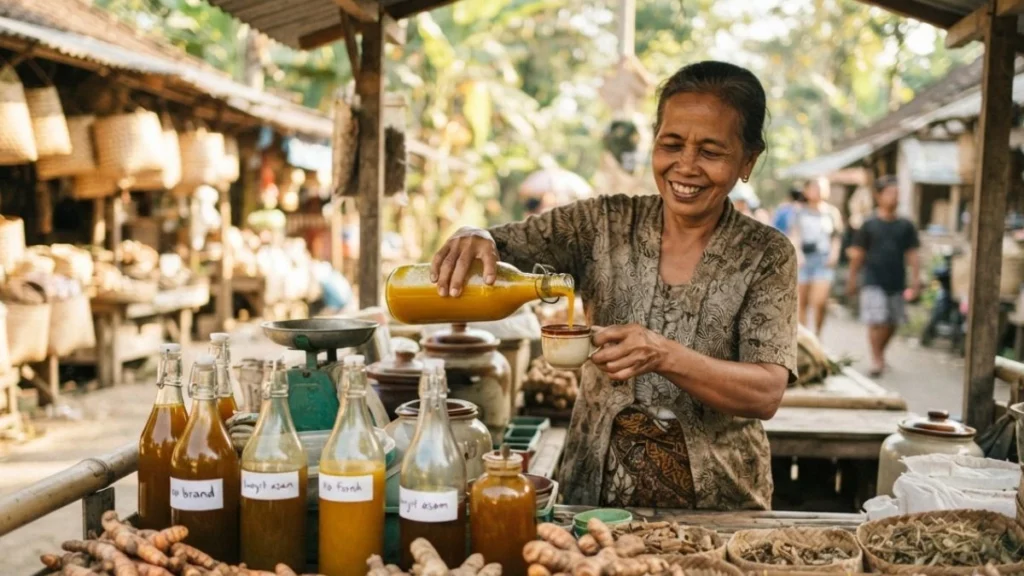
Traditionally, jamu is prepared by jamu gendong sellers — often women who carry bottles of freshly made jamu in woven baskets on their backs, walking through neighborhoods to sell door to door. Recipes are frequently tailored to the individual customer’s age, lifestyle, and specific health concerns, reflecting jamu’s role as a genuinely personalized, relationship-based practice rather than a standardized commercial product.
Historical Background
Jamu’s origins are generally traced to the Mataram Kingdom, a Javanese Hindu-Buddhist kingdom that existed between the 8th and 10th centuries, making the tradition well over a thousand years old. Early jamu recipes are believed to have originated in royal courts, later spreading into wider society and adapted regionally, with each area of Indonesia developing its own distinct ingredients and preparation methods. The practice has traditionally been passed down informally within families and communities — often from mother to daughter — though jamu is now also taught formally in some Indonesian universities.
In December 2023, at the 18th session of the Intergovernmental Committee for the Safeguarding of the Intangible Cultural Heritage held in Kasane, Botswana, UNESCO formally inscribed “Jamu Wellness Culture” onto its Representative List of the Intangible Cultural Heritage of Humanity. This made jamu the thirteenth Indonesian tradition to receive UNESCO Intangible Cultural Heritage recognition, following earlier inscriptions including wayang (2008), batik (2009), angklung (2010), and gamelan (2021). Notably, UNESCO’s recognition specifically honors the traditional skill and knowledge of preparing jamu, not the drink or any single recipe as a product.
Regional Differences
- Central Java, particularly around the historical Mataram region, is widely regarded as jamu’s cultural heartland, with deep royal-court associations.
- Bali has developed its own jamu traditions closely tied to Balinese healing practices, often paired with related treatments like boreh (a traditional herbal body scrub).
- Other regions across Indonesia have developed local variations using regionally available roots, spices, and plants, meaning jamu recipes can differ meaningfully from one part of the archipelago to another, even while sharing the same core wellness philosophy.
Practical Guide
If you want to try jamu as a visitor:
- Look for jamu gendong sellers or local warungs. Freshly made jamu is widely available in markets and from traditional street vendors, especially in Java and Bali.
- Start with kunyit asam or beras kencur. These are among the most accessible and mild-tasting varieties for first-time drinkers.
- Ask about ingredients if you have health conditions or allergies. Since jamu is often customized, checking specific ingredients is a reasonable precaution, particularly for pregnant or breastfeeding visitors.
- Treat it as a wellness tradition, not a quick fix. Jamu is generally consumed regularly as part of an ongoing wellness routine, rather than as a one-time remedy.
Common Misunderstandings
“Jamu is just a modern wellness trend.” Jamu has been practiced in Indonesia for well over a thousand years, tracing back to at least the Mataram Kingdom — its recent popularity outside Indonesia reflects rediscovery, not invention.
“There’s only one jamu recipe.” Jamu is a broad family of herbal blends with countless regional and personalized variations, each associated with different health purposes.
“UNESCO recognized jamu as a specific product or brand.” UNESCO’s recognition specifically honors the traditional knowledge, skill, and cultural practice of preparing jamu — not any single recipe, company, or commercial product.
Jamu represents a genuinely ancient, still-thriving wellness tradition — one now recognized on the world stage as an irreplaceable piece of Indonesian cultural heritage. Whether encountered from a street vendor’s basket or a modern wellness cafe, jamu offers a direct link to over a thousand years of Indonesian herbal knowledge passed down largely through family and community.
For related reading, see Why Sambal Is More Than Just “Spicy” and What Is Gotong Royong?, or browse the full Food Culture pillar.
FAQ
What is jamu made from?
Jamu is made from natural ingredients including turmeric, ginger, tamarind, galangal, and various other roots, spices, and plants, depending on the specific recipe and its intended health purpose.
How old is the jamu tradition?
Jamu is generally traced back to the Mataram Kingdom, a Javanese Hindu-Buddhist kingdom from the 8th to 10th centuries, making it well over a thousand years old.
Did UNESCO officially recognize jamu?
Yes — in December 2023, UNESCO inscribed “Jamu Wellness Culture” on its Representative List of the Intangible Cultural Heritage of Humanity, recognizing the traditional knowledge and skill behind its preparation.
What is the most popular type of jamu?
Kunyit asam (turmeric and tamarind) is among the most popular and widely consumed varieties, often associated with anti-inflammatory and hormonal benefits.
Is jamu safe for everyone to drink?
Most jamu is made from natural food ingredients and widely consumed, but those who are pregnant, breastfeeding, or managing specific health conditions should check ingredients or consult a doctor before regular use.