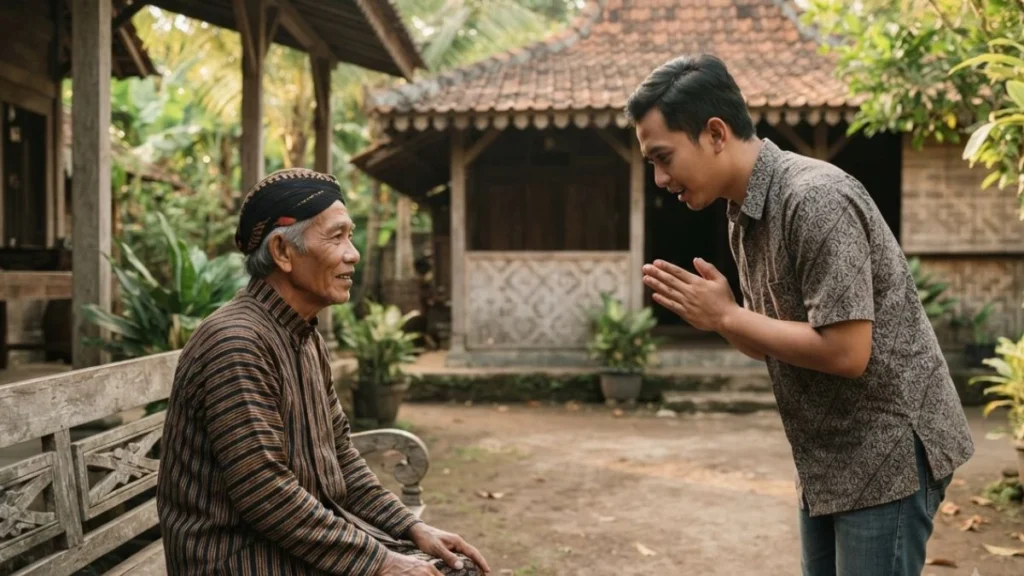
Many visitors assume Bahasa Indonesia and Javanese are the same thing — after all, Java is Indonesia’s most populous island, and Jakarta sits right on it. In reality, comparing javanese vs bahasa indonesia reveals two genuinely distinct languages, one of which comes with a level of social complexity that Indonesian was specifically designed to avoid. For the wider context, see our Ultimate Guide to Understanding Indonesia.
Javanese and Bahasa Indonesia are two separate languages, both belonging to the Austronesian language family, but structurally and socially quite different. Bahasa Indonesia is Indonesia’s standardized national language, based on Malay, used in government, education, and media nationwide, with relatively simple grammar and no built-in system of speech levels. Javanese is a regional language, native to Central and East Java, spoken by more than 80 million people as a first language. Unlike Indonesian, it runs on a complex system of speech levels (ngoko, madya, and krama) that shifts vocabulary and formality depending on the social relationship between speakers.
Why It Matters
Understanding this distinction matters because it’s easy to assume Indonesia has one dominant “local” language when in fact it has hundreds — and Javanese, despite being spoken by tens of millions of people, is not the same as the national language most visitors will actually use and hear. It also reveals something important about Indonesian identity: choosing a language with simpler social rules as the national standard was itself a deliberate, unifying choice, discussed further in our guide to Indonesian local languages.
Cultural Context
The defining feature that separates Javanese from Bahasa Indonesia is its speech level system, technically known as undha-usuk. Javanese speakers select vocabulary — and sometimes grammar — based on the age, social status, and familiarity of the person they’re speaking to:
- Ngoko — the informal, everyday level, used among close friends, family, and people of equal or lower status. It’s the first form of Javanese most children learn at home.
- Madya — a middle level used in situations where full formality isn’t required but familiarity isn’t appropriate either, such as between strangers who want to be neither too casual nor too stiff.
- Krama — the formal, respectful level, used when speaking to elders, strangers of higher status, or in official and public settings. Krama can include specialized honorific vocabulary, sometimes called krama inggil, reserved for the highest level of respect.
Crucially, these levels aren’t just about tone — they often involve entirely different vocabulary for the same concept. A single sentence in Javanese can be expressed in several different ways depending on the speech level required, something that has no real equivalent in standard Bahasa Indonesia, where politeness is generally conveyed through word choice and tone rather than a fundamentally different vocabulary set.
Bahasa Indonesia, by contrast, was intentionally built to avoid this complexity. As Indonesia’s designated national language, it uses relatively straightforward grammar and a single register for most everyday communication, making it dramatically more accessible to learn — both for Indonesians from different ethnic backgrounds and for foreign learners.
Historical Background
Javanese developed independently over many centuries on Java, absorbing significant influence from Sanskrit during the island’s early Hindu-Buddhist kingdoms, and later from Arabic following the spread of Islam in the 15th century, with Dutch loanwords entering during the colonial period as well. Its speech level system is closely tied to the hierarchical social structures of traditional Javanese society, particularly the priyayi (aristocratic and official) class, for whom precise linguistic register was a marker of proper upbringing and social standing.
Bahasa Indonesia, by contrast, was deliberately standardized from Malay and adopted as the national language at independence in 1945 — chosen specifically because it lacked ties to any single ethnic group’s social hierarchy, including Java’s own. This made it a politically neutral, more egalitarian choice for uniting a nation with hundreds of distinct languages and social systems, even though Javanese speakers actually outnumbered Malay speakers at the time.
Regional Differences
Javanese itself isn’t fully uniform — it has multiple regional and social varieties:
- Standard Javanese, centered on the courtly traditions of Yogyakarta and Surakarta (Solo), preserves the most complete and traditionally rigorous speech level system.
- Banyumasan (spoken around Purwokerto) is considered more conservative, retaining older vocabulary including more Sanskrit-derived words, and is generally less formal in daily use of speech levels.
- Coastal dialects, such as those in Indramayu and Cirebon in West Java, use a simplified two-level system (bagongan and bebasan, roughly corresponding to ngoko and krama) rather than the full standard system.
Bahasa Indonesia, by contrast, remains largely consistent nationwide as the standardized language, with regional accents and some local vocabulary influence, but without regional grammar variants of the kind seen across Javanese dialects.
Practical Guide
If you’re navigating both languages:
- You don’t need Javanese to travel or work in Indonesia. Bahasa Indonesia is universally understood and is the practical language for nearly all visitor interactions, even in Java.
- Don’t assume a Javanese phrase works the same way twice. The same idea can require different vocabulary depending on who you’re speaking to — a complexity best left to fluent speakers or careful study, not casual use.
- Use Bahasa Indonesia as your default, even in Java. Javanese speakers will readily switch to Indonesian with visitors, and using Indonesian avoids the real risk of unintentionally using the wrong, socially inappropriate speech level.
- If learning some Javanese, start with ngoko. It’s the informal register most learning resources begin with, appropriate for casual, low-stakes interactions with peers.
Common Misunderstandings
“Javanese is just a dialect of Indonesian.” They’re separate languages with different grammar, vocabulary, and — critically — an entirely different social speech-level system that Indonesian doesn’t have.
“Since Java has the most people, Javanese should be the national language.” Malay/Indonesian was deliberately chosen instead, specifically because it wasn’t tied to Java’s own social hierarchy, making it a more neutral unifying choice despite Javanese having more native speakers at the time.
“All Javanese speakers use the full three-level system fluently and constantly.” Many younger, urban Javanese speakers use simplified or blended forms of ngoko and krama in daily life, and full mastery of the traditional levels, especially krama inggil, is increasingly concentrated among older or more traditionally educated speakers.
Javanese and Bahasa Indonesia are two genuinely different languages serving different purposes — one deeply tied to centuries of regional hierarchy and social nuance, the other deliberately built for simplicity and national unity. Understanding the difference reveals just how much linguistic complexity sits beneath Indonesia’s shared national language.
For related reading, see Indonesian Local Languages: How Many Are There, Really? and Terserah Meaning: Indonesia’s Most Loaded “Whatever”, or browse the full Language & Expressions pillar.
FAQ
Is Javanese a dialect of Bahasa Indonesia?
No — Javanese and Bahasa Indonesia are separate languages, both part of the Austronesian family, but with distinct grammar, vocabulary, and social structures.
What are the main speech levels in Javanese?
The three main levels are ngoko (informal), madya (middle/neutral), and krama (formal/polite), each using different vocabulary depending on the relationship between speakers.
Does Bahasa Indonesia have speech levels like Javanese?
No — Bahasa Indonesia generally uses a single register for everyday communication, expressing politeness through word choice and tone rather than an entirely different vocabulary system.
Why wasn’t Javanese chosen as Indonesia’s national language, since it has the most speakers?
Malay-based Indonesian was chosen specifically because it wasn’t tied to any single ethnic group’s social hierarchy, making it a more neutral and unifying choice for a linguistically diverse new nation.
Do I need to learn Javanese to travel in Java?
No — Bahasa Indonesia is universally understood throughout Java and the rest of Indonesia, making it the practical language of choice for travelers.