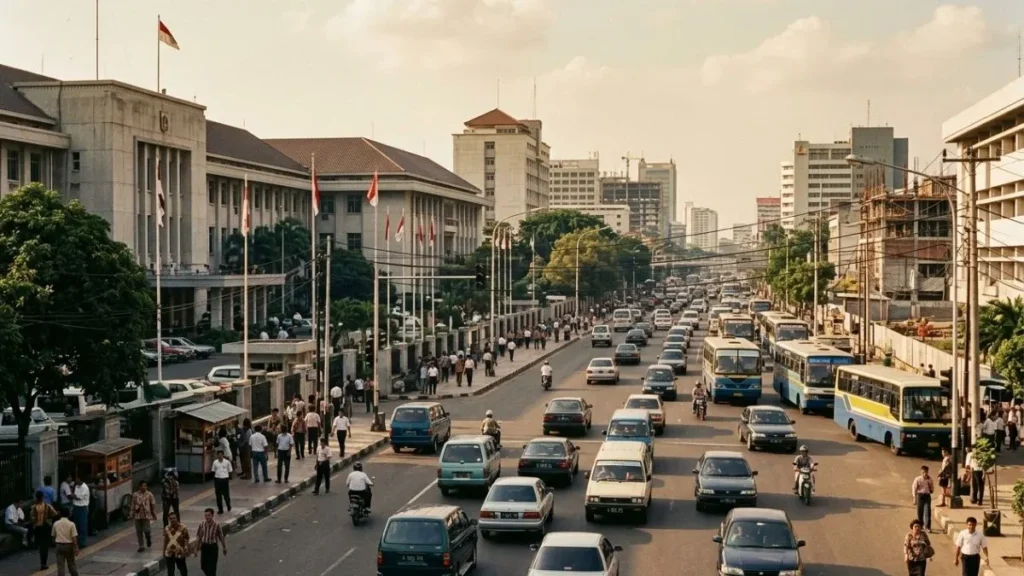
Suharto’s New Order (Orde Baru) was Indonesia’s authoritarian government from 1966 to 1998, following the violent collapse of Sukarno’s “Old Order.” Suharto centralized power through the military, banned the Communist Party after mass killings estimated at 500,000 to over a million people, and ruled for 32 years. The regime delivered major economic growth — GDP grew roughly 7% annually from 1967 to 1997 — while suppressing civil liberties, until the 1997 Asian financial crisis triggered mass protests and Suharto’s resignation on 21 May 1998.
Sukarno declared Indonesian independence and led its founding years — but the man who governed the country for nearly a third of a century afterward built a fundamentally different Indonesia, one shaped as much by rapid development as by documented repression. For the wider context, see our Ultimate Guide to Understanding Indonesia.
What Was the New Order?
The New Order (Orde Baru) refers to the government of Indonesia’s second president, Suharto, from his rise to power in 1966 until his resignation in 1998. It succeeded Sukarno’s “Old Order” and “Guided Democracy” period amid economic chaos, hyperinflation exceeding 600% annually, and the fallout from a failed coup attempt in 1965. Suharto’s government centralized authority through the military, banned the Indonesian Communist Party (PKI), and positioned itself explicitly as a stabilizing, development-focused alternative to what it characterized as Sukarno-era disorder.
How Did Suharto Come to Power?
Following an attempted coup on 30 September 1965 — blamed on the PKI — General Suharto, then commander of the army’s strategic reserve (Kostrad), led a military counter-mobilization. What followed was one of the darkest chapters in modern Indonesian history: mass killings of suspected communists and sympathizers, with historians’ estimates commonly ranging from 500,000 to over a million deaths. On 11 March 1966, amid continuing chaos, Suharto pressured President Sukarno into signing the Supersemar decree, transferring broad executive authority to Suharto. He was formally named acting president in 1967 and inaugurated as Indonesia’s second president in 1968, having effectively sidelined Sukarno entirely.
What Did the New Order Actually Achieve?
The regime’s economic record is genuinely significant by most measures. Facing hyperinflation exceeding 650% annually at the outset, Suharto’s government pursued orthodox stabilization — currency devaluation, subsidy cuts, and strict budget discipline — that brought inflation down to roughly 10% by 1969. Over the following decades:
- GDP grew at an average of roughly 7% annually from 1967 to 1997, among the fastest sustained growth rates in the developing world at the time.
- Absolute poverty fell dramatically, from an estimated 40% of the population in 1976 to roughly 11% by 1996.
- The Green Revolution modernized agriculture, with Western-educated technocrats advising policy and driving major gains in food production and industrialization.
- Foreign investment expanded significantly, integrating Indonesia more deeply into global trade and manufacturing networks.
What Did the New Order Cost?
Alongside this development record, the New Order maintained power through documented authoritarian methods that drew sustained domestic and international criticism:
- One-party political dominance — the regime concentrated political power under the Golkar party, curtailing genuine multi-party competition for over three decades.
- Suppressed civil liberties — press censorship, restricted political expression, and limits on organized dissent were consistent features of New Order governance.
- The 1975 invasion of East Timor, followed by a prolonged occupation associated with mass civilian deaths, remains one of the most heavily documented and criticized episodes of the era.
- Extrajudicial violence at home — including the Petrus (“mysterious shootings”) killings targeting alleged criminals in the 1980s and the 1984 Tanjung Priok massacre — reflected a broader pattern of state violence used to maintain control.
- Ongoing insurgency in Aceh, tied partly to grievances over autonomy and resource distribution, simmered throughout much of the New Order period.
Why Did the New Order Fall?
The 1997 Asian financial crisis hit Indonesia especially hard, exposing structural weaknesses — including extensive nepotism and cronyism within Suharto’s family and inner circle — that the regime’s development narrative had long obscured. Economic collapse fueled mass student-led protests and deadly riots across Jakarta and other cities in 1998. Facing overwhelming domestic pressure and eroding military support, Suharto resigned on 21 May 1998, ending 32 years of New Order rule and opening Indonesia’s Reformasi (Reform) era — a period marked by greater press freedom, democratic reform, and, eventually, direct presidential elections.
New Order vs. Reformasi: What Changed
| Feature | New Order (1966–1998) | Reformasi Era (1998–present) |
|---|---|---|
| Political system | One-party dominance (Golkar), limited competition | Multi-party democracy, direct elections |
| Press freedom | Heavy censorship | Substantially expanded freedom of speech |
| Military role | Central to governance (“dual function”) | Formally reduced political role |
| Regional autonomy | Centralized control | Expanded special autonomy (e.g., Aceh, Papua) |
| Presidential term limits | None in practice (32-year rule) | Constitutionally limited to two terms |
FAQ
What does “New Order” (Orde Baru) mean in Indonesian history?
It refers to Suharto’s government from 1966 to 1998, positioned as a stabilizing, development-focused break from Sukarno’s earlier “Old Order” and “Guided Democracy” period.
How long did Suharto rule Indonesia?
Suharto governed for approximately 32 years, from his rise to power in 1966 and formal presidency from 1967/1968 until his resignation on 21 May 1998.
What caused the New Order to collapse?
The 1997 Asian financial crisis exposed deep economic vulnerabilities and long-standing cronyism, triggering mass protests and riots that ultimately forced Suharto’s resignation in May 1998.
Did the New Order improve Indonesia’s economy?
Yes, by most standard measures — GDP grew roughly 7% annually from 1967 to 1997, and absolute poverty fell from about 40% in 1976 to roughly 11% by 1996, though this came alongside significant authoritarian control and documented human rights abuses.
What is Reformasi?
Reformasi refers to Indonesia’s post-Suharto reform era, beginning with his resignation in May 1998, characterized by greater political openness, press freedom, and democratic institution-building.
Conclusion
Suharto’s New Order left Indonesia with a genuinely dual legacy — three decades of substantial economic growth and poverty reduction, achieved through and alongside sustained authoritarian control, censorship, and documented state violence. Understanding both sides of that record, rather than either alone, offers the most accurate picture of how modern Indonesia’s political and economic institutions actually took shape.
For related reading, see Sukarno and the Fight for Indonesian Independence and The Dutch Colonial Legacy in Indonesia Explained, or browse the full History & Heritage pillar.