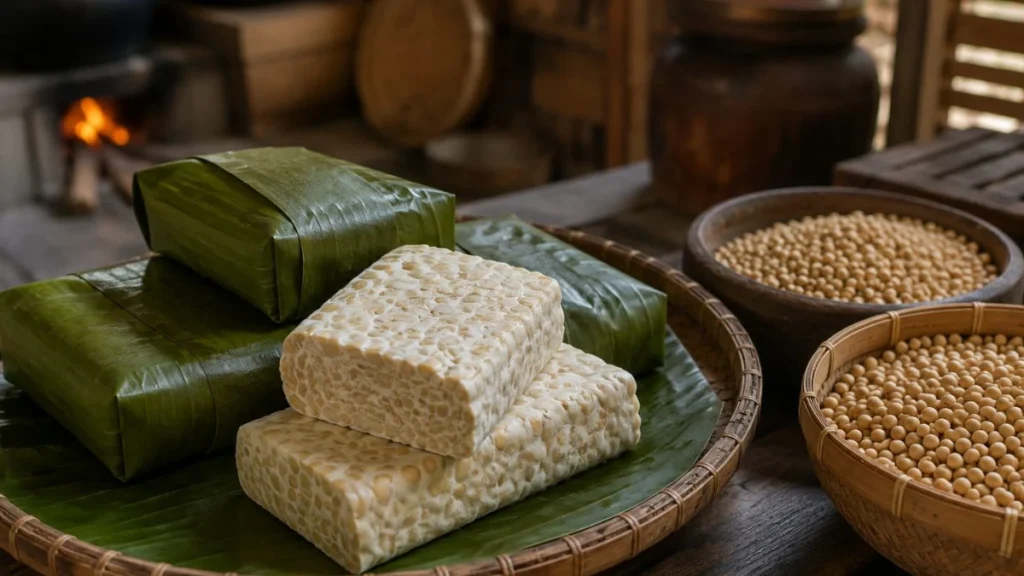
Long before “plant-based protein” became a marketing phrase in Western supermarkets, Javanese households had already perfected a fermented soybean cake that outshines every other soy product from China or Japan in one specific way: it isn’t from either of them. Tempeh origin indonesia traces back not to a food conglomerate or a modern health trend, but to ordinary households in Central Java centuries ago. For the wider context, see our Ultimate Guide to Understanding Indonesia.
Tempeh, also spelled tempe, is a traditional Indonesian food made from fermented soybeans, bound into a firm cake through a natural culturing process using the fungus Rhizopus oligosporus or Rhizopus oryzae. Unlike tofu, which uses only the extracted soy liquid, tempeh ferments the whole soybean, giving it a firmer texture, an earthy flavor, and notably higher protein, fiber, and vitamin content. Historical evidence points to Bayat, Klaten, in Central Java as tempeh’s birthplace, with the food commonly consumed there by around 1700 — making it, by most accounts, the only traditional soy-based food that didn’t originate in China or Japan.
Why It Matters
Tempeh’s story matters because it upends a common assumption: that all traditional soy foods trace back to China or Japan. Understanding its distinct Javanese origin helps explain why tempeh’s name, preparation method, and cultural role differ so clearly from tofu, tempeh’s more internationally recognized soy cousin. It also highlights how a humble, accidental discovery in household kitchens became one of the world’s most nutritionally efficient plant proteins, now embraced far beyond Indonesia.
Cultural Context
Tempeh occupies a distinctive place in Javanese food culture:
- An everyday protein staple — tempeh has long served as an affordable, accessible source of protein for Indonesian households, especially in Java, rather than a specialty or luxury food.
- A ceremonial presence — tempeh regularly appears at Javanese cultural and religious ceremonies, reflecting its deep integration into daily and communal life, not just casual meals.
- Regional variations beyond soybean — some areas use different base ingredients entirely; tempe bongkrek, made from coconut presscake, and tempe benguk, made from velvet bean (koro benguk) in the Wates, Kulon Progo region of Yogyakarta, show how the fermentation technique adapted to locally available ingredients.
- A distinct naming origin — unlike other Indonesian soy product names, which typically derive from Chinese-language roots, the word “tempe” does not come from Chinese. One theory traces it instead to the Old Javanese word tumpi, a whitish fried batter food resembling rempeyek.
Historical Background
The earliest solid documentation of tempeh appears in the Serat Centhini, an Old Javanese manuscript published in the 16th century, indicating that Javanese communities were already producing and consuming tempeh by that time. Food historians generally place its origin in Bayat, Klaten, Central Java, with widespread consumption there by around 1700. The discovery itself appears to have been accidental: Javanese people traditionally wrapped food in teak or sea hibiscus leaves, both of which naturally carry the fungus crucial to tempeh’s fermentation, and cooked soybeans left in these leaf wrappings in Indonesia’s warm, humid climate would have fermented on their own.
Scholars debate whether the technique arrived independently or built on an existing method. One theory suggests Chinese traders introduced a related process — soybean koji, made using Aspergillus mold for soy sauce production — which Javanese communities later adapted, substituting Rhizopus mold, likely because it suited the local climate better. A food historian at Gadjah Mada University has instead argued that native Javanese people developed tempeh independently, with its preparation predating the introduction of Chinese-style tofu products in the archipelago altogether.
European awareness of tempeh came much later. The earliest known European reference appeared in 1875, in a Javanese-Dutch dictionary compiled by J.F.C. Gericke and T. Roorda, which defined tempeh as fermented soybeans or presscake baked or fried into flat cakes. The spelling “tempeh” itself first appeared in an 1896 German article, though “tempe” remained standard in Indonesian usage. Ironically, despite Indonesia’s long tradition of written documents, no known record of tempeh’s origin exists in the native Indonesian language before the 1950s — its early documented history comes almost entirely from Dutch colonial-era sources. Tempeh’s international spread accelerated through the 20th century, including a notable episode during the 1940s when tempeh production in New Guinea was revived using starter cultures sent from Suriname, helping preserve the tradition during a period when local supplies had been lost.
Regional Differences
- Central Java, particularly around Bayat, Klaten, holds the strongest historical claim as tempeh’s birthplace and remains deeply associated with traditional production methods.
- Java as a whole remains the region where tempeh is most widely produced and consumed, though it has since spread across virtually all of Indonesia’s more than 17,000 islands.
- Yogyakarta’s Wates, Kulon Progo area produces the distinctive velvet-bean variant, tempe benguk, adapted to local agricultural conditions rather than relying on soybeans.
- Indonesian diaspora communities abroad, including in Suriname, historically carried tempeh-making traditions with them, helping the food take root internationally well before it became a mainstream health-food product in the West.
Practical Guide
If you want to try or cook with tempeh authentically:
- Try tempe goreng (fried tempeh) as an entry point. It’s widely considered the most popular and approachable way to experience tempeh’s flavor and texture.
- Pair it with rice and vegetables, as Indonesians traditionally do. Tempeh is typically eaten as part of a balanced meal, not as an isolated ingredient.
- Look for regional variants if available. Tempe bongkrek and tempe benguk offer a genuinely different experience from standard soybean tempeh, reflecting local ingredient adaptation.
- Don’t confuse tempeh with tofu. Despite both being soy products, tempeh uses the whole fermented bean and has a firmer texture and more pronounced flavor than tofu’s smoother, milder profile.
Common Misunderstandings
“Tempeh originated in China or Japan, like most soy foods.” Tempeh stands out specifically because it’s widely considered the only traditional soy-based food that did not originate in China or Japan — its roots trace to Central Java, Indonesia.
“Tempeh and tofu are basically the same thing.” Tempeh ferments the whole soybean into a firm cake, while tofu uses only extracted soy liquid — resulting in meaningfully different texture, flavor, and nutritional profiles.
“Tempeh is a recent health-food invention.” Documentation places tempeh’s consumption in Central Java as far back as the 16th and 17th centuries, making it a centuries-old traditional food rather than a modern creation.
Tempeh’s journey from an accidental discovery in Javanese kitchens to a globally recognized protein source reflects centuries of quiet culinary innovation, adapted household by household long before anyone thought to write it down. Understanding its true Indonesian origin adds real depth to a food many people outside Indonesia now eat without knowing where it truly began.
For related reading, see Rendang, Nasi Goreng, and Satay Explained and Why Sambal Is More Than Just “Spicy”, or browse the full Food Culture pillar.
FAQ
Where did tempeh originally come from?
Tempeh originated in Central Java, Indonesia, with historical evidence pointing to Bayat, Klaten, as its birthplace and widespread consumption there by around 1700.
Is tempeh the same as tofu?
No — tempeh ferments the whole soybean into a firm cake, giving it a firmer texture and higher protein and fiber content, while tofu uses only extracted soy liquid.
How old is tempeh?
Documented references place tempeh’s production in Java as far back as the 16th century, based on the Old Javanese manuscript Serat Centhini, with some historians suggesting even older origins.
What gives tempeh its firm texture?
Tempeh’s texture comes from a natural fermentation process using the fungus Rhizopus oligosporus or Rhizopus oryzae, which binds the soybeans into a solid cake.
Are there variations of tempeh beyond soybeans?
Yes — regional variants like tempe bongkrek (coconut presscake) and tempe benguk (velvet bean) show how the fermentation technique adapted to different local ingredients across Indonesia.