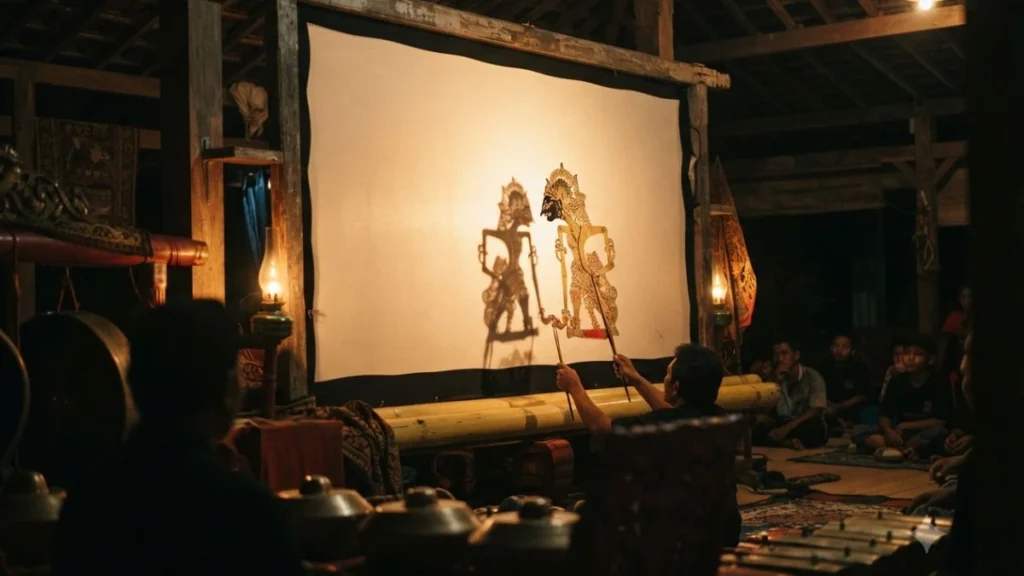
A single performer sits behind a glowing screen for hours, giving voice to dozens of characters, cueing a full orchestra, and casting flickering shadows that have captivated Indonesian audiences for centuries. Understanding the wayang kulit meaning behind this tradition opens up one of the richest performing art forms in the world — one recognized by UNESCO as a masterpiece of human heritage. For the wider context, see our Ultimate Guide to Understanding Indonesia.
Wayang kulit is a traditional Indonesian shadow puppet theatre. Puppeteers move flat, intricately carved leather puppets behind a backlit translucent screen, casting moving shadows that audiences watch from either side. The word wayang means “shadow” or “imagination” in Javanese, while kulit means “skin” or “leather,” referring to the material the puppets are carved from. A single master puppeteer, the dalang, manipulates the puppets, voices every character, and directs the accompanying gamelan orchestra — often across an entire performance lasting from evening until dawn.
Why It Matters
Wayang kulit isn’t just entertainment — it’s historically served as a vehicle for moral teaching, spiritual reflection, political commentary, and communal gathering. Understanding it offers real insight into how Indonesian, and particularly Javanese, culture has long used storytelling to explore themes of good versus evil, duty, and fate. For visitors, catching even part of a performance offers a rare glimpse into a tradition that has remained culturally central for roughly a thousand years.
Cultural Context
A typical wayang kulit performance draws its stories primarily from the Hindu epics Mahabharata and Ramayana, alongside local legends adapted over centuries to reflect Javanese values and worldview. Characters representing good are traditionally positioned on the right side of the screen, while those representing evil appear on the left — a staging convention that reinforces the central moral tension running through most performances.
The dalang sits at the heart of the performance: narrating, voicing dialogue in multiple registers and languages, cueing the gamelan orchestra (typically 20 to 40 musicians playing bronze instruments, gongs, and metallophones), and often weaving in contemporary humor or social commentary alongside the traditional narrative. A respected dalang can command large fees and perform in front of audiences numbering in the thousands, making the role something close to a cultural celebrity.
Historical Background
Wayang kulit’s origins are genuinely debated among scholars. One widely cited theory traces its roots to South Indian leather puppet traditions that spread to Java through trade and cultural exchange alongside Hinduism, likely arriving from around the first century CE onward, with wayang kulit as it’s recognized today taking shape by roughly the 10th–11th century. Other accounts suggest indigenous Javanese storytelling and ritual traditions existed independently and were later blended with imported Hindu epics rather than simply imported wholesale.
For roughly ten centuries, wayang flourished both in the royal courts of Java and Bali and in rural village life, evolving distinct regional and stylistic variations along the way. In November 2003, UNESCO recognized wayang theatre — including wayang kulit — as a Masterpiece of the Oral and Intangible Heritage of Humanity, later folded into UNESCO’s broader Representative List of the Intangible Cultural Heritage of Humanity, with Indonesia formally committed to preserving the tradition as part of that recognition.
Regional Differences
- Central and East Java are considered the heartland of classical wayang kulit, closely associated with royal court traditions and refined Javanese performance style.
- Bali has its own distinct wayang kulit tradition, accompanied by different gamelan ensembles (gender wayang) and performance conventions from Java’s version.
- West Java is better known for wayang golek, a related but visually distinct three-dimensional wooden rod-puppet tradition performed in Sundanese, rather than the flat leather shadow puppets of wayang kulit.
- Other islands, including Lombok, Madura, Sumatra, and Borneo, have developed their own local wayang performance styles and musical accompaniments over time.
Practical Guide
If you want to experience wayang kulit as a visitor:
- Look for cultural centers and museums. Cities like Yogyakarta and Surakarta (Solo) in Java regularly host wayang performances, and museums such as Jakarta’s Wayang Museum showcase the puppets and history even outside performance times.
- Expect long performances, but you don’t have to stay all night. Traditional performances can run from evening until dawn — tourist-oriented shows are often shortened to a more manageable one to two hours.
- Watch from either side of the screen. Traditionally, audiences can view the performance from the shadow side or the puppeteer’s side, each offering a different experience.
- Pay attention to the gamelan, not just the puppets. The musical accompaniment is a core part of the art form, not just background — many dalang are also skilled musicians and singers in their own right.
Common Misunderstandings
“Wayang kulit is just a puppet show for children.” While accessible and entertaining, traditional performances are deeply layered with philosophical, spiritual, and social commentary aimed primarily at adult audiences, even though children are welcome.
“All wayang traditions are the same as wayang kulit.” Wayang is a broad category covering several distinct forms — including wayang golek (wooden rod puppets), wayang klitik (flat wooden puppets), and wayang wong (dance-drama with human performers) — with wayang kulit specifically referring to the leather shadow puppet tradition.
“The dalang only manipulates the puppets.” The dalang is simultaneously puppeteer, narrator, voice actor for every character, and musical director for the gamelan — arguably one of the most demanding solo performance roles in traditional theatre worldwide.
Wayang kulit is far more than shadow play — it’s a centuries-old fusion of visual art, music, literature, and moral storytelling that continues to hold cultural weight in Indonesia today. Recognizing its depth transforms it from a simple puppet show into one of the most sophisticated performance traditions in the world.
For related reading, see What Is Mudik? Indonesia’s Massive Annual Homecoming and Nyepi: Bali’s Day of Silence Explained, or browse the full Traditions & Festivals pillar.
FAQ
What does “wayang kulit” literally mean?
“Wayang” means shadow or imagination in Javanese, and “kulit” means skin or leather — referring to the material used to carve the puppets.
Who is the dalang in a wayang kulit performance?
The dalang is the master puppeteer who manipulates all the puppets, voices every character, narrates the story, and directs the gamelan orchestra throughout the performance.
What stories does wayang kulit typically tell?
Most performances are based on the Hindu epics Mahabharata and Ramayana, often blended with local Javanese legends and contemporary social or political commentary.
Is wayang kulit recognized internationally?
Yes — UNESCO designated wayang puppet theatre, including wayang kulit, as a Masterpiece of the Oral and Intangible Heritage of Humanity in 2003.
How long does a traditional wayang kulit performance last?
Traditional performances can run from evening until dawn, though shows aimed at tourists are typically shortened to one or two hours.