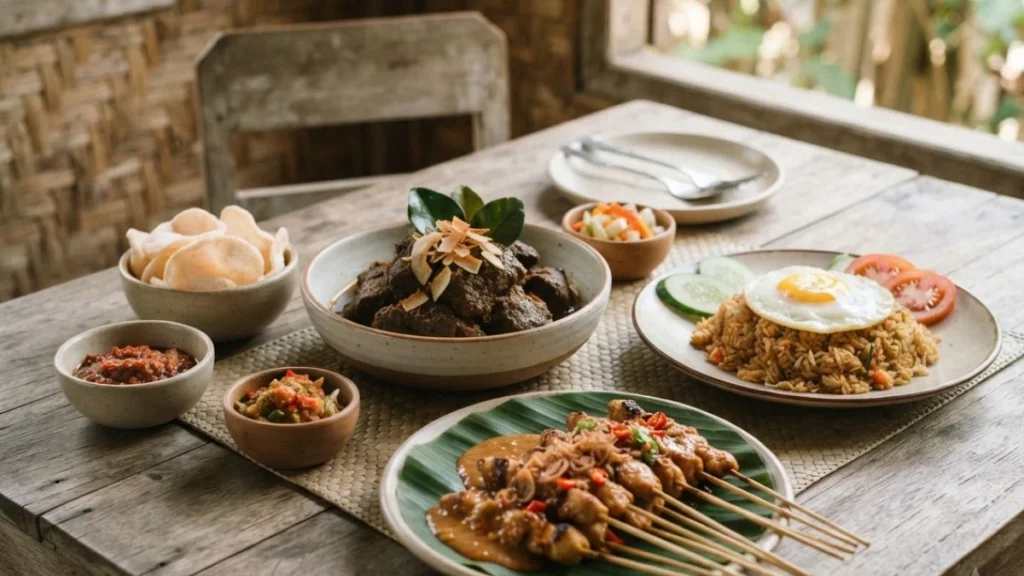
Ask people around the world to name an Indonesian dish, and three names come up again and again: rendang, nasi goreng, and satay. All three have earned genuine international recognition, but they couldn’t be more different in origin, preparation, or the story behind them. This indonesian food guide breaks down what makes each one distinct — and why together they represent such a strong culinary calling card for the entire country. For the wider context, see our Ultimate Guide to Understanding Indonesia.
Rendang is a slow-cooked beef dish from West Sumatra, simmered for hours in coconut milk and a rich spice paste until the meat becomes deeply tender and the sauce reduces to a thick, caramelized coating. Nasi goreng is Indonesian-style fried rice, typically stir-fried with kecap manis (sweet soy sauce), garlic, and shallots, and topped with a fried egg — a dish with Chinese culinary roots that Indonesia has thoroughly made its own. Satay (sate) is skewered, grilled meat — commonly chicken, beef, or lamb — marinated in spices and usually served with a peanut sauce. All three were officially named among Indonesia’s national culinary icons by the Ministry of Tourism in 2018, alongside soto and gado-gado.
Why It Matters
These three dishes offer an accessible entry point into Indonesian cuisine’s broader range — spanning slow-cooked regional specialties, everyday street food, and grilled communal dishes. Understanding what distinguishes them also helps make sense of Indonesia’s genuine international culinary reputation: rendang and nasi goreng were both ranked among CNN’s World’s 50 Best Foods, with rendang taking the top spot in a widely cited 2017 reader poll.
Cultural Context
Each dish carries a distinct cultural role:
- Rendang is deeply tied to Minangkabau culture in West Sumatra, traditionally served at ceremonial occasions and to honored guests. West Sumatra alone is said to have over 150 regional versions of the dish, with nearly every village claiming its own take.
- Nasi goreng functions as Indonesia’s ultimate everyday comfort food — eaten for breakfast, lunch, or dinner, and sold everywhere from street carts to high-end restaurants. Its recipe varies significantly by region: Central Java often adds tempeh and sambal, West Java incorporates seafood, Bali adds coconut and peanuts, and West Sumatra tops it with rendang itself.
- Satay is often a social, communal food, grilled over charcoal and shared among family or friends — Indonesians frequently debate which regional satay style (Madura, Padang, or Lilit from Bali, among many others) is genuinely the best.
Historical Background
Rendang’s origins trace to roughly the 16th century in West Sumatra, developed by the Minangkabau people, with some food historians linking its spice profile to Indian curry traditions introduced by Arab and Indian traders during the 13th and 14th centuries. Rendang later spread well beyond West Sumatra as Minangkabau people migrated for work and trade across Indonesia and internationally, a pattern closely tied to the merantau migration tradition common in Minangkabau culture. In 2011 and again in 2017, rendang was ranked the world’s most delicious food in CNN’s widely cited World’s 50 Best Foods reader poll.
Nasi goreng’s roots trace back much further, to ancient Chinese stir-fried rice traditions, brought to the archipelago by Chinese traders and migrants. Over centuries, the dish absorbed Dutch and Malay culinary influences during the colonial period, evolving into the distinctly Indonesian version now built around kecap manis — a sweet soy sauce not typically used in the original Chinese dish. In the same 2017 CNN poll, nasi goreng placed second, right behind rendang.
Satay’s history is less precisely documented, though it’s widely believed to have developed from Middle Eastern or South Asian kebab-style grilling traditions, introduced through trade and later adapted into a distinctly Indonesian form using local spices, marinades, and peanut sauce. Satay placed 14th in the same CNN poll, receiving more than ten times the votes of its Thai counterpart in that particular ranking.
Regional Differences
- Rendang varies enormously by village and family recipe in West Sumatra, though the core technique — slow-cooking meat in coconut milk and spice paste until nearly dry — remains consistent.
- Nasi goreng shows strong regional identity: Javanese versions often lean sweet and use tempeh, while Sumatran versions frequently incorporate rendang or other spicier proteins.
- Satay varies by region and protein: Madura is known for its distinctive peanut sauce style, Padang satay uses a thick yellow curry-based sauce rather than the more common peanut sauce, and Bali’s sate lilit wraps minced, spiced meat around lemongrass skewers rather than using cubed meat.
Practical Guide
If you’re trying these dishes for the first time:
- Start with nasi goreng if you want something familiar and mild. It’s the most universally approachable of the three, widely available, and easy to customize.
- Try rendang for a richer, more intense flavor experience. Be prepared for real heat and depth — it’s meant to be a standout dish, not an everyday quick meal.
- Order satay as a shareable, social dish. It’s well suited to group meals and pairs naturally with rice and Indonesian pickles (acar).
- Ask locally about regional variations. If you’re in West Sumatra, Java, Bali, or Madura specifically, asking about the local take on any of these dishes often leads to a more authentic, specific version worth trying.
Common Misunderstandings
“Rendang is a curry.” While influenced by curry traditions, rendang is technically a dry, caramelized braise rather than a wet curry — the liquid is meant to cook down almost entirely, unlike a typical curry sauce.
“Nasi goreng is a purely Indonesian invention.” Its stir-fried rice technique traces back to ancient Chinese cuisine — Indonesia’s contribution is the distinct flavor profile built around kecap manis and regional adaptations, not the base cooking method itself.
“All satay is served with peanut sauce.” While peanut sauce is common, regional variations like Padang’s curry-based sauce show that satay’s accompaniments vary significantly by region.
Rendang, nasi goreng, and satay each tell a different story about Indonesian cuisine — one rooted in regional ceremony and slow-cooked tradition, one built from centuries of cultural blending into an everyday staple, and one centered on communal, social grilling. Together, they offer one of the clearest and most rewarding starting points for understanding Indonesian food culture as a whole.
For related reading, see What Is Jamu? Indonesia’s Traditional Herbal Drink and Eating With Hands in Indonesia, or browse the full Food Culture pillar.
FAQ
Which is spicier, rendang or satay?
Rendang is generally spicier and more intensely flavored, cooked with a dense spice paste, while satay’s heat level depends heavily on its accompanying sauce and marinade.
Is nasi goreng originally from Indonesia?
The stir-fried rice technique originated in ancient China, but Indonesia developed its own distinct version using kecap manis and regional ingredients, making it a genuinely Indonesian dish in its current form.
What makes rendang different from a typical curry?
Rendang is slow-cooked until the liquid reduces almost entirely, creating a dry, caramelized coating on the meat, unlike a typical wet curry sauce.
What is the most famous regional variation of satay?
Madura satay is among the most widely recognized styles nationally, known for its distinctive peanut sauce, though regional versions like Padang and Bali’s sate lilit are also well known.
Were these dishes officially recognized by Indonesia’s government?
Yes — in 2018, Indonesia’s Ministry of Tourism officially named rendang, nasi goreng, satay, soto, and gado-gado as the country’s national culinary icons.