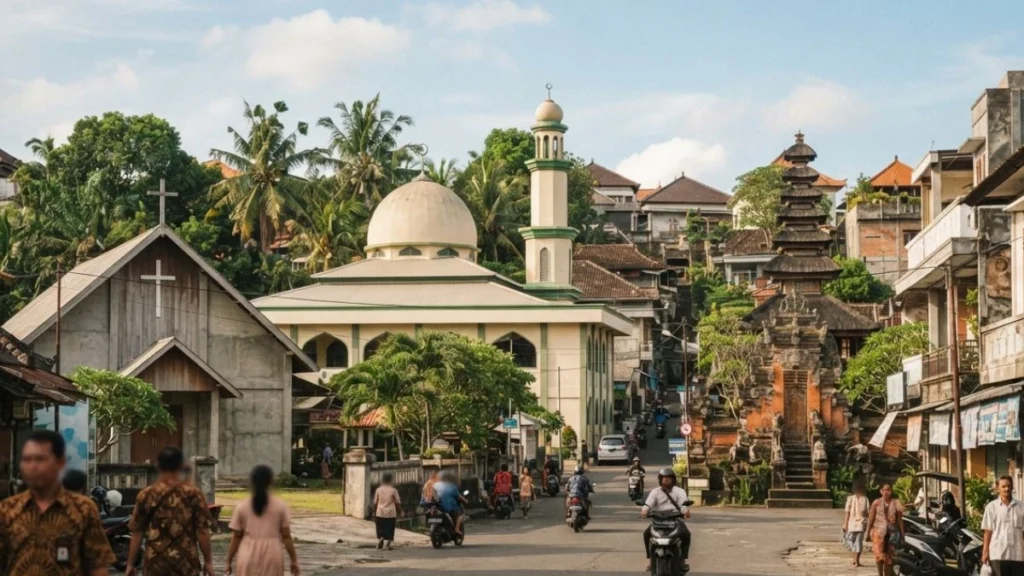
Indonesia is home to the largest Muslim population on Earth — yet its constitution guarantees freedom of religion, its national motto translates to “Unity in Diversity,” and six entirely different faiths hold official state recognition side by side. Understanding religious diversity in Indonesia means looking well past that headline statistic, into how the country structures, protects, and occasionally struggles with its extraordinary range of belief. For the wider context, see our Ultimate Guide to Understanding Indonesia.
Indonesia officially recognizes six religions: Islam, Protestantism, Catholicism, Hinduism, Buddhism, and Confucianism. As of 2024, roughly 87% of the population identifies as Muslim, making Indonesia home to the largest Muslim population of any country in the world. Protestant and Catholic Christians follow at around 10-11% combined, then Hindus (about 1.7%, concentrated in Bali), Buddhists (around 0.8%), and Confucians (roughly 0.05%). Pancasila, Indonesia’s founding national philosophy, anchors this official recognition — its first principle affirms belief in one supreme God as a unifying, rather than exclusionary, framework for the country’s religious life.
Why It Matters
Understanding Indonesia’s religious diversity helps explain why the country, despite its overwhelming Muslim majority, doesn’t function as an Islamic state, and why religious identity plays such a visible role in daily life — from national ID cards that list a person’s religion, to public holidays observed across multiple faiths. For visitors and newcomers, recognizing this diversity also helps make sense of the different places of worship, festivals, and customs encountered while traveling across the archipelago’s different regions.
Cultural Context
Religious life in Indonesia is shaped by several overlapping dynamics:
- Pancasila — the five founding principles of the Indonesian state, with “Belief in the One and Only God” as its first tenet, functions as the philosophical basis for religious coexistence rather than any single religion’s dominance.
- Bhinneka Tunggal Ika — Indonesia’s national motto, “Unity in Diversity,” is more than a slogan; it’s treated as a constitutional commitment to protecting the right of recognized faith communities to practice freely.
- Indigenous belief systems (Aliran Kepercayaan) — pre-existing animist and ancestral belief traditions that predate the arrival of the major world religions continue to be practiced, and are increasingly recognized by the government, including on national identity documents.
- Everyday religious visibility — mosques, churches, temples, and vihara often exist within close proximity of one another in many Indonesian cities, and religious holidays across multiple faiths are observed as national public holidays.
Historical Background
Indonesia’s religious landscape reflects centuries of layered influence: indigenous animist traditions were followed by Hindu-Buddhist kingdoms that flourished from around the 4th century onward, leaving behind monuments like Borobudur and Prambanan. Islam arrived later, spreading gradually through trade networks beginning around the 11th century and blending significantly with existing local and ancestral customs rather than replacing them outright. European colonization introduced Christianity more widely, particularly in eastern Indonesia and parts of Sumatra and Sulawesi. Confucianism, brought by Chinese traders and migrants over centuries, was formally recognized as Indonesia’s sixth official religion in 2006, following a period after Sukarno’s downfall in the 1960s when official policy briefly limited recognition strictly to monotheistic faiths.
Regional Differences
Religious concentration varies significantly by region:
- Java, Sumatra, Kalimantan, and Sulawesi are predominantly Muslim, though with wide variation in practice, from strict orthodoxy to more syncretic Javanese traditions that blend Islamic practice with older local customs.
- Bali remains overwhelmingly Hindu, a distinctive exception to Indonesia’s Muslim-majority pattern, with its own richly developed temple culture and ceremonial calendar.
- Eastern Indonesia, including parts of Papua, Maluku, and North Sulawesi, shows a much higher concentration of Christian communities, a legacy of colonial-era missionary activity in those regions.
- Ethnic Chinese Indonesian communities, found across the country but especially in urban centers, make up a significant share of Indonesia’s Buddhist and Confucian populations.
Practical Guide
If you’re navigating Indonesia’s religious diversity as a visitor:
- Expect religious identity to be visible in daily life. Indonesian ID cards list religious affiliation, and this identity often shapes local customs, holidays, and social expectations in ways more visible than in many secular Western countries.
- Respect local dress and behavior norms at religious sites. Requirements vary by faith and site — mosques, temples, and churches each have their own expectations around dress, footwear, and conduct.
- Recognize regional variation before assuming a single national norm. Bali’s Hindu-majority culture, for instance, differs enormously from religious practice in Muslim-majority Aceh, even though both are part of the same country.
- Be aware that religious sensitivities exist alongside legal protections. While the constitution supports religious freedom, blasphemy-related laws and occasional friction over building houses of worship remain real issues in some areas.
Common Misunderstandings
“Indonesia is an Islamic state.” Despite having the world’s largest Muslim population, Indonesia is constitutionally a secular republic that officially recognizes six religions under the unifying framework of Pancasila, not an Islamic state governed by religious law.
“Everyone in Indonesia is Muslim.” While Islam is the majority religion at roughly 87%, Indonesia is home to substantial Christian, Hindu, Buddhist, and Confucian populations, with some regions, like Bali, having an entirely different religious majority.
“Indigenous beliefs have disappeared.” Pre-existing animist and ancestral belief systems, broadly termed Aliran Kepercayaan, continue to be practiced today and are increasingly recognized by the state, often existing alongside one of the six officially recognized religions.
Indonesia’s religious diversity is a genuinely defining feature of national identity — protected constitutionally, structured through Pancasila, and expressed differently from one region to the next. Understanding this diversity offers real insight into how a single, vast archipelago nation manages to hold such different faith traditions together under one shared philosophy of unity.
For related reading, see What Is Gotong Royong? and How Ramadan Shapes Daily Life in Indonesia, or browse the full Beliefs & Spirituality pillar.
FAQ
How many official religions does Indonesia recognize?
Indonesia officially recognizes six religions: Islam, Protestantism, Catholicism, Hinduism, Buddhism, and Confucianism.
Is Indonesia an Islamic country?
No — while Indonesia has the world’s largest Muslim population at roughly 87% of its people, it is constitutionally a secular republic, not an Islamic state.
What percentage of Indonesians are Hindu?
Hindus make up around 1.7% of Indonesia’s population, concentrated primarily in Bali, where Hinduism remains the majority religion.
When was Confucianism recognized as an official religion in Indonesia?
Confucianism was formally recognized as Indonesia’s sixth official religion in 2006.
What is Pancasila’s role in Indonesia’s religious diversity?
Pancasila is Indonesia’s founding national philosophy, with its first principle affirming belief in one supreme God as a unifying framework that supports coexistence among the country’s recognized religions.