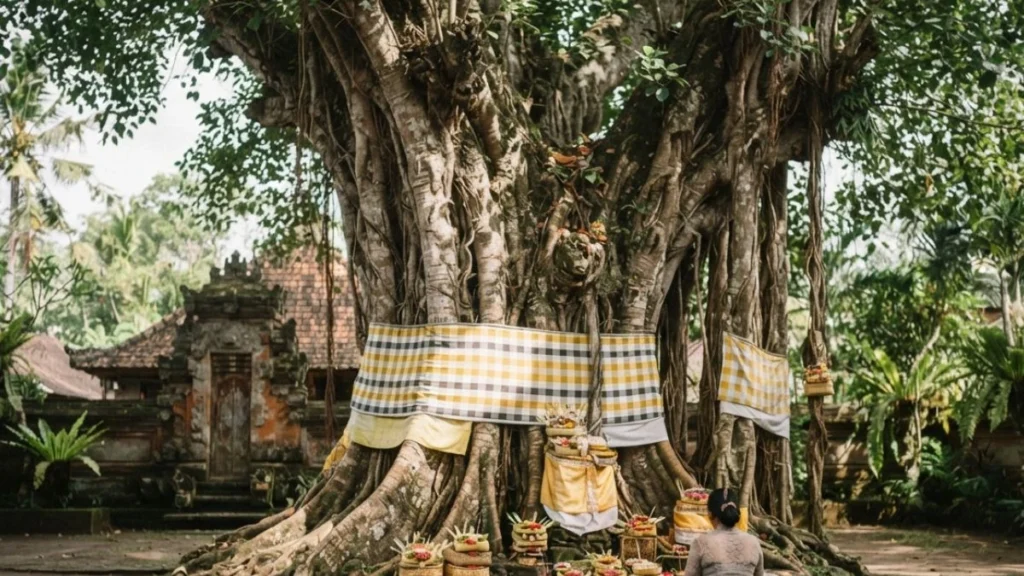
Long before Hindu temples, Islamic mosques, or Christian churches ever appeared on Indonesian soil, communities across the archipelago were already leaving offerings at sacred trees, rivers, and mountains. That older spiritual layer never fully disappeared — understanding indonesian animism folk belief today means recognizing a living tradition, not simply a historical footnote. For the wider context, see our Ultimate Guide to Understanding Indonesia.
Animism, the belief that spirits inhabit natural features, ancestors, and objects, was Indonesia’s original spiritual framework long before the arrival of Hinduism, Buddhism, Islam, and Christianity. While not recognized as one of Indonesia’s six official religions, animism and related indigenous belief systems — collectively known as Aliran Kepercayaan (“streams of belief”) — remain genuinely practiced today. Estimates suggest roughly 20 million people across Indonesia, concentrated especially in Java, Kalimantan, and Papua, follow some form of traditional belief system. Hundreds of distinct Aliran Kepercayaan communities exist nationwide, and many blend animist practice with one of the officially recognized religions rather than standing apart from it entirely.
Why It Matters
Recognizing animism’s continued presence helps explain many practices that might otherwise seem confusing to outsiders — offerings left at sacred sites, ceremonies invoking both ancestral spirits and a recognized world religion side by side, or the deep reverence some Indonesian communities show toward specific mountains, forests, or bodies of water. Understanding this layer of belief also reveals just how central religious syncretism is to Indonesian spirituality as a whole, rather than treating animism as something fully replaced by later religious traditions.
Cultural Context
Animist belief and practice appears across Indonesia in genuinely varied forms:
- Sacred natural sites — mountains, rivers, forests, and specific trees are widely regarded as inhabited by spirits requiring respect, offerings, or ritual acknowledgment before use.
- Nyai Roro Kidul — the revered Queen of the Southern Sea in Javanese belief, considered so powerful that one of Java’s well-known hotels reportedly keeps a room permanently reserved in her honor.
- Toraja funeral rites (Sulawesi) — elaborate ceremonies involving buffalo sacrifice, rooted in animist ancestor veneration, that have become internationally recognized even as they retain deep local spiritual meaning.
- Dayak traditions (Kalimantan) — ceremonies honoring forest spirits tied closely to agricultural cycles and community wellbeing, still practiced by some communities today.
- Sumba and Nias traditions — clan- and locality-based moral frameworks, where, as one Sumba community member described it, custom and right-and-wrong are understood as tied specifically to one’s own clan and village rather than universal rules.
Many practitioners describe their beliefs less as a formal “religion” in the Western sense and more as a meditation-based or ancestrally rooted spiritual path — one that frequently coexists with, rather than competes against, one of Indonesia’s six officially recognized religions.
Historical Background
Animism represents Indonesia’s oldest identifiable spiritual tradition, practiced across the archipelago long before Hindu and Buddhist influence arrived from India around the first century CE, followed later by Islam from around the 13th century and Christianity introduced more widely during the colonial period. Rather than being erased by each new arrival, animist beliefs were frequently absorbed and blended — a pattern clearly visible in Balinese Hinduism’s incorporation of animist and Buddhist elements, and in Javanese Kejawen’s fusion of animism with Islamic and Hindu-Buddhist mysticism.
During Dutch colonial rule, sacred natural sites were often reframed through a colonial, capitalist lens — recast as extractable economic resources rather than protected spiritual spaces, a shift some scholars describe as part of a broader colonization of local belief systems. For decades after independence, Indonesia’s legal and administrative framework only formally recognized six world religions, leaving Aliran Kepercayaan followers without full legal standing. This changed significantly in 2017, when Indonesia’s Constitutional Court ruled that requiring followers of indigenous belief systems to leave the religion field blank on official identity documents was unconstitutional — a landmark decision granting indigenous and animist belief systems meaningful legal recognition for the first time.
Regional Differences
- Java hosts widespread animist-influenced practice woven into Kejawen tradition, including reverence for figures like Nyai Roro Kidul and various local spirits tied to specific places.
- Kalimantan (Borneo) is home to Dayak communities that maintain ceremonies honoring forest and nature spirits, closely tied to agricultural and community life.
- Sulawesi, particularly among the Sa’dan Toraja, features animist-rooted funeral traditions involving elaborate buffalo sacrifice ceremonies that have gained international recognition.
- Papua contains numerous distinct indigenous communities where traditional animist beliefs and practices remain especially well preserved, reflecting the region’s relative geographic isolation.
- Sumba and Nias maintain strongly clan- and locality-based animist moral and social frameworks, distinct from more centralized religious systems.
Practical Guide
If you encounter animist practices or sacred sites while in Indonesia:
- Treat sacred natural sites with genuine respect. Mountains, forests, rivers, and specific trees considered sacred by local communities deserve the same consideration as a temple, mosque, or church.
- Ask before photographing ceremonies. Animist rituals, including funeral ceremonies like those of the Toraja, carry deep spiritual meaning for participants — always ask permission before observing or photographing closely.
- Don’t assume animism has been replaced by modern religion. Many Indonesians who identify with one of the six official religions may still hold or practice animist-influenced beliefs alongside their formal religious identity.
- Approach with curiosity, not judgment. What might look unfamiliar from an outside perspective is, for practitioners, a serious, meaningful, and often ancestrally significant spiritual practice.
Common Misunderstandings
“Animism has disappeared from modern Indonesia.” Roughly 20 million people are estimated to still practice some form of traditional Aliran Kepercayaan belief today, particularly in Java, Kalimantan, and Papua.
“Animism is officially recognized as one of Indonesia’s religions.” It isn’t one of the six officially recognized religions, though a landmark 2017 Constitutional Court ruling granted indigenous belief followers meaningful legal recognition on identity documents.
“Animist practices and mainstream religions can’t coexist.” In practice, many Indonesians blend animist elements with Islam, Hinduism, Christianity, or other recognized religions — Balinese Hinduism and Javanese Kejawen are two of the clearest examples of this ongoing syncretism.
Animism represents Indonesia’s deepest spiritual root — a tradition that predates every major world religion now practiced across the archipelago, and one that continues to shape ceremony, belief, and reverence for the natural world today. Recognizing its persistence, and its recent legal recognition, offers a genuinely fuller picture of Indonesia’s spiritual landscape than the six official religions alone can provide.
For related reading, see Kejawen: Java’s Quiet Mystical Tradition Explained and Religious Diversity in Indonesia Explained, or browse the full Beliefs & Spirituality pillar.
FAQ
Is animism an official religion in Indonesia?
No — animism is not one of Indonesia’s six officially recognized religions, though indigenous belief systems (Aliran Kepercayaan) gained meaningful legal recognition following a 2017 Constitutional Court ruling.
How many people in Indonesia still practice animism today?
Estimates suggest roughly 20 million people practice some form of traditional animist or indigenous belief, concentrated especially in Java, Kalimantan, and Papua.
Who is Nyai Roro Kidul?
Nyai Roro Kidul is the revered Queen of the Southern Sea in Javanese animist belief, considered so significant that some hotels in Java reportedly maintain a room in her honor.
What is Aliran Kepercayaan?
Aliran Kepercayaan, meaning “streams of belief,” is the collective term for Indonesia’s various indigenous and animist belief systems, with hundreds of distinct communities documented nationwide.
Can Indonesians practice animism alongside an official religion?
Yes — many Indonesians blend animist beliefs with one of the six officially recognized religions, a pattern clearly seen in traditions like Balinese Hinduism and Javanese Kejawen.