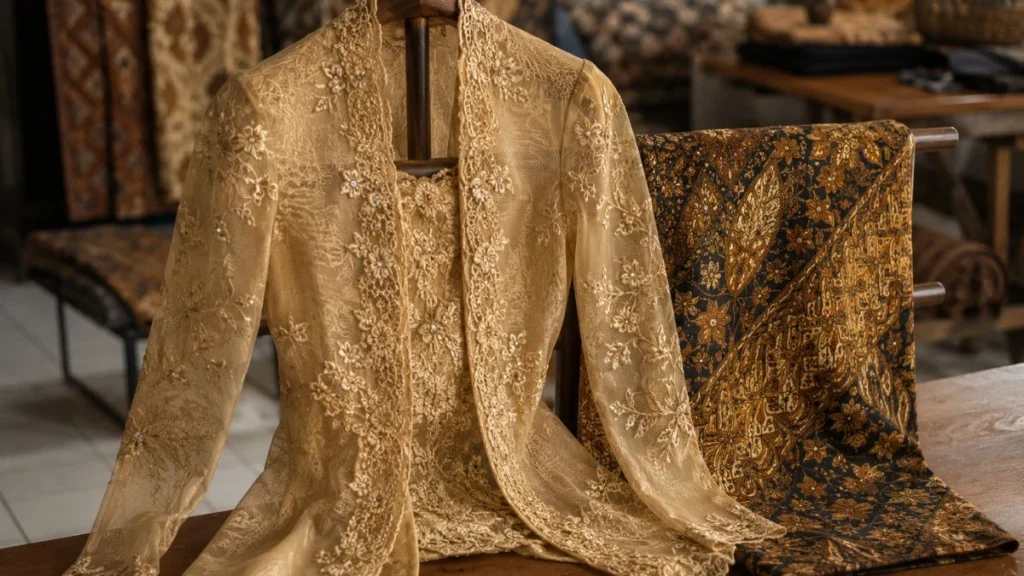
Indonesia, Malaysia, Brunei, Singapore, and Thailand don’t agree on much when it comes to claiming cultural heritage — but in 2024, all five governments did something unusual: they submitted a joint nomination for the same traditional garment, rather than compete over whose version came first. Kebaya indonesia unesco recognition reflects that rare, shared approach to preserving culture across borders. For the wider context, see our Ultimate Guide to Understanding Indonesia.
Kebaya is a traditional upper garment with a front opening, typically made from lightweight fabric such as brocade, cotton, gauze, lace, or voile, and often adorned with intricate embroidery. Wearers fasten the front with buttons, pins, or brooches, and pair it with a sarong, kemben, or kain — a length of batik, ikat, songket, or tenun cloth wrapped around the waist. In Indonesia, kebaya holds official status as national attire, though it’s most closely associated with Javanese, Sundanese, and Balinese women specifically. On December 4, 2024, UNESCO’s Intergovernmental Committee inscribed kebaya onto its Representative List of the Intangible Cultural Heritage of Humanity, under the title “Kebaya: knowledge, skills, tradition, and practices” — the result of a joint nomination by Indonesia, Brunei, Malaysia, Singapore, and Thailand.
Why It Matters
Kebaya’s joint UNESCO nomination matters beyond fashion — it demonstrates how neighboring countries with genuinely overlapping cultural history can choose collaborative recognition over competing claims. Understanding kebaya also reveals how a centuries-old garment can remain a living, evolving tradition rather than a museum piece: it’s still worn today for weddings, national holidays, and religious ceremonies, and increasingly reinterpreted by younger generations who pair it with modern trousers or contemporary streetwear.
Cultural Context
Several distinct kebaya styles carry their own history and social meaning:
- Kebaya Kartini — popular among 19th-century Javanese aristocrats, typically made from fine, thick, often white fabric with a V-shaped neckline and a signature front fold for a slender silhouette.
- Kebaya Panjang (also called Kebaya Labuh) — a longer style with its own distinct tailoring conventions.
- Sulam embroidery — the intricate decorative stitching commonly applied to sheer kebaya blouses, often paired with a set of interlinked brooches called keronsang.
- Everyday reinterpretation — many younger wearers today mix kebaya with modern trousers or streetwear, treating it as an act of cultural preservation rather than old-fashioned dress.
- Professional adoption — the modern female cabin crew uniforms of Singapore Airlines, Malaysia Airlines, and Indonesia’s own carriers all draw directly from kebaya styling, extending its visibility well beyond ceremonial contexts.
Historical Background
Kebaya’s origins trace to the 15th and 16th centuries, shaped by overlapping Chinese, Arab, and European clothing influences arriving through trade across Southeast Asia. Historians even debate the word’s own etymology across these same cultures: one account traces “kebaya” to the Arabic word habaya, meaning a long garment with a front slit, while historian Denys Lombard instead links it to the Arabic word qaba, also meaning clothing. Over time, kebaya became closely associated with upper-class Indonesian women, and during the Dutch colonial era, it spread in popularity across women of many different ethnic groups rather than staying confined to one community.
By 2023, Indonesia, Brunei, Malaysia, Thailand, and Singapore agreed to pursue a joint UNESCO nomination for kebaya, recognizing that the garment represented shared regional history rather than a single national origin. That collaborative nomination succeeded on December 4, 2024, at the 19th session of the Intergovernmental Committee for the Safeguarding of Intangible Cultural Heritage in Asunción, Paraguay. UNESCO specifically framed kebaya as a garment that “acts as a bridge between diverse communities,” rather than crediting any one country as its sole origin point.
Regional Differences
- Central Java, including Solo, remains one of the most active living centers for kebaya craftsmanship, where travelers can learn directly from local artisans and cultural communities through workshops.
- Bali maintains its own distinct kebaya tradition, closely tied to temple ceremonies and traditional dress requirements at religious sites.
- Malaysia, Singapore, and Brunei each maintain kebaya traditions with their own regional tailoring conventions and social associations, reflecting centuries of shared Malay-Indonesian cultural exchange.
- Southern Thailand is home to communities that share cultural costumes closely related to kebaya, a reflection of cross-border ethnic and cultural ties in the region rather than a separate, unrelated tradition.
Practical Guide
If you want to experience or purchase kebaya authentically:
- Visit Solo (Surakarta) in Central Java. This city offers some of the most accessible opportunities to see kebaya crafted and worn as a living tradition, not just a museum artifact.
- Learn to distinguish kebaya styles before buying. Kebaya Kartini, Kebaya Panjang, and regional variations differ meaningfully in cut, fabric weight, and formality — worth understanding before a purchase.
- Expect a wide price range. Kebaya in Indonesia can range from roughly 200,000 to 1 million rupiah, depending on fabric quality and the complexity of embroidery and tailoring.
- Wear kebaya appropriately for the occasion. It remains standard formal attire at Indonesian weddings, national holidays, and religious ceremonies, making it a genuinely respected choice rather than a costume.
Common Misunderstandings
“Kebaya belongs to only one country.” Kebaya’s 2024 UNESCO listing was a joint nomination by Indonesia, Brunei, Malaysia, Singapore, and Thailand, recognizing it as shared Southeast Asian heritage rather than the property of a single nation.
“Kebaya is old-fashioned and only worn by older generations.” Many younger wearers today mix kebaya with modern trousers or contemporary fashion, treating it as an active form of cultural preservation rather than outdated dress.
“Kebaya is purely Indonesian in origin.” Its development involved centuries of Chinese, Arab, and European influence arriving through Southeast Asian trade networks, making its history genuinely multicultural rather than singularly indigenous.
Kebaya stands as a rare example of neighboring countries choosing shared recognition over competing cultural claims — a garment whose UNESCO status honors overlapping regional history rather than any single national origin. Understanding its craftsmanship, styles, and cross-border story reveals just how deeply interconnected Southeast Asian cultural identity really is.
For related reading, see Understanding Batik: Indonesia’s Wax-Resist Textile Art and Indonesian Wedding Traditions by Region, or browse the full Culture pillar.
FAQ
When was kebaya recognized by UNESCO?
UNESCO inscribed kebaya onto its Representative List of the Intangible Cultural Heritage of Humanity on December 4, 2024, following a joint nomination by Indonesia, Brunei, Malaysia, Singapore, and Thailand.
What is kebaya made of?
Kebaya is typically made from lightweight fabric such as brocade, cotton, gauze, lace, or voile, often adorned with embroidery, and fastened at the front with buttons, pins, or brooches.
Is kebaya only worn in Indonesia?
No — kebaya is worn across several Southeast Asian countries, including Brunei, Malaysia, Singapore, and parts of southern Thailand and the Philippines, reflecting a shared regional heritage.
What is Kebaya Kartini?
Kebaya Kartini is a style popular among 19th-century Javanese aristocrats, typically made from fine, often white fabric, featuring a V-shaped neckline and a distinctive front fold.
Where does the word “kebaya” come from?
Its etymology is debated — one theory traces it to the Arabic word “habaya” (a long garment with a front slit), while historian Denys Lombard links it instead to the Arabic word “qaba,” also meaning clothing.