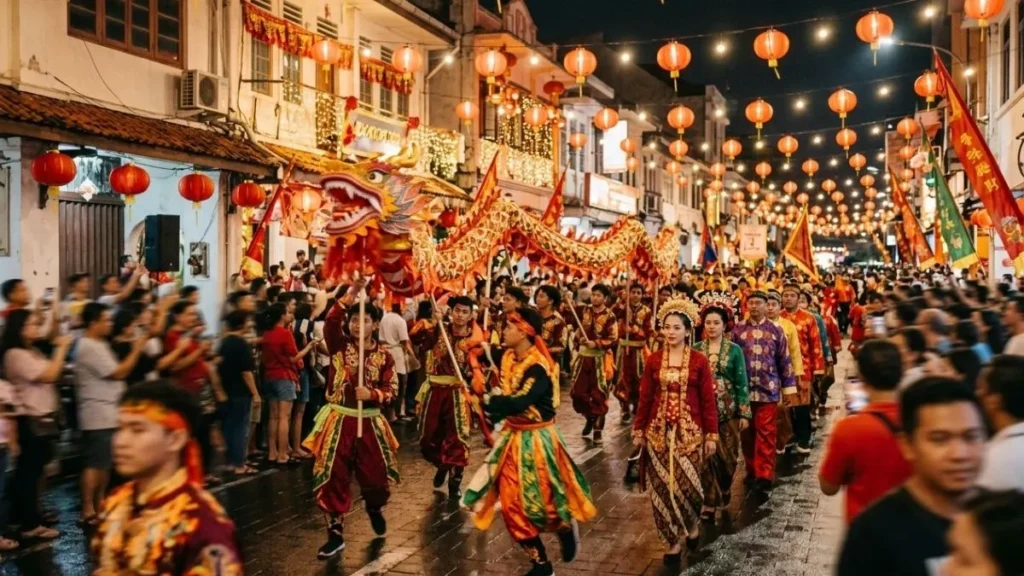
Cap Go Meh marks the 15th and final day of Chinese New Year celebrations in Indonesia, and nowhere is it bigger than Singkawang, West Kalimantan — nicknamed the “city of a thousand temples.” The city’s signature event is the Tatung Parade: hundreds of spirit mediums, believed to be possessed by ancestral or divine spirits, pierce their cheeks with blades and needles without apparent injury, in a ritual blending Hakka Chinese and indigenous Dayak tradition.
Most Chinese New Year celebrations wind down quietly after the first few days. In one Indonesian city on Borneo, the biggest spectacle is still two weeks away. For the wider context, see our Ultimate Guide to Understanding Indonesia.
What Is Cap Go Meh?
Cap Go Meh literally translates from Hokkien as “the 15th night of the first month” (cap = ten, go = five, meh = night), marking the closing celebration of the Lunar New Year cycle. Where Imlek (Chinese New Year itself) is a time for giving thanks and praying for a better year ahead, Cap Go Meh is the celebration — the festive peak that closes out the two-week New Year period. It’s observed across Indonesia’s ethnic Chinese communities, but one city has turned it into something unlike anywhere else in the world.
Why Is Singkawang Indonesia’s Cap Go Meh Capital?
Singkawang, in West Kalimantan, is nicknamed the “city of a thousand temples” and is one of two Indonesian cities — alongside provincial capital Pontianak — known informally as Indonesia’s “Chinatowns,” given their majority ethnic Chinese populations alongside Dayak, Malay, and other communities. Chinese immigrants, predominantly of Hakka ethnicity, settled the area more than three centuries ago as miners and traders. That deep, longstanding Hakka Chinese presence — layered with genuine cultural exchange alongside the indigenous Dayak population — is why Singkawang’s Cap Go Meh has grown into what’s widely described as the biggest celebration of its kind in Southeast Asia.
What Happens During the Tatung Parade?
The Tatung Parade is the ritual centerpiece of Singkawang’s Cap Go Meh, held specifically on the 15th day and believed to cleanse the city of misfortune and evil spirits for the year ahead:
- Spirit possession. Tatung — a Hakka term for someone considered spiritually empowered — are believed to be possessed by ancestral spirits, deities, or supernatural forces called Lauya during the ritual.
- Selection, not open participation. Only specific individuals, often chosen through hereditary lineage or spiritual validation, can serve as tatung; it isn’t a role anyone can simply volunteer for.
- Preparation through ritual cleansing. Before the parade, tatung undergo spiritual purification and commit to abstaining from certain foods or behaviors.
- Extraordinary physical feats. During the parade itself, tatung pierce their cheeks with steel wires or needles, sit on blades, or endure other sharp instruments — believed to remain unharmed as long as they stay within the possessed trance state.
- Genuine cross-cultural fusion. Tatung costumes combine traditional Chinese garments with Dayak cultural elements, and participants themselves include both ethnic Chinese and Dayak individuals — a visible symbol of the coexistence between these two communities in West Kalimantan.
Cap Go Meh in Singkawang vs. Elsewhere in Indonesia
| Feature | Singkawang | Other Indonesian Cities |
|---|---|---|
| Scale | Widely described as Southeast Asia’s largest Cap Go Meh celebration | Smaller, more localized observances |
| Signature ritual | Tatung Parade (trance, body piercing) | Lantern displays, lion/dragon dance |
| Cultural blend | Hakka Chinese + indigenous Dayak fusion | Primarily Chinese-Indonesian community focus |
| Government involvement | Officially promoted as a tourism event, with regional officials attending | Varies by city |
| Participant scale | Historically 700–1,000+ tatung in a single parade | Typically no equivalent trance ritual at this scale |
Common Misunderstandings
“Cap Go Meh and Chinese New Year (Imlek) are the same event.” Imlek marks the start of the Lunar New Year period, while Cap Go Meh specifically marks its 15th and final day — the celebratory close of the whole cycle, not the new year itself.
“The Tatung ritual is purely a staged tourist performance.” While Indonesia’s government and tourism sector actively promote the event, the trance ritual itself carries genuine spiritual significance for participants and the Hakka Chinese community, rooted in centuries-old practices to ward off epidemics and misfortune.
“Only ethnic Chinese participate as tatung.” Indigenous Dayak individuals also take part as tatung alongside ethnic Chinese participants, reflecting genuine cultural fusion rather than a single-community tradition.
FAQ
What does “Cap Go Meh” mean?
Cap Go Meh translates from Hokkien as “the 15th night of the first month,” marking the final, celebratory day of the Chinese New Year period.
What is a Tatung?
A Tatung is a spirit medium — a person believed to be possessed by an ancestral spirit, deity, or supernatural force — who performs extraordinary feats like body piercing during Singkawang’s Cap Go Meh parade.
Why is Singkawang’s Cap Go Meh so famous?
Singkawang has a deep, centuries-old Hakka Chinese population blended with indigenous Dayak communities, and its Tatung Parade has grown into what’s widely regarded as the largest Cap Go Meh celebration in Southeast Asia.
Is it safe to watch the Tatung Parade?
Yes — as a spectator, the parade is a public event widely promoted for tourism; the risk of injury applies specifically to tatung participants during their trance ritual, not to onlookers.
When does Cap Go Meh happen each year?
Cap Go Meh falls on the 15th day after Chinese New Year, so its date shifts annually along with the lunar calendar, typically landing in late January or February.
Conclusion
Cap Go Meh in Singkawang shows something genuinely distinctive about Indonesian pluralism — a centuries-old Hakka Chinese ritual, fused with indigenous Dayak tradition, thriving openly in a Muslim-majority nation. Understanding the Tatung Parade’s spiritual roots, not just its visual spectacle, reveals why this closing celebration has become one of Indonesia’s most singular cultural events.
For related reading, see Local Spirits and Sacred Places: Animism in Indonesia Today and Dayak Culture: Borneo’s Longhouse Societies, or browse the full Traditions & Festivals pillar.